
Related Articles

When we talk about modern cars, we often focus on the engine, transmission, brakes, and other visible mechanical parts. However, there is another important component working quietly behind the scenes. It is called the ECU, which stands for Engine Control Unit. In my view, the ECU is one of the most important electronic components in a modern vehicle because it helps the engine operate efficiently, smoothly, and safely.
A modern engine cannot depend only on mechanical parts. It needs accurate information about temperature, air pressure, engine speed, fuel mixture, and many other conditions. The ECU collects this information from different sensors and uses it to make decisions. It then controls important engine functions according to the information it receives.
Understanding what an ECU is and why it is important can help car owners understand many common engine problems, warning lights, fuel economy issues, and modern vehicle technology.
What Is an ECU?
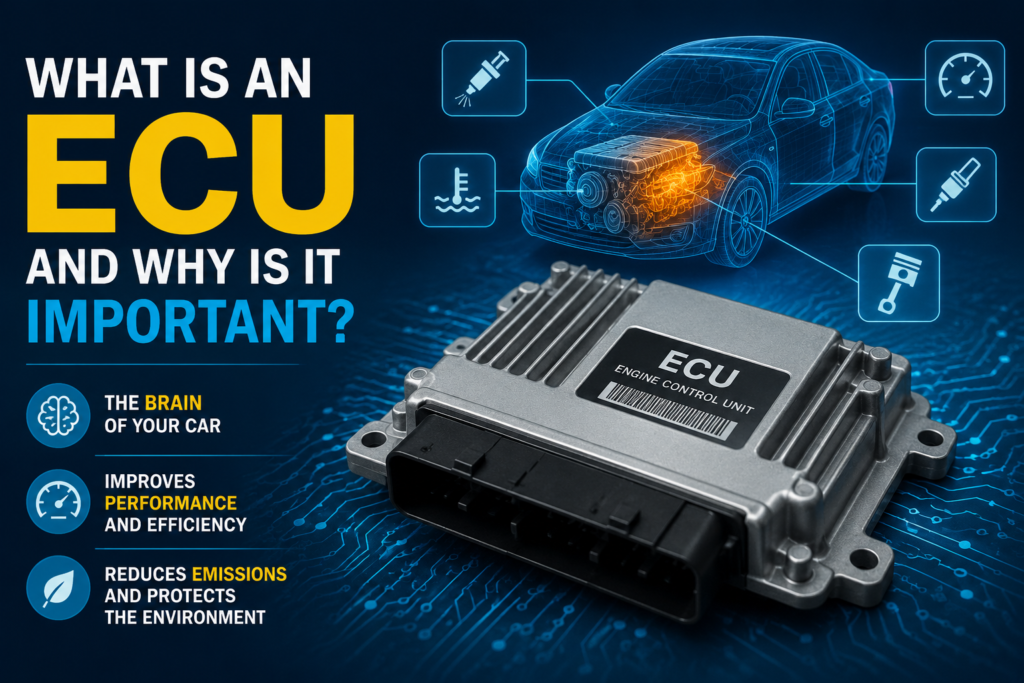
An Engine Control Unit, commonly known as an ECU, is a computer inside a vehicle that manages important engine functions. It receives information from different sensors installed around the engine and processes that information using programmed instructions.
The ECU then sends commands to various components to keep the engine working properly. For example, it can control fuel injection, ignition timing, idle speed, and emissions related systems.
I like to think of the ECU as the brain of the engine. The brain receives information from different parts of the body and makes decisions based on that information. In a similar way, the ECU receives information from sensors and decides what the engine needs at a particular moment.
Modern ECUs are highly advanced compared with the simple electronic systems used in older vehicles. They can process a large amount of information very quickly and make adjustments many times while the engine is running.
How Does an ECU Work?
The basic operation of an ECU is easier to understand when we divide it into three main stages. First, the ECU receives information. Second, it processes that information. Third, it sends commands to different engine components.
For example, the engine has sensors that measure air temperature, coolant temperature, engine speed, throttle position, oxygen levels, and air pressure. These sensors continuously send information to the ECU.
The ECU analyzes this information using its programmed calculations. It then determines how much fuel should be injected, when the spark plugs should ignite the fuel mixture, and how different systems should operate.
This process happens extremely quickly. The driver usually does not notice it because the ECU is constantly making small adjustments while the vehicle is running.
Main Functions of an ECU
The ECU performs several important functions. One of its main responsibilities is controlling the fuel injection system. The engine needs the correct amount of fuel to produce power efficiently. Too much fuel can reduce fuel economy and increase emissions, while too little fuel can cause poor performance.
The ECU also controls ignition timing. Spark plugs must produce a spark at the correct time for the engine to operate properly. The ECU uses information from engine sensors to determine the appropriate timing.
Another important function is idle speed control. When a car is stopped with the engine running, the ECU helps maintain a stable engine speed. This prevents the engine from running too fast or stalling.
The ECU also plays a major role in emissions control. Modern vehicles have strict emissions requirements, so the ECU monitors several systems to help reduce harmful exhaust gases.
In many modern vehicles, the ECU can also communicate with other control modules in the vehicle. This allows different electronic systems to work together.
Important Sensors Connected to the ECU
The ECU depends heavily on sensors. Without accurate sensor information, it would not know what is happening inside the engine.
One common sensor is the oxygen sensor. It measures oxygen levels in the exhaust and helps the ECU adjust the air and fuel mixture.
The mass airflow sensor measures the amount of air entering the engine. The ECU uses this information to determine how much fuel is needed.
The throttle position sensor tells the ECU how much the throttle is open. This helps the ECU understand how much power the driver is requesting.
The coolant temperature sensor monitors engine temperature. The ECU uses this information to make adjustments during cold starts and normal operating conditions.
The crankshaft position sensor provides information about engine speed and crankshaft position. This information is extremely important for fuel injection and ignition timing.
There are many other sensors in modern vehicles, and their exact number depends on the vehicle and engine design.
Why Is the ECU Important?
The ECU is important because modern engines need precise control. Mechanical components alone cannot provide the level of accuracy required by today’s vehicles.
One major advantage of ECU control is better fuel efficiency. By continuously adjusting fuel delivery according to driving conditions, the ECU can help the engine use fuel more effectively.
The ECU can also improve engine performance. When fuel injection and ignition timing are properly controlled, the engine can respond more smoothly to changes in throttle input.
Another important benefit is reduced emissions. The ECU monitors engine conditions and works with emissions control systems to help reduce harmful gases.
The ECU also contributes to engine reliability. By monitoring various engine conditions, it can identify unusual readings and help protect the engine from certain operating problems.
From my point of view, this combination of performance, efficiency, emissions control, and monitoring is what makes the ECU such an essential part of a modern vehicle.
ECU and the Check Engine Light
Many drivers become concerned when the check engine light appears on the dashboard. The ECU is closely connected to this warning system.
When the ECU detects a problem with a sensor or engine related component, it can store a diagnostic trouble code. Depending on the problem, it may also turn on the check engine light.
However, the check engine light does not always mean that the ECU itself is damaged. This is an important point for car owners. A faulty sensor, damaged wiring, fuel system problem, ignition issue, or emissions related problem can cause a warning.
A mechanic can use an OBD diagnostic scanner to communicate with the vehicle’s computer and read stored trouble codes. These codes can provide useful information about the area where a problem may exist.
Common Signs of ECU Related Problems
Although ECU failures are not always common, problems with the ECU or its communication with other components can cause noticeable symptoms.
A vehicle may experience difficulty starting, rough idling, poor acceleration, reduced fuel economy, unexpected stalling, or unusual engine behavior.
In some situations, communication problems between the ECU and other modules can also cause warning lights or electronic issues.
It is important not to assume that the ECU is faulty simply because an engine is running badly. Many different components can produce similar symptoms. Proper diagnosis is therefore important before replacing an expensive electronic control unit.
Can an ECU Be Repaired?
In some cases, an ECU can be repaired, but it depends on the type and severity of the problem. A professional technician may be able to diagnose issues involving damaged circuits, power supply problems, connectors, or other electronic components.
Sometimes the problem is not inside the ECU at all. A damaged wire, weak battery, poor ground connection, or faulty sensor can create symptoms that look like an ECU problem.
If an ECU does need to be replaced, the replacement unit may need to be programmed or configured for the specific vehicle. Modern vehicles often use electronic security systems, so simply installing another ECU may not always be enough.
For this reason, I would always recommend proper diagnosis before spending money on an ECU replacement.
ECU vs Other Vehicle Control Modules
It is also useful to understand that the ECU is not necessarily the only computer in a modern car.
Depending on the vehicle, there may be separate control modules for the transmission, airbags, brakes, body electronics, climate control, and other systems.
The engine control unit focuses mainly on engine related functions. In many modern vehicles, these different modules communicate with each other through the vehicle’s electronic communication network.
This communication allows the car to coordinate different systems. For example, engine information can be shared with the transmission control system to help provide smooth gear changes.
ECU Technology in Modern Cars
ECU technology has changed significantly over the years. Older vehicles relied much more heavily on mechanical systems, while modern vehicles use sophisticated electronic controls.
Today’s ECUs can monitor many parameters and make adjustments almost instantly. Some modern engines use advanced strategies to improve fuel economy, performance, emissions, and reliability.
As vehicles become more connected and automated, electronic control systems are becoming even more important. Hybrid and electric vehicles also use sophisticated control computers, although their systems and responsibilities can differ from those of a traditional gasoline engine ECU.
This shows how important electronic control technology has become in the automotive industry.
How to Take Care of Your Car’s ECU
The ECU usually does not require regular maintenance like engine oil or filters. However, protecting the vehicle’s electrical system is still important.
A healthy battery and charging system can help prevent electrical problems. Loose or corroded electrical connections should also be addressed because poor connections can affect communication and power supply.
It is also important to protect electronic components from water and unnecessary damage. If the vehicle has electrical problems, getting them diagnosed early can prevent further complications.
Regular vehicle maintenance is still one of the best ways to support the systems controlled by the ECU.
Final Thoughts
The ECU is one of the most important parts of a modern car because it acts as the central computer responsible for controlling many engine functions. It receives information from sensors, processes that information, and sends commands to components such as fuel injectors and ignition systems.
In my opinion, the ECU is a perfect example of how modern automotive technology combines mechanical engineering with electronics. The engine may still rely on pistons, valves, fuel, and combustion, but the ECU helps coordinate these components with remarkable precision.
Understanding the ECU also makes it easier to understand modern car problems. When a warning light appears or the engine starts behaving differently, the vehicle’s computer and diagnostic system can provide valuable information.
As cars continue to become smarter and more electronically controlled, the role of the ECU and other vehicle control modules will continue to grow. For anyone interested in car technology, understanding what an ECU is and why it is important is an excellent starting point for learning how modern vehicles really work.
I can also create an AdSense friendly featured image for this ECU article suitable for WordPress.