Related Articles
Choosing the right tire size for your car is one of those things that looks simple until you actually start comparing tire numbers. When I first started paying closer attention to car maintenance, I realized that tire size is much more important than simply choosing a tire that fits the wheel. The correct tire size can affect handling, braking, comfort, fuel economy, and even the overall safety of the vehicle.
Every car is designed to work with specific tire sizes. Using the correct size helps the suspension, steering system, wheels, and tires work together as intended. On the other hand, choosing an incorrect tire size can change the way a car behaves on the road.
In this guide, I will explain how to choose the right tire size for your car, how to read the numbers printed on a tire, and what important factors you should consider before buying new tires.
Why Tire Size Matters
Tires are the only parts of your car that actually touch the road, so their size and condition matter a lot. The correct tire size provides the right balance between road grip, comfort, handling, and vehicle stability.
If you install a tire that is too large or too small, you may notice changes in steering response or ride comfort. The speedometer can also become less accurate if the overall diameter of the tire changes significantly.
In my opinion, the safest approach is always to start with the tire size recommended by the vehicle manufacturer. If you want to use a different size, you should understand exactly how that change will affect your car.
Where to Find Your Car’s Correct Tire Size
Before buying anything, find the original tire size recommended for your vehicle. There are several places where you can usually find this information.
The driver’s side door frame is one of the most useful places to check. Many cars have a tire information label attached to the door or door frame. This label normally shows the recommended tire size along with the correct tire pressure.
You can also check your owner’s manual. The manual may provide information about standard tire sizes and alternative sizes approved by the manufacturer.
Another option is to look at the tires currently installed on your car. However, I would not rely on the existing tires alone because a previous owner may have installed a different size.
The vehicle manufacturer’s recommendation should be your main reference.
How to Read a Tire Size
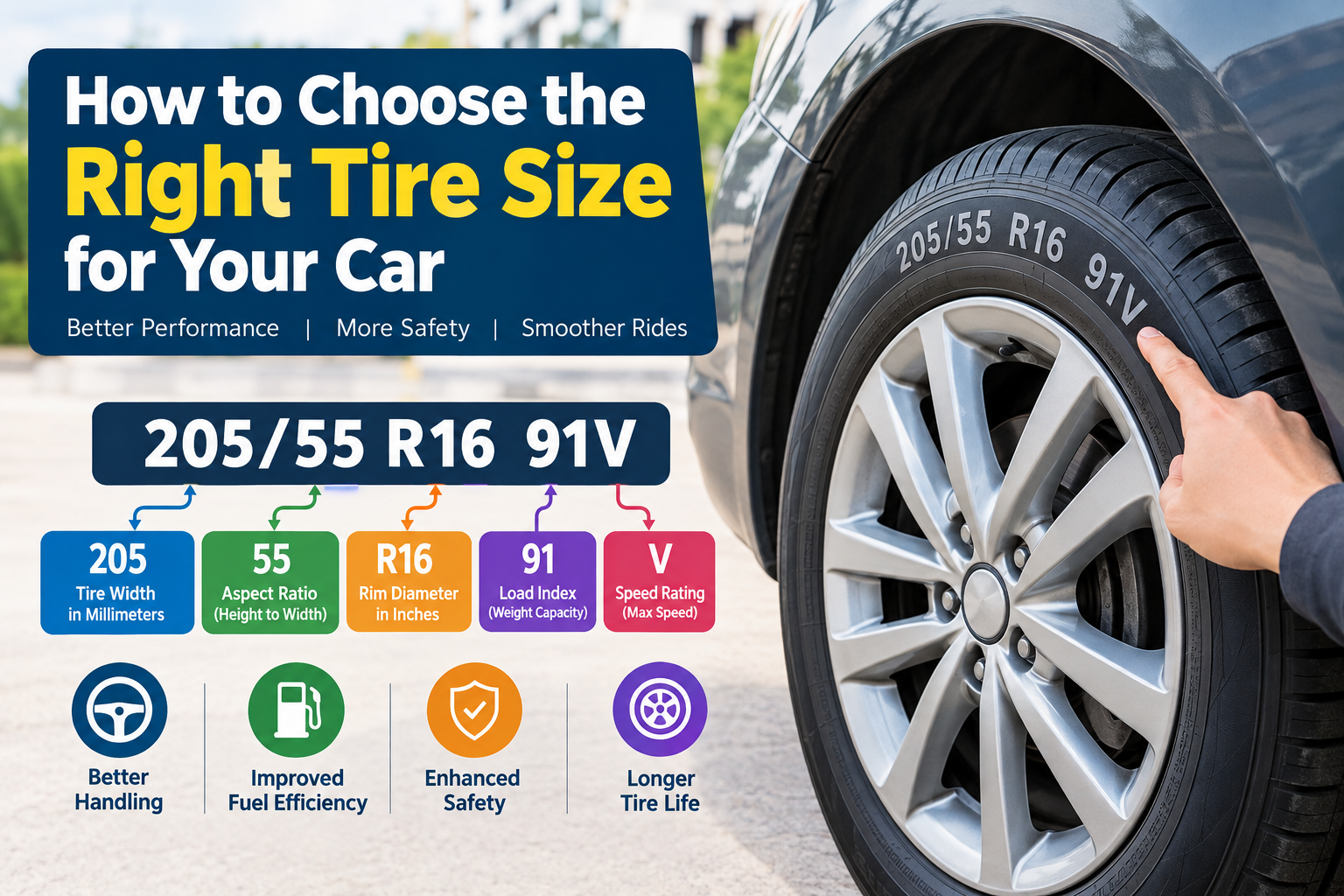
A tire may have markings such as:
205/55 R16 91V
At first, this combination of numbers and letters can look confusing. Once you understand each part, however, reading a tire size becomes quite easy.
The first number, 205, represents the tire width in millimeters. In this example, the tire is 205 millimeters wide.
The number 55 represents the aspect ratio. It means the sidewall height is 55 percent of the tire’s width.
The letter R means the tire has radial construction. Most modern passenger car tires use radial construction.
The number 16 represents the wheel diameter in inches. Therefore, this tire is designed to fit a 16 inch wheel.
The number 91 represents the load index. It tells you how much weight the tire can safely support according to its rated capacity.
Finally, the letter V represents the speed rating. It indicates the maximum speed category for which the tire is rated under specified conditions.
Understanding these markings makes it much easier to choose the right tire size for your car.
Check the Tire Width
Tire width is an important part of tire selection. Wider tires can provide a larger contact area with the road, which can influence handling and grip.
However, wider does not automatically mean better.
Your car’s suspension, wheel size, body clearance, and steering system are designed around specific dimensions. Installing a tire that is too wide can cause clearance problems in some vehicles.
For normal daily driving, I recommend sticking with the manufacturer’s recommended width unless you have a specific reason to change it and have confirmed that the alternative size is approved for your vehicle.
Understand the Aspect Ratio
The aspect ratio describes the height of the tire sidewall compared with its width.
For example, a tire marked 205/55 has a sidewall height equal to 55 percent of its width.
A lower aspect ratio generally means a shorter sidewall. This can provide a different steering feel and handling response, but it can also make the ride feel firmer.
A tire with a taller sidewall can provide more cushioning over rough roads. This can be particularly noticeable when driving on roads with potholes or uneven surfaces.
This is why I would not choose an aspect ratio based only on appearance. The correct balance between handling and comfort is more important for everyday driving.
Check the Wheel Diameter
The wheel diameter must match the tire. If your tire size ends in R16, it is designed for a 16 inch wheel.
You cannot simply install a tire designed for a 17 inch wheel onto a 16 inch wheel. The tire and wheel must be compatible.
Some drivers change their wheel diameter to achieve a different appearance or driving feel. This is commonly called changing the wheel setup. However, when doing this, the overall tire diameter needs to remain within an appropriate range.
Changing wheel and tire dimensions without understanding the measurements can create problems with clearance, handling, and speedometer accuracy.
Do Not Ignore the Load Index
The load index is another important number on a tire. It tells you the maximum load capacity of the tire under the conditions specified by the tire manufacturer.
Your replacement tire should have an appropriate load rating for your vehicle.
This becomes especially important for larger vehicles, SUVs, vans, and cars that regularly carry passengers or heavy luggage.
I would never choose a tire based only on price or appearance. The load rating is an important safety specification and should match the requirements of the vehicle.
Pay Attention to the Speed Rating
The speed rating is represented by a letter such as T, H, V, or W. Each rating corresponds to a particular speed category under specified test conditions.
The correct speed rating depends on the vehicle manufacturer’s recommendations and the type of tire being used.
It is important to remember that a speed rating is not a recommendation to drive at that speed. It is a classification used to describe the tire’s performance capability under controlled conditions.
For normal road driving, following the vehicle manufacturer’s specification is the sensible approach.
Consider Your Driving Conditions
When choosing the right tire size for your car, size is not the only thing to consider. Your driving conditions also matter.
If you mostly drive around the city, you may prioritize comfort, fuel economy, and durability.
If you frequently drive on highways, stable handling and good wet road performance may be more important.
If you regularly drive on rough roads, a suitable sidewall height and a durable tire construction can make a noticeable difference.
The climate where you live also matters. Rain, heat, cold temperatures, and road conditions can all affect tire performance.
This is why I think buying tires should be treated as a complete decision rather than simply looking for the cheapest option with the correct size.
Should You Choose a Different Tire Size?
Some drivers choose a different tire size to change the appearance or driving characteristics of their car. This can be possible in certain situations, but it should be done carefully.
A different tire size can affect the overall diameter, steering response, ride height, suspension behavior, and speedometer readings.
Before changing tire size, check whether the alternative size is approved for your vehicle. You should also make sure the tire fits the wheel correctly and has the required load and speed ratings.
If you are unsure, asking a qualified tire professional is a better option than guessing.
Check All Four Tires
When replacing tires, remember to check whether your car requires the same size on all four wheels.
Some performance cars and certain other vehicles use different front and rear tire sizes. This setup is sometimes called a staggered tire configuration.
Do not assume that all four tires must always have identical dimensions. Check the owner’s manual, vehicle information label, or manufacturer specifications first.
If your car uses the same size on all four wheels, replacing all four with the correct matching size is usually the simplest approach.
Do Not Forget Tire Pressure
Choosing the right tire size is only part of proper tire care. Correct tire pressure is equally important.
The recommended pressure is usually listed on the vehicle information label or in the owner’s manual. It is generally not the number printed on the tire sidewall.
The number on the tire indicates information related to the tire’s maximum inflation conditions, while the vehicle’s recommended pressure is designed around the car’s weight and suspension setup.
I recommend checking tire pressure regularly, especially before long trips.
Proper inflation can help improve handling, tire wear, and fuel efficiency.
Check the Manufacturing Date
When buying new tires, I also recommend checking the tire’s manufacturing information. Tires have markings that can help identify when they were produced.
If you are buying tires that have been sitting in storage for a long time, ask the seller about their age and storage conditions.
A tire’s condition is important even if it has never been installed on a car. Proper storage can make a difference.
Avoid Choosing Tires Based Only on Price
Price is obviously important, but the cheapest tire is not always the best choice for your vehicle.
When comparing tires, I would look at the correct size, load index, speed rating, intended use, road conditions, warranty, and manufacturer information.
A slightly more expensive tire may provide better durability or performance for your particular driving needs.
At the same time, expensive does not automatically mean suitable. The tire still needs to have the correct specifications for your car.
Common Mistakes When Choosing Tire Size
One common mistake is buying tires based only on the wheel diameter.
Another mistake is ignoring the load index or speed rating.
Some drivers also assume that wider tires will always improve performance. That is not necessarily true because the vehicle is designed around a specific combination of components.
Using an incorrect tire size can also affect the accuracy of the speedometer and other vehicle systems.
Another mistake is relying entirely on what a friend or salesperson recommends without checking the manufacturer’s specifications.
The safest starting point is always the information provided for your specific vehicle.
Final Thoughts
Learning how to choose the right tire size for your car is easier once you understand what the numbers and letters mean. The most important thing is to match the tire specifications with the requirements of your vehicle.
Start by checking the driver’s door label and owner’s manual. Confirm the tire width, aspect ratio, wheel diameter, load index, and speed rating. Then consider your normal driving conditions, road quality, climate, and personal priorities.
In my view, the right tire is not simply the one that looks good or costs less. It is the tire that properly fits your vehicle and provides the balance of safety, comfort, handling, and durability you need.
Taking a few extra minutes to verify the correct tire size before purchasing can save you from expensive problems later and help your car perform the way it was designed to perform.