Related Articles

When I think about the important parts of a modern car engine, the throttle body is one component that deserves more attention. Many drivers know about the engine, fuel injectors, spark plugs, and battery, but they may not know exactly what a throttle body does. In simple words, the throttle body controls how much air enters the engine. Since an engine needs the right amount of air and fuel to produce power, the throttle body plays an important role in engine performance.
In this article, I will explain what a throttle body is, how it works, why it is important, what happens when it becomes dirty or faulty, and how you can recognize common throttle body problems.
What Is a Throttle Body?
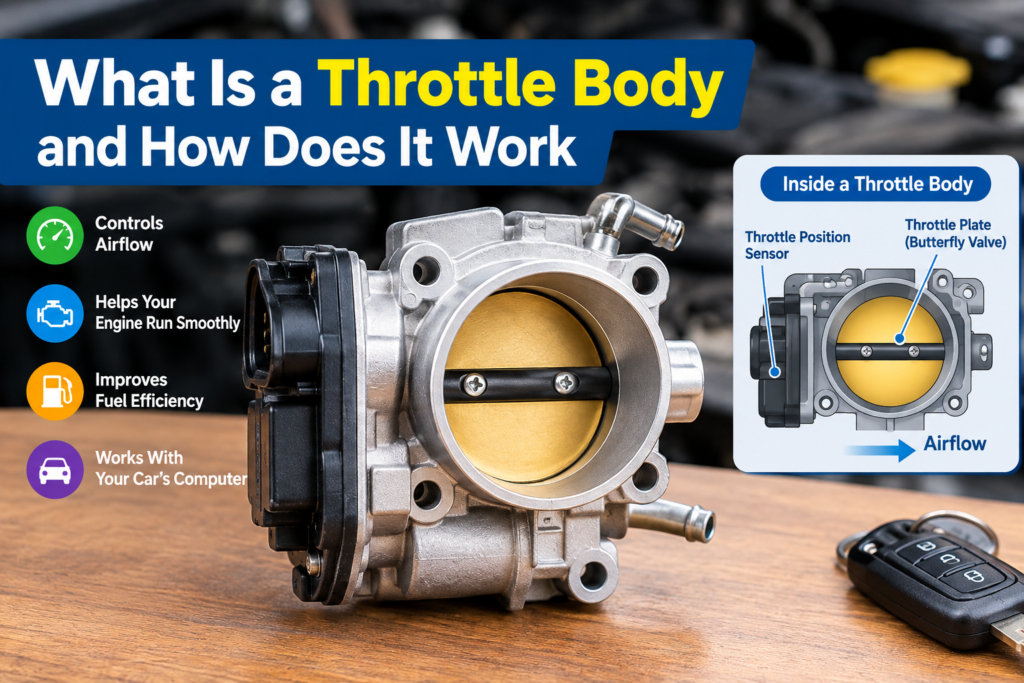
A throttle body is a component installed in the air intake system of a gasoline engine. Its main job is to control the amount of air flowing into the engine. It usually sits between the air intake hose and the intake manifold.
Inside the throttle body, there is a round plate called the throttle plate or butterfly valve. This plate can open and close to control airflow.
When you press the accelerator pedal, the vehicle’s computer receives information about your request for more engine power. It then controls the throttle opening in modern electronic throttle systems. When the throttle plate opens wider, more air can enter the engine. The engine computer adjusts fuel delivery to maintain the proper air and fuel mixture.
This process happens very quickly, which is why the engine can respond to changes in the accelerator pedal almost immediately.
How Does a Throttle Body Work?
The basic working principle of a throttle body is actually quite simple.
When the engine is running, it continuously needs air. The throttle body controls how much of that air can enter the intake manifold.
When you lightly press the accelerator pedal, the throttle plate opens slightly. A small amount of air enters the engine, allowing the engine to produce a lower amount of power.
When you press the accelerator harder, the throttle plate opens further. This allows more air to enter the engine. The engine computer can then provide more fuel, increasing engine power and acceleration.
When the accelerator is released, the throttle plate closes significantly. The engine continues running because a controlled amount of air is still allowed to enter through the intake system.
In older vehicles, the accelerator pedal was connected to the throttle body using a mechanical cable. Many modern vehicles use an electronic throttle control system instead. In this system, sensors and an electric motor control the throttle plate.
Main Parts of a Throttle Body
A throttle body may look like a simple metal housing, but it contains several important components.
Throttle Plate
The throttle plate is the main moving part inside the throttle body. It is usually a round metal plate mounted on a shaft.
Its job is to control airflow. When the plate is more open, more air can pass through. When it closes, airflow is reduced.
Throttle Position Sensor
The throttle position sensor monitors the position of the throttle plate. It sends information to the engine control module.
The engine computer uses this information to understand how far the throttle is open and how the driver is requesting engine power.
Electric Throttle Motor
Modern vehicles with electronic throttle control often use an electric motor to move the throttle plate.
The engine computer can control this motor based on information from the accelerator pedal, engine speed, vehicle speed, and several other sensors.
Throttle Body Housing
The housing contains the throttle plate and other components. It also provides a controlled passage for air entering the engine.
Idle Air Control System
Some older throttle body designs use a separate idle air control valve to regulate air when the throttle plate is mostly closed. Many newer electronic throttle systems control idle speed directly through the throttle plate.
What Happens When You Press the Accelerator?
One thing I find interesting about modern cars is how many systems communicate when you simply press the accelerator pedal.
In an older vehicle, the pedal could be mechanically connected to the throttle body. Pressing the pedal physically moved the throttle plate.
Modern vehicles are different. When you press the accelerator, a sensor detects the pedal position. The vehicle computer processes that information and determines how much the throttle should open.
The electronic throttle motor then moves the throttle plate to the required position.
At the same time, the engine computer considers information from different sensors. It can monitor engine speed, engine temperature, airflow, intake pressure, and other conditions.
Based on this information, the computer adjusts fuel delivery and ignition timing to help the engine operate properly.
Why Is the Throttle Body Important?
The throttle body is important because an engine needs controlled airflow to operate efficiently.
Too little air can limit engine power. Too much or uncontrolled air can affect the air and fuel mixture and cause poor engine operation.
A properly working throttle body helps provide predictable accelerator response, stable engine operation, and proper airflow.
It also works closely with the engine control module and other engine management components.
This is why a throttle body problem can sometimes affect much more than acceleration.
Symptoms of a Dirty Throttle Body
A throttle body can become dirty over time. Oil vapors, dust, carbon deposits, and other contaminants can collect around the throttle plate and housing.
One common symptom is rough idling. The engine may feel like it is shaking or running unevenly while the vehicle is stopped.
Another possible symptom is hesitation during acceleration. You may press the accelerator and notice that the engine does not respond as smoothly as it normally does.
Other symptoms can include inconsistent idle speed, reduced engine performance, poor throttle response, or an illuminated check engine light.
In some cases, the engine may stall when coming to a stop.
However, these symptoms can also be caused by other engine problems. I would not recommend replacing the throttle body simply because one of these symptoms appears. Proper diagnosis is important before replacing any expensive component.
What Causes a Throttle Body to Become Dirty?
A throttle body can become dirty through normal engine operation.
Air entering the engine can contain small amounts of dust and other particles, even when the air filter is working properly. Oil vapors from the engine ventilation system can also enter the intake system.
Over time, these substances can create deposits around the throttle plate.
The amount of buildup depends on the vehicle, driving conditions, engine design, maintenance history, and other factors.
Vehicles that are driven in dusty environments may require more attention to the air intake system.
How to Clean a Throttle Body
Cleaning a throttle body can help remove deposits that affect airflow and throttle movement.
Before cleaning, I recommend checking the vehicle manufacturer’s instructions because throttle body designs and electronic systems can be different.
The general process involves accessing the throttle body, inspecting the throttle plate, and using a suitable throttle body cleaning product.
It is important not to damage electrical components or force an electronic throttle plate beyond its normal operating range.
After cleaning, some vehicles may require an idle relearn or throttle relearn procedure. This depends on the vehicle and its engine management system.
If you are not comfortable working around the electronic throttle system, having a qualified technician perform the service can be a safer option.
Electronic Throttle Control Explained
Electronic throttle control is now common in modern vehicles.
Instead of using a direct mechanical cable between the accelerator pedal and throttle plate, electronic systems use sensors and an electric motor.
The accelerator pedal has sensors that tell the engine computer how much the pedal has been pressed.
The computer then calculates the appropriate throttle opening.
This system gives manufacturers more control over engine operation. It can also work with systems such as cruise control, traction control, stability control, and various driver assistance features.
Because the system is electronic, a fault in the sensors, wiring, motor, or computer communication can affect throttle operation.
Can a Bad Throttle Body Affect Fuel Economy?
A faulty or dirty throttle body can sometimes contribute to poor fuel economy, but it is not always the main cause.
Fuel economy depends on many factors, including driving habits, tire pressure, engine condition, fuel quality, vehicle weight, traffic, weather, and maintenance.
If the throttle body is not controlling airflow correctly, the engine may not operate as efficiently as it should.
However, I would always check other possible causes before blaming the throttle body alone.
Can a Throttle Body Cause a Check Engine Light?
Yes, a throttle body problem can sometimes trigger the check engine light.
Modern vehicles continuously monitor many engine components. If the computer detects that the throttle position does not match the expected value, it may store a diagnostic trouble code.
Problems with the throttle position sensor, electronic throttle motor, wiring, or related systems can also cause warning lights.
If the check engine light appears, using a diagnostic scanner can help identify the stored fault code.
A code can provide useful information, but it does not always mean that the component named in the code needs to be replaced. Further testing may still be necessary.
How Often Should a Throttle Body Be Cleaned?
There is no single cleaning interval that applies to every vehicle.
Some vehicles may operate for many years without requiring throttle body cleaning, while others may develop noticeable deposits sooner.
I prefer to think of throttle body cleaning as condition based maintenance rather than something that automatically needs to be done at a specific mileage.
During regular maintenance, the air intake system can be inspected. If significant deposits are visible or symptoms are present, further inspection may be appropriate.
Following the manufacturer’s maintenance recommendations is always a good starting point.
Throttle Body vs Fuel Injector
The throttle body and fuel injector perform completely different jobs.
The throttle body controls air entering the engine, while fuel injectors deliver fuel into the engine.
Both are important because an engine needs the correct balance of air and fuel.
A dirty throttle body can affect airflow and throttle response, while a faulty fuel injector can affect fuel delivery.
Understanding this difference can make engine troubleshooting easier.
Final Thoughts
In my view, the throttle body is one of those engine components that seems simple but has a very important job. It controls the amount of air entering the engine and works closely with the engine computer to provide the power and throttle response we expect from a modern car.
A dirty throttle body can contribute to rough idling, hesitation, inconsistent acceleration, and other symptoms. Electronic throttle systems also depend on sensors, wiring, and computer controls, so diagnosing a problem correctly is important.
Regular vehicle maintenance, a clean air intake system, and attention to unusual engine behavior can help keep the throttle body working properly.
If you understand what a throttle body does, it becomes much easier to understand how your car manages engine airflow and responds when you press the accelerator. It is a small part of the overall engine system, but its role in modern vehicle performance is significant.