Related Articles
Checking your car brake fluid at home is one of those simple maintenance tasks that many drivers overlook. I believe it is worth learning because your braking system depends on clean and properly filled brake fluid to work correctly. You do not always need a mechanic just to check the fluid level. With a little care and the right information, most car owners can inspect the brake fluid reservoir at home in a few minutes.
Brake fluid plays an important role in transferring the pressure from your brake pedal to the braking components at each wheel. If the fluid level becomes too low or the fluid becomes contaminated, your braking performance can be affected. That is why I recommend making brake fluid inspection part of your regular car maintenance routine.
In this guide, I will explain how to check your car brake fluid at home, what the fluid should look like, what the minimum and maximum marks mean, and what you should do if you notice a problem.
What Is Brake Fluid?
Brake fluid is a special hydraulic fluid used by your vehicle braking system. When you press the brake pedal, the pressure created by your foot is transferred through the brake fluid to the brake components. This allows the brake pads or brake shoes to apply force and slow down the wheels.
Most modern cars use hydraulic braking systems. Depending on the vehicle, the manufacturer may specify a particular type of brake fluid such as DOT 3, DOT 4, DOT 5, or DOT 5.1. These fluids are not always interchangeable, so I always recommend checking your owner’s manual before adding any brake fluid.
Brake fluid is different from engine oil, transmission fluid, coolant, or power steering fluid. Using the wrong fluid can cause serious problems, so it is important to identify the correct product before doing any work.
Where Is the Brake Fluid Reservoir?
The first step in checking brake fluid is finding the reservoir. In most vehicles, the brake fluid reservoir is located under the hood near the back of the engine compartment.
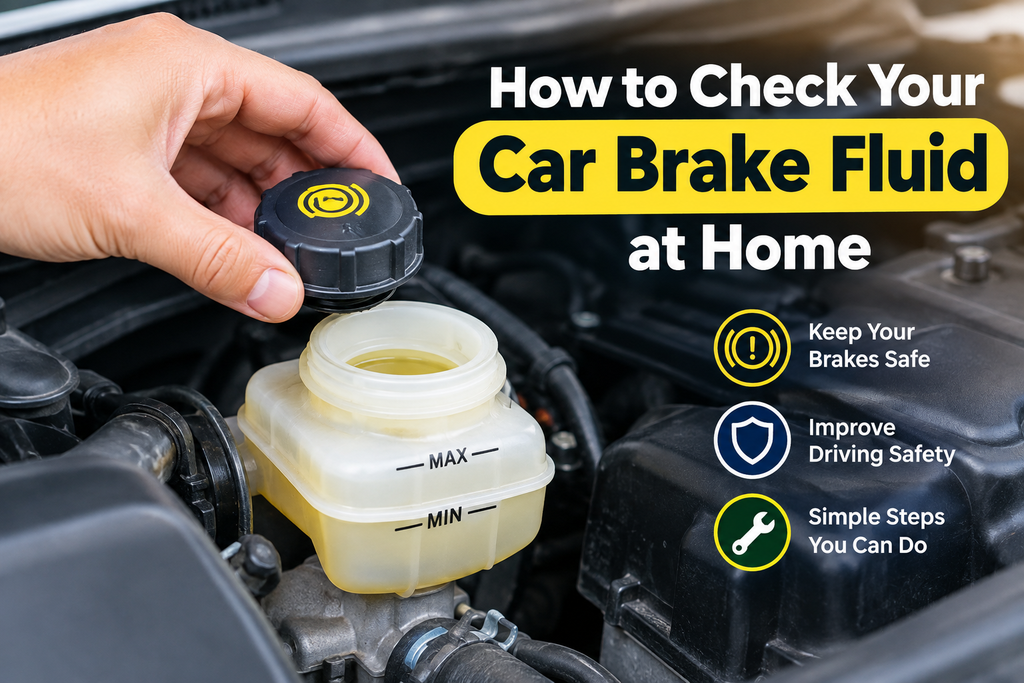
It is usually a small plastic container that is either transparent or partly transparent. You may see markings labeled MIN and MAX on the side. The reservoir normally sits above or near the brake master cylinder.
The cap often has a brake symbol or information printed on it. If you are unsure about the location, check your vehicle owner’s manual.
I recommend identifying the reservoir before touching anything. The engine compartment contains many different components and fluid containers, so guessing can lead to mistakes.
What You Need to Check Brake Fluid
The good thing about checking brake fluid is that you usually do not need many tools. For a basic inspection, you need your car owner’s manual, a clean flashlight if visibility is poor, and a clean cloth.
You should also have the correct brake fluid available only if your vehicle actually needs a top up.
I would not open the reservoir unnecessarily. If the fluid level can be clearly seen through the transparent container, you may be able to inspect it without removing the cap.
Step 1: Park Your Car Safely
Before checking the brake fluid, park your vehicle on a flat and stable surface. Turn off the engine and apply the parking brake.
Allow the vehicle to cool if you have recently driven it. Although checking the reservoir does not normally require working around extremely hot components, it is better to inspect the engine compartment when it is reasonably cool.
Make sure the car is secure before opening the hood. Safety should always come before maintenance.
Step 2: Open the Hood
Pull the hood release inside your vehicle and then open the hood from the front. Secure the hood using the built in support or gas struts, depending on your vehicle.
Take a moment to look around the engine compartment. Find the brake fluid reservoir using your owner’s manual if necessary.
Do not confuse it with the coolant reservoir. Coolant reservoirs are usually larger and have different markings. The brake fluid reservoir is normally smaller and located near the brake master cylinder.
Step 3: Check the Brake Fluid Level
Once you locate the brake fluid reservoir, look at the markings on the side.
You will normally see a MIN mark and a MAX mark. The fluid level should generally be between these two markings.
If the fluid is close to the MAX mark, the level is usually acceptable. If it is close to or below the MIN mark, the braking system needs further attention.
I would not simply add fluid without thinking about why the level is low. Brake fluid does not normally disappear quickly during normal operation. A low level can sometimes be related to brake pad wear or a leak in the braking system.
Step 4: Look at the Fluid Color
The color of brake fluid can also provide useful information.
Fresh brake fluid is often clear, pale yellow, or light amber depending on its type. As it ages, it can become darker.
If the fluid looks very dark, dirty, or contaminated, it may be time to have the braking system inspected and the fluid replaced according to the manufacturer’s maintenance schedule.
Color alone does not tell the complete story, but it can be a useful warning sign when combined with other symptoms.
Step 5: Inspect the Reservoir
While checking the level, take a close look at the reservoir itself.
Look for cracks, damage, heavy dirt, or signs of fluid around the reservoir and nearby components. You can also look around the brake master cylinder area for signs of leakage.
Do not touch brake fluid with your bare hands unnecessarily. Brake fluid can damage paint and may irritate skin. If any fluid spills onto painted bodywork, clean it promptly according to safe vehicle maintenance practices.
Step 6: Check the Brake Warning Light
Your dashboard may provide another important clue.
If the brake warning light stays illuminated after starting the vehicle or comes on while driving, do not ignore it. Depending on the vehicle, the warning light may indicate low brake fluid, a parking brake that is still applied, or another brake system issue.
Some modern vehicles also provide electronic warnings related to brake system conditions.
If a warning light appears together with a low brake fluid level or changes in braking performance, I recommend having the vehicle inspected as soon as possible.
Should You Add Brake Fluid Yourself?
Adding brake fluid can be simple, but I would only do it when you are certain about the correct fluid type and the reason for the low level.
Check the owner’s manual for the recommended brake fluid specification. Never assume that every vehicle uses the same type.
Before opening the reservoir, clean the area around the cap so dirt does not fall into the reservoir. Add only the recommended fluid and avoid overfilling.
If the brake fluid level is very low, I would not treat topping it up as a permanent solution. A significant drop in fluid can indicate a leak or other brake system problem.
What Does Low Brake Fluid Mean?
Low brake fluid can happen for several reasons.
One possibility is normal brake pad wear. As brake pads become thinner, the brake system may require more fluid volume at the wheel end, which can cause the reservoir level to drop gradually.
Another possibility is a hydraulic leak. A leak can be more serious because brake fluid may escape from a brake line, hose, caliper, wheel cylinder, or another component.
If you repeatedly need to add brake fluid, there is a reason that needs to be investigated.
Signs You May Have a Brake Problem
Checking the reservoir is only one part of brake maintenance. Pay attention to how your car behaves when braking.
A soft or spongy brake pedal can indicate air or another problem in the hydraulic system. A brake pedal that feels unusually low can also require inspection.
Other warning signs include a brake warning light, visible fluid leakage, unusual noises, pulling to one side while braking, vibration, or a noticeable change in stopping performance.
If your brakes do not feel normal, I would avoid continuing to drive the vehicle unnecessarily. Brakes are a critical safety system and should be inspected by a qualified professional when a problem is suspected.
How Often Should You Check Brake Fluid?
There is no single interval that applies to every vehicle. I prefer checking the brake fluid whenever I perform other basic under hood inspections.
You can check it every few weeks, before a long road trip, or whenever you are checking other fluids.
Your vehicle owner’s manual should provide the recommended brake fluid replacement interval. Some manufacturers recommend replacing brake fluid based on time or mileage because brake fluid can absorb moisture over time.
Important Safety Tips
There are a few things I always keep in mind when checking brake fluid.
First, use only the brake fluid specification recommended by the vehicle manufacturer.
Second, keep dirt and moisture away from the reservoir.
Third, never ignore a brake warning light or sudden change in pedal feel.
Fourth, do not continue driving if the brakes are not working normally.
Finally, never assume that ad