
Related Articles

Electric vehicles have changed the way we think about modern transportation. Instead of relying on a traditional petrol or diesel engine, an electric vehicle uses electricity, batteries, electric motors, software, and several advanced control systems to move from one place to another. When I first started learning about EV technology, I found that many of the terms sounded complicated. However, once the main components are understood, the whole system becomes much easier to follow.
In this article, I will explain the common electric vehicle technology used in modern EVs in simple language. I will cover the electric motor, battery pack, battery management system, regenerative braking, charging technology, power electronics, thermal management, and other important systems that make an electric car work.
What Is Electric Vehicle Technology?
Electric vehicle technology refers to the collection of electrical, mechanical, electronic, and software systems used to power and control an electric vehicle. The most important difference between an EV and a conventional car is the way energy is stored and converted into movement.
A petrol car stores energy in fuel and uses an internal combustion engine to produce mechanical power. An electric vehicle stores electrical energy in a battery and sends that energy to an electric motor.
This basic change makes the design of an EV very different from a traditional vehicle.
Electric Motor
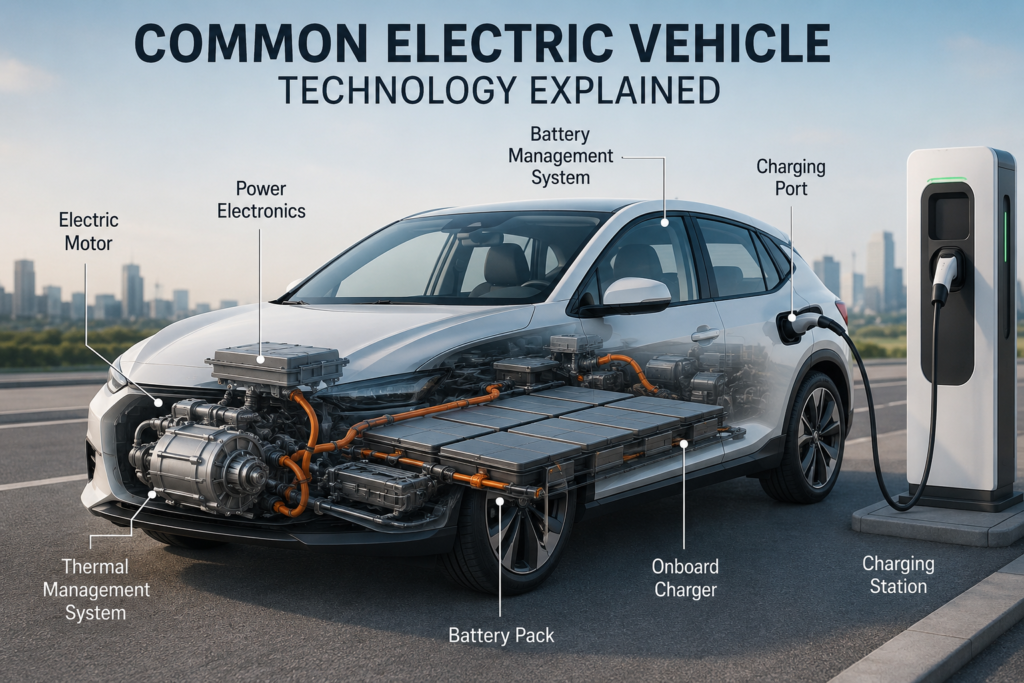
The electric motor is one of the most important parts of an electric vehicle. It converts electrical energy from the battery into mechanical energy that turns the wheels.
Most modern EVs use highly efficient electric motors. Depending on the vehicle design, manufacturers may use permanent magnet motors, induction motors, or other motor technologies.
One thing I find particularly interesting about electric motors is their ability to deliver strong torque almost immediately. This is why many electric cars can feel very quick when accelerating from a stop.
Some electric vehicles use one motor to drive either the front or rear wheels. More advanced models can use two motors, with one motor powering each axle. This can provide all wheel drive and allow the vehicle software to control power distribution more precisely.
EV Battery Pack
The battery pack is another major part of electric vehicle technology. It stores the electrical energy needed to power the motor and other systems in the vehicle.
Most modern electric vehicles use lithium ion battery technology because it provides a useful combination of energy density, weight, performance, and durability.
An EV battery is not simply one large battery. It is normally made up of many individual cells. These cells are arranged into modules and then combined into a larger battery pack.
The size of the battery is usually measured in kilowatt hours, commonly written as kWh. A larger battery can generally store more energy, which can help provide greater driving range. However, battery size is not the only factor that affects range. Vehicle weight, aerodynamics, temperature, driving style, tires, and road conditions also matter.
Battery Management System
The battery management system, often called the BMS, is one of the most important pieces of electronic technology inside an EV.
The BMS monitors the condition of individual battery cells and helps keep the battery operating within safe limits. It can monitor things such as voltage, temperature, current, and state of charge.
The system also helps prevent conditions that could damage the battery. For example, it can control charging and power delivery when battery conditions require additional protection.
In my view, the BMS is like the brain that constantly watches over the battery. Without effective battery management, modern EV battery packs would be much more difficult to operate safely and efficiently.
Power Electronics
Power electronics control the flow of electrical energy between the battery, motor, and other systems.
One important component is the inverter. The battery generally supplies direct current, while many electric motors require alternating current. The inverter converts and controls electrical power so that the motor can operate correctly.
The inverter also helps control motor speed and torque. When the driver presses the accelerator, the vehicle control system determines how much electrical power should be sent to the motor.
This process happens extremely quickly. The result is smooth and precise acceleration without the need for a traditional multi speed transmission in most EVs.
Regenerative Braking
Regenerative braking is another common EV technology that makes electric cars different from conventional vehicles.
When a normal car slows down using friction brakes, much of the vehicle’s kinetic energy is converted into heat. An electric vehicle can recover some of that energy.
During regenerative braking, the electric motor can work like a generator. As the vehicle slows down, some of its movement energy is converted back into electrical energy and sent to the battery.
Regenerative braking does not recover all of the energy, but it can improve overall efficiency. It can also reduce the amount of work required from the traditional friction braking system.
This technology is one reason electric vehicles can feel different to drive. When I lift my foot from the accelerator in some EVs, the car can slow down noticeably without immediately using the brake pedal.
EV Charging Technology
Charging technology is essential because an electric vehicle needs electricity to replenish its battery.
There are different types of EV charging. Home charging is often the most convenient option for people who have suitable electrical access. Public charging stations can provide additional flexibility for longer journeys.
Charging speed depends on several factors, including the charger, vehicle battery, charging system, temperature, and current battery state of charge.
AC charging is commonly used for home and slower public charging. DC fast charging can deliver electricity to the battery more quickly and is particularly useful during long trips.
However, fast charging is not always at the same speed from beginning to end. An EV may reduce charging power as the battery becomes more full. This helps manage battery temperature and protect battery health.
Onboard Charger
The onboard charger is another important EV component. It is responsible for converting AC electricity from a suitable charging source into DC electricity that can be stored in the battery.
The capacity of the onboard charger can affect how quickly an EV can charge using AC power.
It is important to understand that the onboard charger and DC fast charging system work differently. During DC fast charging, the external charging equipment supplies DC power more directly to the battery system, while the vehicle manages the charging process through its control electronics.
Thermal Management System
Temperature has a major effect on battery performance and electric vehicle efficiency.
EVs therefore use thermal management systems to control the temperature of components such as the battery, electric motor, power electronics, and sometimes the passenger cabin.
Keeping the battery within an appropriate temperature range can help maintain performance and charging capability.
In cold weather, the battery may need to be warmed. In hot conditions, the system may need to remove heat.
This is an area of EV technology that is easy to overlook. A battery may have excellent specifications on paper, but real world performance can depend heavily on temperature management.
Electric Vehicle Control Software
Modern electric vehicles are not only machines. They are also highly computerized systems.
Software controls many parts of an EV, including acceleration, regenerative braking, battery management, charging, thermal management, driver assistance, and energy consumption.
The vehicle constantly receives information from sensors and electronic control units. It then uses that information to make decisions about how the vehicle should operate.
This software based approach is one of the reasons modern EVs can receive new features and improvements through software updates.
Single Speed Transmission
Most electric vehicles do not need the complicated multi gear transmissions commonly found in petrol and diesel vehicles.
Electric motors can operate across a wide range of speeds while producing useful torque. Because of this, many EVs use a simple single speed reduction gearbox.
This design has fewer moving parts compared with many traditional transmissions. It can contribute to smooth acceleration and reduced mechanical complexity.
Some high performance EVs may use more advanced transmission designs, but a single speed setup is common in many electric cars.
Regenerative and Friction Braking Together
Although regenerative braking can slow the vehicle, EVs still generally have conventional friction brakes.
The vehicle can combine both braking methods depending on driving conditions. Regenerative braking may handle part of the deceleration while friction brakes provide additional stopping power when needed.
Electronic control systems help manage the transition between these braking methods.
This combination provides a balance between energy recovery and reliable braking performance.
Charging Port and Communication Technology
The charging port is the connection point between the vehicle and charging equipment. It allows electrical energy to enter the vehicle while also supporting communication between the car and charger.
Modern charging systems can exchange information about charging status, power requirements, and safety conditions.
Some advanced charging systems also support features such as scheduled charging and intelligent energy management.
These features can help drivers charge when electricity is more convenient or when they want the vehicle ready at a specific time.
Advanced Driver Assistance Systems
Many modern electric vehicles also include advanced driver assistance systems. These technologies can use cameras, radar, ultrasonic sensors, and other equipment to monitor the surrounding environment.
Depending on the vehicle, these systems may provide features such as adaptive cruise control, lane assistance, automatic emergency braking, parking assistance, and blind spot monitoring.
It is important to remember that driver assistance technology does not remove the driver’s responsibility. These systems are designed to assist the driver, not replace proper attention and safe driving.
Vehicle Energy Management
One of the most interesting parts of electric vehicle technology is energy management.
An EV constantly uses electrical energy for several purposes. The battery may power the motor, air conditioning, heating, lights, infotainment system, safety systems, and other electronics.
The vehicle software monitors energy use and can provide the driver with information about efficiency and remaining range.
Driving smoothly, maintaining appropriate tire pressure, and avoiding unnecessary acceleration can all help reduce energy consumption.
Wireless and Smart EV Technology
The EV industry is also moving toward more connected and intelligent technology.
Some vehicles can communicate with smartphone applications, allowing owners to check battery charge, locate their car, monitor charging, or prepare the cabin temperature remotely.
Smart charging technology can also help coordinate vehicle charging with electricity availability.
Another emerging area is bidirectional charging, where compatible vehicles can send electricity back to a home or electrical system. This could make some EVs useful as temporary energy storage devices in the future.
Why EV Technology Is Important
The biggest advantage of electric vehicle technology is efficiency. Electric motors can convert a high percentage of electrical energy into useful movement, while traditional engines lose significant energy as heat.
EV technology can also reduce the number of mechanical components required for propulsion. There is no conventional engine oil system, exhaust system, or traditional fuel injection system in a fully electric vehicle.
However, EVs are not perfect. Battery production, charging infrastructure, electricity sources, cost, range, and charging time are all important considerations.
I believe the most useful way to look at electric vehicles is not to consider them simply as cars without petrol engines. They are a different type of transportation technology built around electricity, electronics, software, and energy management.
Final Thoughts
Common electric vehicle technology may seem complicated at first, but the basic concept is relatively straightforward. The battery stores energy, the power electronics control that energy, and the electric motor converts it into movement.
Around these main components are systems such as the battery management system, regenerative braking, thermal management, charging technology, onboard charger, sensors, and software. Together, these technologies allow an EV to operate efficiently and safely.
As electric vehicle technology continues to develop, we can expect improvements in battery chemistry, charging speed, driving range, software, energy management, and vehicle efficiency.
For anyone interested in buying or understanding an electric car, learning these basic technologies is a great starting point. Once you understand how the major components work together, many of the advanced EV features become much easier to understand.