Related Articles
Modern cars are becoming smarter every year, and one of the features I find particularly useful is Lane Keeping Assist. Many newer vehicles come with this technology as part of their driver assistance systems. If you have ever driven on a highway for a long time, you probably know how easy it can be to move slightly away from the center of your lane without realizing it. Lane Keeping Assist is designed to help with exactly this situation.
In my view, Lane Keeping Assist is one of those car technologies that can provide an extra layer of safety when used correctly. It does not replace the driver, but it can help reduce the chance of unintentionally leaving a lane. Understanding how this system works can help drivers use it more confidently and responsibly.
What Is Lane Keeping Assist?
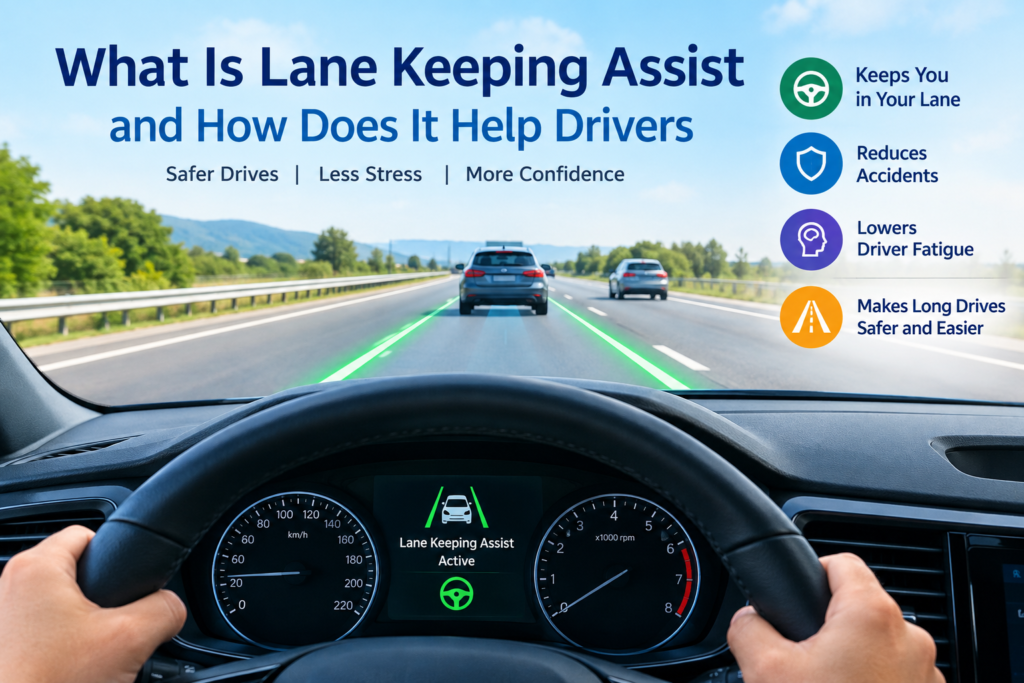
Lane Keeping Assist is a driver assistance feature that helps keep a vehicle within its marked traffic lane. The system uses cameras and sometimes other sensors to identify lane markings on the road. When the vehicle starts moving toward a lane boundary without an obvious steering input from the driver, the system can provide a warning or gently adjust the steering.
Different car manufacturers use different names and technologies for this feature. Some systems may provide only a warning, while others can actively make small steering adjustments to guide the vehicle back toward the center of the lane.
The important thing to understand is that Lane Keeping Assist is a support system. The driver still needs to pay attention to the road, keep both hands ready to control the steering wheel, and make all important driving decisions.
How Does Lane Keeping Assist Work?
The technology behind Lane Keeping Assist is quite interesting. A forward facing camera is usually mounted near the top of the windshield. This camera watches the road ahead and looks for visible lane markings.
The vehicle’s computer processes information from the camera and other sensors. It can determine where the lane boundaries are and compare them with the vehicle’s current position.
If the system notices that the car is getting too close to a lane marking, it may first provide a visual or audible warning. Depending on the vehicle, the steering wheel may also vibrate.
In vehicles with active Lane Keeping Assist, the system can make a small steering correction. This correction is generally designed to help guide the vehicle back toward the lane rather than take complete control of driving.
I think this is an important distinction because some drivers assume the technology can drive the car by itself. That is not what Lane Keeping Assist is designed to do.
Why Is Lane Keeping Assist Important?
One major reason Lane Keeping Assist is useful is that drivers can become distracted or tired during long journeys. Even when someone is trying to concentrate, small changes in steering can happen naturally.
For example, imagine driving on a highway for several hours. You are looking ahead, but your attention briefly moves toward a road sign or your mirrors. During that moment, the vehicle could gradually move toward another lane.
Lane Keeping Assist can recognize this movement and alert the driver or provide a small steering correction.
It can therefore act as an additional safety layer. However, it should never encourage a driver to become less attentive.
Lane Keeping Assist and Driver Fatigue
Driver fatigue is another situation where Lane Keeping Assist can be helpful. Long distance driving can become physically and mentally tiring, especially when the road is straight and the surroundings change very little.
When a driver becomes tired, maintaining a perfectly centered position in the lane can become more difficult. Small steering movements can gradually increase.
A lane keeping system can detect some of these movements and provide assistance. In my opinion, this can be particularly useful on long highway journeys.
Still, Lane Keeping Assist is not a solution for tired driving. If you feel sleepy, the correct response is to stop somewhere safe and take a break. Technology should support responsible driving rather than encourage drivers to continue when they need rest.
Lane Keeping Assist vs Lane Departure Warning
People sometimes confuse Lane Keeping Assist with Lane Departure Warning. Although they are related, they are not exactly the same.
Lane Departure Warning generally alerts the driver when the vehicle begins moving out of its lane. The warning may appear on the dashboard, through an audible alert, or through steering wheel vibration.
Lane Keeping Assist can go one step further by applying a small steering correction when the vehicle begins drifting toward the lane boundary.
Some modern vehicles combine both technologies. The driver may receive a warning first, followed by steering assistance if the vehicle continues moving toward the lane marking.
The exact operation depends on the vehicle manufacturer and model.
When Does Lane Keeping Assist Work Best?
Lane Keeping Assist usually works best when the road has clear and visible lane markings. Highways and major roads are often suitable because their lane lines are generally easier for cameras to detect.
Good weather and clear visibility can also help the system operate properly.
However, road conditions can affect performance. Heavy rain, snow, fog, damaged lane markings, construction zones, dirt on the road, or strong sunlight can make it harder for cameras to recognize lane boundaries.
For this reason, drivers should never assume the system will always work.
What Happens When Lane Markings Are Missing?
One limitation of Lane Keeping Assist is that it depends heavily on the system being able to identify lane markings.
If the road has faded lines or no visible markings, the system may not be able to determine where the lane boundaries are.
In some situations, the vehicle may display a warning indicating that the system is temporarily unavailable. This is normal behavior and does not necessarily mean there is a problem with the vehicle.
I recommend treating Lane Keeping Assist as an assistant rather than something that should always be active and reliable under every road condition.
Can Lane Keeping Assist Steer the Car?
Some versions of Lane Keeping Assist can make small steering adjustments. This can give the impression that the car is steering itself, but that is not how drivers should think about the technology.
The driver remains responsible for controlling the vehicle.
The system is generally designed to make limited corrections rather than handle every steering situation. It may not respond correctly to sharp curves, missing road markings, unusual road layouts, or unexpected obstacles.
Keeping your attention on the road is therefore essential.
Benefits of Lane Keeping Assist
There are several potential benefits of Lane Keeping Assist.
The first is that it can help reduce unintended lane departures. A small steering correction or warning can remind the driver that the vehicle is moving away from its intended path.
Another benefit is additional support during long highway journeys. Maintaining lane position for hours can be tiring, and assistance may reduce some of the workload.
The system can also provide useful warnings when a driver is unintentionally drifting toward another lane.
For me, the biggest advantage is the extra layer of awareness it can provide. It is not a replacement for good driving habits, but it can support them.
Limitations of Lane Keeping Assist
Like any automotive technology, Lane Keeping Assist has limitations.
It may struggle when lane markings are faded, covered, damaged, or blocked. Bad weather can also affect the camera’s ability to recognize the road.
Some systems may not perform well on narrow roads or roads with unusual markings. Sharp curves and construction areas can also create challenging situations.
Another important limitation is that the system cannot understand every situation in the same way a careful driver can. A driver may intentionally cross a lane marking to avoid an obstacle, change lanes, or follow a temporary traffic arrangement.
The driver must therefore remain in control and understand when the system is active.
How Should Drivers Use Lane Keeping Assist?
I believe the best way to use Lane Keeping Assist is as an extra safety feature rather than a replacement for attention.
Before driving, it is a good idea to understand how the system works in your particular vehicle. Read the owner’s manual and learn what the dashboard symbols mean.
Keep the windshield area around the camera clean because dirt or damage can affect the camera’s ability to see the road.
Always keep your attention on traffic and maintain proper control of the steering wheel.
If the system gives a warning, treat it as useful information rather than something to ignore.
Does Lane Keeping Assist Make Driving Safer?
Lane Keeping Assist is designed to help reduce unintended lane departures, and it can provide useful assistance in suitable driving conditions. However, no driver assistance system can eliminate every driving risk.
Safe driving still depends on paying attention, following traffic rules, maintaining a safe speed, keeping a proper following distance, and avoiding distractions.
I see Lane Keeping Assist as another tool that can support these habits. When the technology and responsible driving are used together, drivers can benefit from an additional layer of assistance.
Final Thoughts
Lane Keeping Assist is an interesting example of how modern automotive technology is changing the driving experience. By using cameras and vehicle sensors, the system can recognize lane markings and help prevent unintended movement away from the driver’s lane.
It can provide warnings, steering assistance, or both depending on the vehicle and system design.
In my opinion, the most important thing is to understand what Lane Keeping Assist can and cannot do. It is not an autonomous driving system, and it should never be used as an excuse to stop paying attention.
When used correctly, Lane Keeping Assist can be a helpful feature for everyday driving and especially for longer highway journeys. The driver remains the most important part of the safety system, while technology provides an additional layer of support when it is needed.
For anyone buying a modern car, I think it is worth learning about Lane Keeping Assist and understanding how it works before relying on it. Knowing the technology can make it easier to use the feature responsibly and get the most benefit from it.