Related Articles
Modern cars are much smarter than many people realize. They are equipped with dozens of sensors and electronic control systems that constantly monitor engine performance, emissions, fuel delivery, transmission behavior, and many other functions. Years ago, finding a mechanical problem often meant spending hours inspecting different parts of the vehicle. Today, an OBD2 diagnostic tool can quickly identify many issues by communicating directly with the car’s computer.
When I first used an OBD2 scanner, I was surprised by how much information it could display in just a few seconds. Instead of guessing what was wrong with the vehicle, I could see fault codes, sensor readings, and other useful data that made troubleshooting much easier. In my opinion, an OBD2 diagnostic tool is one of the most valuable devices every car owner can understand, even if they are not a professional mechanic.
In this article, I will explain how OBD2 diagnostic tools work, what they can do, how to use them, and why they have become an essential part of modern vehicle maintenance.
What Is an OBD2 Diagnostic Tool?
OBD2 stands for On Board Diagnostics Second Generation.
An OBD2 diagnostic tool is an electronic device that connects to a vehicle’s onboard computer to read information about the engine and other vehicle systems.
The scanner communicates with the vehicle’s Electronic Control Unit, often called the ECU, which constantly monitors sensors throughout the car.
Whenever the ECU detects a problem, it stores a diagnostic trouble code that can later be read using an OBD2 scanner.
This system helps identify problems much faster than traditional inspection methods.
Why OBD2 Systems Were Introduced
Before OBD systems became common, diagnosing engine problems was much more difficult.
Mechanics often relied on experience, visual inspection, and trial and error.
Modern OBD2 systems were introduced to standardize vehicle diagnostics and improve emissions control.
Today, almost every modern passenger vehicle uses OBD2 technology, making repairs faster and more accurate.
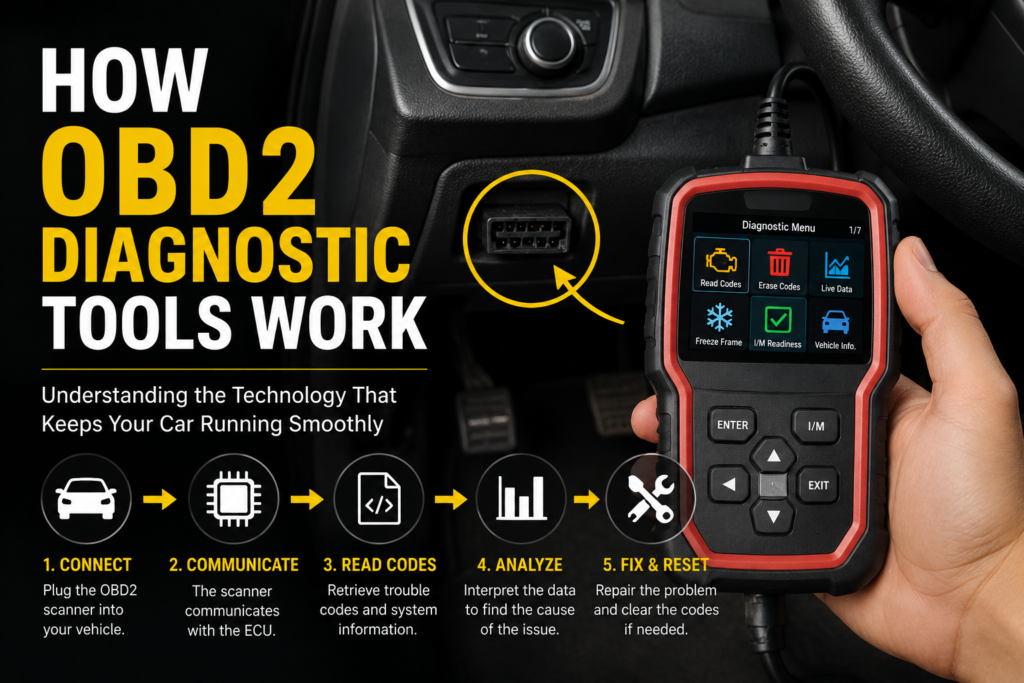
How an OBD2 Scanner Works
The process is surprisingly simple.
Every compatible vehicle has an OBD2 diagnostic port, usually located underneath the dashboard near the driver’s seat.
The scanner plugs into this connector.
Once connected, the scanner communicates with the vehicle’s ECU using standardized communication protocols.
The ECU sends stored information, including trouble codes, sensor data, and system status.
The scanner then displays this information on its screen or within a smartphone application if it is a Bluetooth model.
What the ECU Does
The Electronic Control Unit acts as the brain of the vehicle.
It receives information from many different sensors throughout the engine and other systems.
Examples include oxygen sensors, mass airflow sensors, coolant temperature sensors, throttle position sensors, crankshaft position sensors, and many others.
The ECU continuously analyzes this information and adjusts engine operation to maintain performance, fuel efficiency, and emissions.
When sensor readings fall outside the expected range, the ECU records a fault code.
What Are Diagnostic Trouble Codes?
Diagnostic Trouble Codes, commonly called DTCs, are standardized codes stored inside the ECU whenever a problem is detected.
Each code begins with a letter followed by four numbers.
For example, a code beginning with P relates to the powertrain.
Codes beginning with B involve body systems.
Codes beginning with C relate to chassis systems.
Codes beginning with U involve communication networks between electronic modules.
Reading these codes helps technicians identify the area requiring inspection.
Generic and Manufacturer Specific Codes
Not every diagnostic code has the same meaning.
Generic codes are standardized across all manufacturers.
These codes follow international OBD2 standards and can usually be read by almost any scanner.
Manufacturer specific codes provide additional information unique to a particular vehicle brand.
Advanced scanners often support both types.
Live Data Monitoring
One feature I find especially useful is live data.
Instead of only displaying stored fault codes, many OBD2 scanners show real time sensor information while the engine is running.
This may include engine speed, coolant temperature, intake air temperature, fuel trim values, oxygen sensor readings, battery voltage, throttle position, and many other measurements.
Watching live data helps identify problems that may not immediately trigger a warning light.
Clearing Fault Codes
Most OBD2 scanners can also erase stored trouble codes.
After repairing a problem, clearing the codes resets the warning light.
However, clearing codes without fixing the actual issue usually results in the warning light returning after the ECU detects the same problem again.
For this reason, repairs should always come before resetting codes.
Freeze Frame Data
Another valuable feature is freeze frame data.
When a fault occurs, the ECU stores a snapshot of engine operating conditions at that exact moment.
This information may include engine speed, coolant temperature, vehicle speed, throttle position, and fuel system status.
Freeze frame data helps technicians understand the conditions that caused the problem.
Readiness Monitors
Modern vehicles constantly monitor emission related systems.
These tests are called readiness monitors.
An OBD2 scanner can display whether these tests have completed successfully.
This information becomes especially important before vehicle emissions inspections.
If readiness monitors are incomplete, the vehicle may fail inspection even if no warning lights are present.
Types of OBD2 Diagnostic Tools
Several different scanner types are available.
Basic code readers simply display trouble codes and clear warning lights.
Mid level scanners provide live data, freeze frame information, and additional diagnostic features.
Professional diagnostic tools offer advanced functions such as module programming, service resets, component testing, and manufacturer specific diagnostics.
Bluetooth OBD2 adapters connect wirelessly to smartphones using dedicated applications.
These compact devices have become very popular among everyday drivers.
Benefits of Using an OBD2 Scanner
I believe every car owner can benefit from understanding OBD2 scanners.
They help identify engine problems early.
They reduce unnecessary guesswork.
They save diagnostic time.
They improve maintenance planning.
They allow drivers to understand warning lights before visiting a repair shop.
They may even help prevent expensive repairs through early detection.
Common Problems Detected by OBD2
OBD2 scanners can identify a wide range of engine related issues.
Faulty oxygen sensors.
Engine misfires.
Catalytic converter problems.
Mass airflow sensor failures.
Evaporative emission leaks.
Fuel system issues.
Ignition coil failures.
Throttle body problems.
Coolant temperature sensor faults.
Many transmission related problems can also be detected depending on the vehicle.
Limitations of OBD2 Scanners
Although extremely useful, OBD2 scanners cannot diagnose every possible mechanical problem.
They identify electronic faults and provide useful diagnostic information.
However, additional testing is often necessary.
For example, low engine compression, worn bearings, suspension damage, or mechanical brake problems may require traditional inspection methods.
The scanner is a diagnostic aid rather than a complete repair solution.
Can Beginners Use an OBD2 Scanner?
Absolutely.
Many entry level scanners are designed specifically for beginners.
Most display clear fault code descriptions instead of only showing numbers.
Smartphone applications often provide additional explanations, repair suggestions, and live graphs.
Learning the basics takes very little time and can greatly improve your understanding of vehicle maintenance.
Tips for Using an OBD2 Scanner
Always read the owner’s manual before connecting the scanner.
Turn the ignition on if required by your scanner instructions.
Record fault codes before clearing them.
Research code meanings carefully instead of replacing parts immediately.
Repair confirmed problems before resetting warning lights.
Use quality diagnostic tools from reputable manufacturers.
These simple habits help produce more accurate diagnostic results.
Is Buying an OBD2 Scanner Worth It?
From my experience, purchasing a basic OBD2 scanner is a smart investment for almost every vehicle owner.
Even affordable scanners can quickly identify warning light causes and provide valuable maintenance information.
Instead of immediately visiting a repair shop for every warning light, you can perform an initial diagnosis yourself and better understand the problem before deciding on repairs.
Final Thoughts
In my opinion, OBD2 diagnostic tools have completely changed the way modern vehicles are diagnosed and maintained. They allow drivers and technicians to communicate directly with the vehicle’s computer, read diagnostic trouble codes, monitor live sensor data, and identify potential problems long before they become serious. Understanding how these tools work not only makes troubleshooting easier but also helps vehicle owners make informed decisions about maintenance and repairs.
While an OBD2 scanner cannot replace professional mechanical expertise, it remains one of the most useful automotive tools available today. Whether you are an experienced mechanic or simply someone who wants to take better care of your car, learning how to use an OBD2 diagnostic tool can save time, reduce repair costs, and provide greater confidence whenever a warning light appears on your dashboard.