Related Articles

Automatic Emergency Braking, commonly called AEB, is one of the most useful safety technologies found in modern cars. I personally think it is one of those features that many drivers may not notice during normal driving, but it can become extremely important when something unexpected happens on the road. The basic idea behind automatic emergency braking is simple. The vehicle watches the road ahead, detects a possible collision, warns the driver, and can apply the brakes automatically when the driver does not react quickly enough.
Modern driving involves many distractions and unexpected situations. A vehicle ahead can suddenly stop, a pedestrian can step into the road, or traffic can slow down within seconds. Even an experienced driver may need more time to react than the situation allows. This is where automatic emergency braking can provide an additional layer of protection.
What Is Automatic Emergency Braking?
Automatic Emergency Braking is an advanced driver assistance system designed to help prevent or reduce the severity of a collision. The system uses cameras, radar sensors, or a combination of different sensors to monitor the area around the vehicle.
When the system identifies an object or person in the vehicle’s path, it calculates whether a collision could happen. If the driver does not respond appropriately, the vehicle can automatically apply the brakes.
It is important to understand that AEB is not designed to replace the driver. It is a safety support system. The driver still needs to pay attention, control the vehicle, and make responsible decisions.
In my view, the biggest advantage of AEB is the extra reaction time it can provide. Sometimes a fraction of a second can make a significant difference during an emergency.
How Automatic Emergency Braking Works
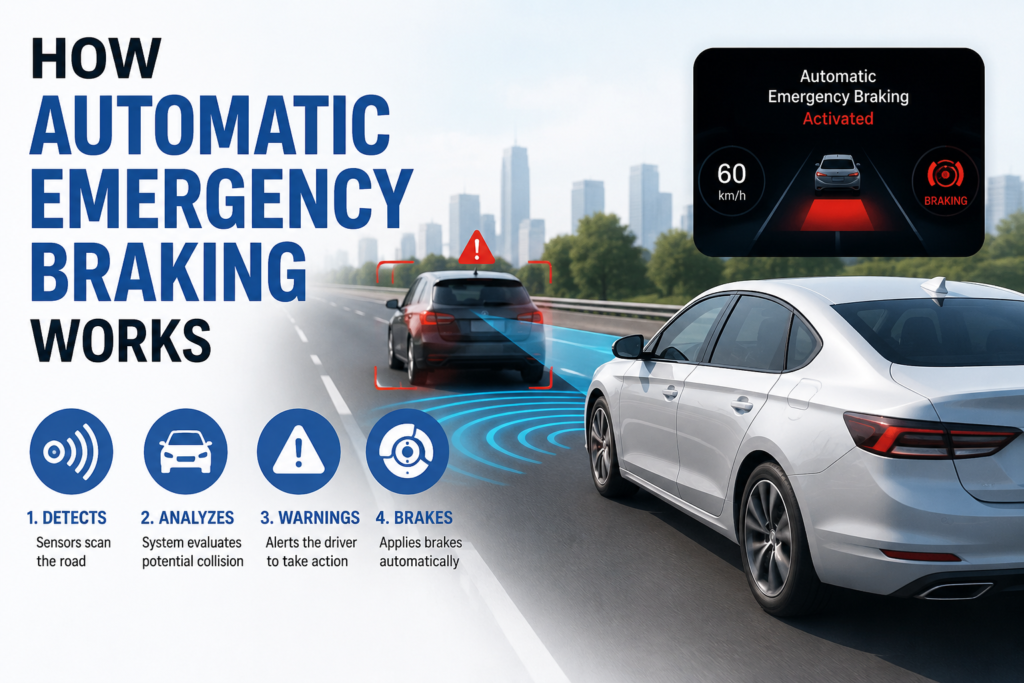
The operation of automatic emergency braking involves several important steps. Although the technology works very quickly, there is a lot happening in the background.
1. Sensors Monitor the Road
The first step is monitoring the road ahead. Depending on the vehicle, AEB can use cameras, radar sensors, or both.
A camera can recognize visual information such as vehicles, pedestrians, traffic lanes, and other objects. Radar can measure the distance and relative speed of objects in front of the vehicle.
Some vehicles use multiple sensors to improve detection. The information collected by these sensors is continuously sent to the vehicle’s computer system.
2. The System Identifies Potential Obstacles
After collecting information, the vehicle determines what is in front of it. The system may recognize another vehicle, a pedestrian, cyclist, or another object depending on the capabilities of the car.
This part is extremely important because the system needs to distinguish between something that could cause a collision and something that is harmless.
For example, a vehicle parked safely on the side of the road may not require emergency braking. However, a vehicle directly in the path of your car that is rapidly slowing down could create a serious risk.
3. The System Calculates Collision Risk
Once an object is detected, the system estimates how quickly the distance between the vehicle and the object is changing.
It considers factors such as vehicle speed, distance, direction, and the movement of the object. The system then calculates whether a collision appears likely.
This calculation happens very quickly. The purpose is to determine whether the driver has enough time to respond normally or whether additional braking assistance may be necessary.
4. The Driver May Receive a Warning
Many AEB systems do not immediately apply strong braking. Instead, they may first warn the driver.
The warning can appear on the dashboard, through an audible alert, or through other forms of driver notification. Some vehicles may also provide steering wheel or seat vibrations.
The idea is to give the driver an opportunity to take control. If the driver brakes or steers away from danger, the automatic braking system may no longer need to intervene.
5. Automatic Braking Can Be Applied
If the system determines that a collision is becoming unavoidable and the driver has not reacted sufficiently, it can apply the brakes automatically.
The amount of braking depends on the situation. In some cases, the system may apply partial braking to reduce speed. In a more serious emergency, it may apply stronger braking.
The main objective is either to prevent the collision completely or reduce the speed before impact. Even when a crash cannot be avoided, reducing the vehicle’s speed can potentially reduce the seriousness of the accident.
What Sensors Does AEB Use?
Automatic emergency braking systems can use different types of sensors.
Cameras
Cameras are commonly used to understand what is happening visually around the vehicle. They can help identify vehicles, pedestrians, cyclists, road markings, and other objects.
One advantage of cameras is that they can provide detailed visual information. However, their performance can be affected by darkness, heavy rain, fog, dirt, or other conditions that make visibility difficult.
Radar
Radar sensors use radio waves to detect objects and estimate their distance and movement.
Radar can be useful in conditions where a camera may have difficulty seeing clearly. It can measure how quickly an object is approaching the vehicle and provide important information to the braking system.
Sensor Combination
Many modern vehicles combine camera and radar information. I believe this approach makes sense because each sensor has different strengths.
When multiple sensors provide information about the same situation, the vehicle’s computer can compare that information and make a more informed decision.
Can Automatic Emergency Braking Stop Every Accident?
No. This is one of the most important things drivers should understand about AEB.
Automatic emergency braking is designed to assist the driver, but it cannot guarantee that every accident will be prevented. Its performance depends on many factors, including vehicle speed, road conditions, sensor visibility, object type, and system design.
For example, a system may have difficulty detecting certain objects or situations. Heavy rain, snow, fog, dirt on sensors, poor lighting, or unusual road conditions can also affect performance.
Some AEB systems are designed mainly for vehicles, while more advanced systems can detect pedestrians and cyclists as well.
Because of these limitations, drivers should never treat automatic emergency braking as a replacement for paying attention.
Automatic Emergency Braking at Different Speeds
AEB performance can vary depending on vehicle speed.
At lower speeds, the system may be particularly useful in situations such as city traffic. A vehicle in front may suddenly stop, giving the driver very little time to react.
At higher speeds, automatic braking can still provide valuable assistance, but completely avoiding a collision may be more difficult because the vehicle covers a greater distance in a shorter amount of time.
This is why safe driving remains important even when a vehicle has advanced safety features.
Automatic Emergency Braking vs Forward Collision Warning
Automatic emergency braking and forward collision warning are related technologies, but they are not exactly the same.
Forward collision warning primarily alerts the driver when a potential frontal collision is detected. It tells the driver that action may be necessary.
Automatic emergency braking goes a step further. If the driver does not respond appropriately, the system can automatically apply the brakes.
I think it is useful to think of forward collision warning as an alert system and AEB as an intervention system. Many modern vehicles combine both technologies to provide additional protection.
Benefits of Automatic Emergency Braking
There are several reasons why automatic emergency braking has become an important vehicle safety feature.
The first benefit is faster reaction. Electronic systems can monitor the road continuously and respond extremely quickly when a dangerous situation develops.
Another benefit is collision severity reduction. Even if the system cannot completely prevent an accident, reducing speed before impact can make a meaningful difference.
AEB can also be useful in busy urban environments. Traffic conditions can change quickly, and drivers may occasionally become distracted for a moment.
The technology can also provide peace of mind. Knowing that the vehicle has another safety system watching for potential collisions can make modern driving technology more reassuring.
Limitations of Automatic Emergency Braking
Despite its benefits, AEB has limitations.
Sensors can become dirty or blocked. Weather conditions can interfere with detection. The system may also behave differently depending on the vehicle manufacturer and model.
Another important limitation is that AEB cannot understand every road situation perfectly. Roads are complicated environments, and unusual objects or unexpected movements can challenge the system.
Drivers should also remember that automatic braking does not mean the car can drive itself. Steering, observation, judgment, and speed control still remain the responsibility of the driver.
Should You Trust Automatic Emergency Braking?
I would say drivers should trust AEB as a helpful safety feature, but not depend on it completely.
The best approach is to treat automatic emergency braking as an additional safety layer. The driver should remain focused on the road while the vehicle’s technology provides backup support.
If the system activates unexpectedly, the driver should remain calm and understand that it detected a potential risk. It is also important to keep cameras and sensors clean and follow the vehicle manufacturer’s recommendations.
The Future of Automatic Emergency Braking
Vehicle safety technology continues to improve, and automatic emergency braking is likely to become even more capable.
Future systems may provide better object recognition, improved performance in poor weather, and more accurate prediction of how pedestrians, cyclists, and vehicles are likely to move.
As vehicle computers become more advanced, safety systems can process larger amounts of information in less time. This could allow AEB technology to respond to increasingly complex traffic situations.
From my point of view, this is a positive development because the goal of these technologies is not to remove the driver from the process. The goal is to give drivers better support when unexpected situations occur.
Final Thoughts
Automatic Emergency Braking is an important part of modern vehicle safety technology. It works by using sensors such as cameras and radar to monitor the road, identify potential obstacles, calculate collision risk, warn the driver, and apply the brakes when necessary.
The technology can help prevent some collisions and can reduce the severity of others. However, it has limitations and should never be considered a replacement for an attentive driver.
In my opinion, the real value of AEB comes from the extra layer of protection it provides. A driver can make a mistake, traffic can suddenly change, or an unexpected object can appear on the road. Having a system that can recognize danger and react quickly can be extremely valuable.
As cars continue to become smarter, features like automatic emergency braking will likely become a normal part of everyday driving. For drivers, understanding how this technology works is just as important as having it in the vehicle. The safest approach is still simple: stay alert, maintain a safe speed, keep enough distance from other vehicles, and allow safety technology to assist you when you need it most.