Related Articles
Modern cars are becoming smarter every year, and one of the features I find especially useful is the technology designed to help drivers stay safely within their lane. Two terms that often create confusion are Lane Departure Warning and Lane Keeping Assist. Both systems are designed around the same basic idea, which is helping prevent unintended lane drifting, but they do not work in exactly the same way.
In my view, understanding the difference between Lane Departure Warning and Lane Keeping Assist is important because these features are not a replacement for careful driving. They are driver assistance technologies that can provide an extra layer of safety when attention drops for a moment.
What Is Lane Departure Warning?
Lane Departure Warning, commonly called LDW, is a driver assistance system that monitors the vehicle position within its lane. It generally uses cameras or other sensors to identify lane markings on the road.
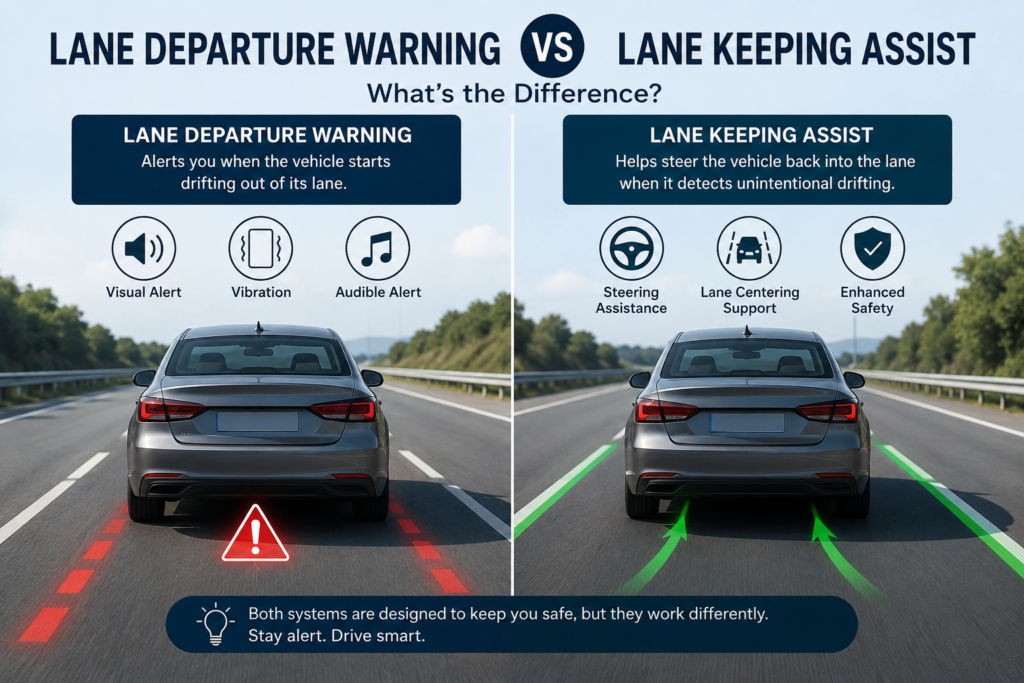
When the system detects that the vehicle is moving toward or crossing a lane marking without the driver intentionally using a turn signal, it can alert the driver. Depending on the vehicle, the warning may appear on the dashboard, sound an audible alert, or come through steering wheel vibration.
The main purpose of Lane Departure Warning is simple. It tells the driver that the vehicle may be leaving its lane unintentionally.
For example, imagine driving on a highway after several hours on the road. You become slightly distracted and the car slowly moves toward the edge of the lane. LDW may recognize this movement and warn you before the vehicle crosses the marking.
I consider this system more like an electronic reminder. It does not normally try to control the direction of the vehicle. Instead, it gets the driver’s attention so the driver can correct the steering.
What Is Lane Keeping Assist?
Lane Keeping Assist, usually called LKA, takes the idea a step further. Like Lane Departure Warning, it uses cameras and sensors to monitor lane markings and determine the vehicle’s position on the road.
The major difference is that Lane Keeping Assist can provide steering assistance when the vehicle begins to leave its lane unintentionally.
If the system detects that the car is drifting toward a lane marking, it may apply a small steering correction to help guide the vehicle back toward the center of the lane. The exact behavior depends on the manufacturer and vehicle model.
From my point of view, this is where the two systems become noticeably different. LDW mainly tells you that something is happening, while LKA can actively assist with the correction.
However, Lane Keeping Assist does not mean the vehicle can drive itself. The driver still needs to keep both attention and control on the road.
Lane Departure Warning vs Lane Keeping Assist
The easiest way to understand the difference is to think about their roles.
Lane Departure Warning is primarily a warning system. It detects possible unintended lane departure and alerts the driver.
Lane Keeping Assist is an assistance system. It can detect lane departure and may provide steering input to help keep the vehicle within its lane.
Both systems may use similar cameras and sensors, but their response can be different.
For example, if your vehicle begins moving toward another lane without the turn signal being activated, an LDW system may beep or vibrate the steering wheel. An LKA system may provide a gentle steering correction in addition to a warning.
This does not mean every Lane Keeping Assist system works exactly the same way. Some systems may provide stronger steering assistance, while others may only make a small correction.
How Does Lane Departure Warning Work?
Lane Departure Warning usually relies on a forward facing camera mounted near the windshield. The camera looks at the road ahead and searches for visible lane markings.
The vehicle’s computer processes this information and estimates where the car is positioned relative to the lane.
If the system notices that the vehicle is moving toward or across a lane marking and the movement appears unintended, it can activate a warning.
Turn signals are important because they help the system understand driver intention. If a driver activates the turn signal before changing lanes, the vehicle may recognize that the lane movement is intentional and avoid giving an unnecessary warning.
Of course, the system has limitations. Poor weather, faded road markings, construction zones, sharp curves, and blocked lane lines can make it more difficult for the camera to identify lanes accurately.
How Does Lane Keeping Assist Work?
Lane Keeping Assist uses similar principles but can take an additional step by providing steering support.
The camera monitors lane markings and the vehicle’s position. When the system believes the vehicle is unintentionally drifting from its lane, the electronic steering system can make a small adjustment.
The correction is usually designed to assist rather than completely take over steering.
I think this distinction is very important. A driver should never assume that Lane Keeping Assist will always keep the car perfectly centered. The road environment can change quickly, and the system may not recognize every situation correctly.
The driver remains responsible for steering, braking, accelerating, and making decisions.
Which One Is Safer?
It is difficult to say that one system is always safer because they perform different jobs. Both can contribute to road safety when used correctly.
Lane Departure Warning can be helpful because it gives the driver an immediate reminder when the vehicle starts drifting. This can be particularly useful during long highway journeys.
Lane Keeping Assist can provide another level of support because it may physically help correct the vehicle’s direction.
In my opinion, Lane Keeping Assist can be more useful in situations where a driver unintentionally begins drifting, but that does not make Lane Departure Warning unnecessary. A warning can still be valuable because it keeps the driver involved and aware of what is happening.
Lane Keeping Assist Does Not Mean Self Driving
One of the biggest misunderstandings about modern driver assistance technology is confusing assistance with autonomous driving.
Lane Keeping Assist is not the same as self driving.
Even when the system provides steering assistance, the driver must remain attentive. Depending on the vehicle, the system may also require the driver to keep their hands on the steering wheel.
The technology is designed to reduce the chance of an unintended lane departure, not to replace the driver.
This is something I always consider important when discussing modern car safety features. Technology can help, but it should never encourage drivers to become less attentive.
When Lane Departure Warning Can Be Useful
LDW can be particularly useful on highways and long straight roads where driver fatigue can become an issue.
It may also help when a driver becomes temporarily distracted. A warning can bring attention back to the road before a dangerous situation develops.
However, drivers should not deliberately test the system by allowing the car to drift. It is better to treat the warning as an emergency backup rather than something to depend on during normal driving.
When Lane Keeping Assist Can Be Useful
Lane Keeping Assist can be helpful during long highway drives because it can provide small steering corrections when the vehicle begins to drift.
It can also be useful when the driver makes a minor steering error. Instead of allowing the vehicle to continue moving toward the lane boundary, the system may help guide it back.
Still, its performance depends heavily on road conditions. Clear lane markings generally make these systems easier to operate effectively.
Limitations of Both Systems
No driver assistance system is perfect.
Lane Departure Warning and Lane Keeping Assist can have difficulty when lane markings are faded, missing, covered by snow, blocked by dirt, or affected by road construction.
Heavy rain, fog, glare, and other poor visibility conditions can also affect camera based systems.
There can also be situations where the road layout is complicated. Temporary markings, merging lanes, split roads, and unusual intersections may create challenges for the system.
Because of these limitations, I would never consider these features a substitute for proper driving habits.
Can You Turn These Features Off?
Many vehicles allow drivers to adjust or disable Lane Departure Warning and Lane Keeping Assist. The exact controls depend on the manufacturer and model.
Some drivers may prefer to keep both systems active all the time, while others may adjust them depending on the type of road.
Personally, I think it makes sense to understand the system before changing its settings. Instead of turning a feature off simply because a warning feels annoying, it is better to learn why the warning is happening and understand the available sensitivity settings.
Which Technology Should You Choose?
If you are comparing two vehicles and one offers Lane Departure Warning while another offers Lane Keeping Assist, I would generally consider Lane Keeping Assist the more advanced feature because it can provide steering assistance in addition to warnings.
However, the quality of the system matters just as much as the name of the feature.
Different manufacturers use different cameras, sensors, software, and steering systems. One vehicle’s Lane Keeping Assist may feel very different from another vehicle’s system.
That is why I would recommend looking beyond the feature name when comparing cars. It is useful to understand how the system actually behaves in real driving conditions.
Final Thoughts
Lane Departure Warning and Lane Keeping Assist are closely related, but they are not the same technology.
Lane Departure Warning primarily alerts the driver when the vehicle appears to be leaving its lane unintentionally. Lane Keeping Assist can go a step further by providing steering assistance to help guide the vehicle back toward its lane.
In my opinion, both technologies are valuable additions to modern cars. LDW can act as an extra reminder, while LKA can provide additional steering support when needed.
The most important thing to remember is that these systems are designed to assist the driver, not replace the driver. Good attention, proper steering control, safe speed, and awareness of surrounding traffic are still essential.
As automotive technology continues to improve, features like Lane Departure Warning and Lane Keeping Assist will likely become more common. Understanding how they work can help drivers use them properly and get the most benefit from modern vehicle safety technology.