Related Articles


Modern cars come with many smart features that are designed to make driving more efficient, comfortable, and environmentally friendly. One feature that many drivers notice is engine start stop technology. If you have ever stopped at a traffic light and noticed that your engine suddenly switched off, you have probably experienced this system.
In my view, engine start stop technology is one of the simplest ideas used in modern cars. Instead of allowing the engine to keep running while the vehicle is standing still, the system temporarily turns it off. When the driver is ready to move, the engine starts again automatically. The main purpose is to reduce unnecessary idling, which can help lower fuel consumption and emissions.
What Is Engine Start Stop Technology?
Engine start stop technology is an automatic system that temporarily switches off the engine when a vehicle stops and restarts it when driving needs to continue.
It is also called auto start stop, stop start technology, or idle stop technology. You can commonly find it in modern cars with gasoline or diesel engines, as well as in hybrid vehicles.
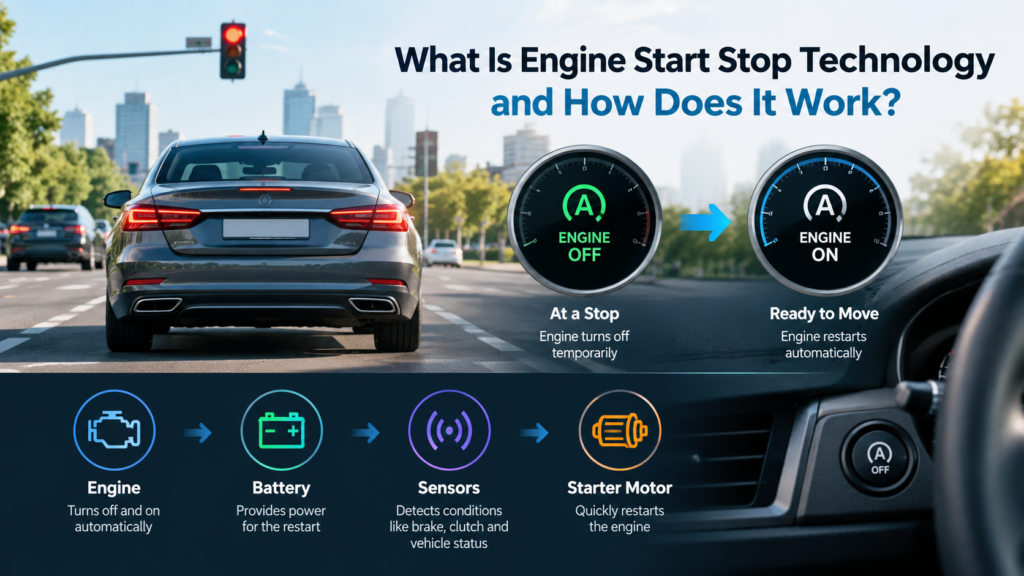
The basic idea is very easy to understand. When your car is moving, the engine runs normally. When you come to a complete stop, such as at a traffic light, the vehicle’s computer checks several conditions. If everything is suitable, it turns the engine off. When you release the brake or press the clutch, depending on the vehicle, the system restarts the engine.
The system is particularly useful in city driving because cars frequently stop at traffic lights, intersections, and during traffic congestion.
Why Do Cars Use Start Stop Technology?
The biggest reason manufacturers use engine start stop technology is to reduce unnecessary fuel consumption.
When a traditional car is stopped with its engine running, the engine continues consuming fuel even though the vehicle is not moving. This is known as idling.
Imagine sitting at a traffic signal for one minute. Your car is not traveling anywhere, but the engine is still running. Start stop technology tries to eliminate this unnecessary engine operation by switching the engine off during suitable stops.
According to Natural Resources Canada, idle stop start technology can reduce fuel consumption and emissions during city driving by around 4 to 10 percent or more, depending on the vehicle and driving conditions.
The actual benefit varies from one driver and vehicle to another. A person who spends a lot of time in heavy traffic may notice more benefit than someone who mostly drives on highways.
How Does Engine Start Stop Technology Work?
The process is controlled by the vehicle’s electronic control systems. Sensors continuously monitor information about the vehicle and its operating conditions.
When you stop the car, the computer checks whether the engine should be switched off. The system may consider factors such as vehicle speed, brake or clutch position, battery condition, engine temperature, cabin temperature, and other vehicle conditions.
If the required conditions are satisfied, the engine is temporarily stopped.
For an automatic transmission vehicle, this can happen when the vehicle comes to a stop while the driver keeps the brake pedal pressed. In many vehicles, releasing the brake tells the system that the driver wants to move, so the engine starts again.
In a manual transmission vehicle, the clutch and gear position are commonly part of the process. The exact operation varies by manufacturer and vehicle design.
The Role of Sensors
Sensors are extremely important in start stop technology.
The system needs to know what the car is doing before it decides whether it is safe and practical to turn the engine off. For example, it needs to know whether the vehicle has stopped, whether the driver is pressing the brake, and whether the battery has enough energy for another engine start.
The computer also monitors other conditions. If the system determines that stopping the engine could reduce comfort or create a problem, it can keep the engine running.
This is why drivers may notice that the start stop feature does not activate every time they stop the car. That behavior is usually intentional.
The Battery Has an Important Job
Many people think the starter motor is the only important part of this technology, but the battery also plays a major role.
A start stop vehicle may restart its engine much more frequently than a conventional vehicle. Because of this, vehicles equipped with the system are designed with electrical components that can handle the additional demands.
Some vehicles use advanced battery technology such as an AGM battery. The battery must provide power not only for starting the engine but also for electrical systems while the engine is temporarily switched off.
This is one reason why using the correct battery specified for your vehicle is important. Installing an unsuitable battery can affect the operation of the start stop system.
What Happens When the Engine Turns Off?
When the system switches the engine off, the entire vehicle does not simply become completely inactive.
Many electrical features can continue operating from the vehicle’s battery. Depending on the vehicle, lights, entertainment systems, displays, and other electrical functions can remain available.
Climate control is more complicated because conventional air conditioning systems are often connected to engine operation. Modern vehicles therefore use different strategies to maintain cabin comfort, and the system can restart the engine when necessary.
This is another reason why start stop technology does not always activate under every condition.
How Does the Engine Restart So Quickly?
One of the most impressive parts of the system is how quickly the engine can restart.
When the computer determines that the driver wants to move, it activates the starting system. The starter motor or starter generator turns the engine, and the engine control system manages fuel and ignition so that the engine can begin running again.
Modern start stop systems are designed to make this process quick and smooth. From the driver’s seat, the restart may feel like a small vibration or a quiet change in engine sound before the car moves away.
The system is carefully designed because a slow or rough restart would make driving uncomfortable.
Does Start Stop Technology Save Fuel?
Yes, engine start stop technology can save fuel, especially during city driving, but the amount depends heavily on driving conditions.
If you spend most of your time driving on open highways, there may be little opportunity for the system to stop the engine. In heavy urban traffic, however, the engine may otherwise spend a considerable amount of time idling.
Natural Resources Canada reports city driving fuel consumption reductions of about 4 to 10 percent or more for idle stop start technology, depending on the system and conditions.
I think it is important to understand that start stop technology is not designed to dramatically transform fuel economy by itself. Instead, it saves small amounts of fuel repeatedly. Over many trips, those small savings can become meaningful.
Does Start Stop Technology Damage the Engine?
This is one of the most common questions about the feature.
Many drivers feel concerned when they hear the engine repeatedly switching off and restarting. It can seem like all those extra starts must cause excessive engine wear.
Modern vehicles with start stop technology are designed specifically for this type of operation. Manufacturers use suitable starting systems, batteries, electronic controls, and other components to handle repeated engine starts.
Modern engine oils and engine hardware are also developed with the operating conditions of start stop systems in mind.
That does not mean every component will last forever. Batteries, starters, and other parts can eventually wear out, just as they do in other vehicles. Proper maintenance and using the manufacturer’s recommended parts are important.
When Does the System Not Turn the Engine Off?
A start stop system does not have to activate every time the vehicle stops.
For example, if the battery does not have sufficient charge, the system may keep the engine running. The system may also avoid stopping the engine when conditions such as cabin temperature, engine temperature, or other operating requirements are not suitable.
This is actually an important safety and comfort feature. The system is not simply following one rule that says the engine must turn off whenever the vehicle stops. Instead, it makes a decision based on information collected from the vehicle.
Natural Resources Canada notes that electronic controls can prevent engine shutdown when the battery cannot provide enough power for restarting or supporting necessary accessories.
Can You Turn Start Stop Technology Off?
Many vehicles provide a button that allows the driver to temporarily disable the automatic start stop function.
The exact method depends on the vehicle. Some cars have a dedicated button, while others provide settings through the vehicle’s controls.
If you turn the system off, the car generally continues operating like a conventional vehicle, with the engine remaining running during stops. Some vehicles may automatically reactivate the feature after the vehicle is restarted.
Always check your owner’s manual because the behavior can vary between manufacturers and models.
Benefits of Engine Start Stop Technology
There are several potential benefits of this technology.
The first is improved fuel efficiency during situations involving frequent stops. The second is reduced unnecessary idling and potentially lower exhaust emissions. The third is that the technology works automatically, so the driver does not need to manually switch the engine off and on at every traffic light.
For people who regularly drive through busy cities, these advantages can be more noticeable.
Possible Disadvantages
There are also a few things drivers may not like.
Some people find the repeated engine shutdown and restart noticeable. Others prefer the feeling of having the engine continuously running. The system can also place greater demands on the battery and starting components because the engine is restarted more frequently.
Another point is that fuel savings depend on driving conditions. If you rarely stop, the system has fewer opportunities to provide a benefit.
In my opinion, these points are worth understanding rather than simply assuming that start stop technology is either completely good or completely bad.
Final Thoughts
Engine start stop technology is a straightforward idea supported by sophisticated electronics. The engine turns off when the vehicle does not need to move and starts again when the driver is ready to continue.
Sensors, computers, batteries, starter systems, and vehicle controls all work together to make this process happen smoothly. The main goal is to reduce unnecessary idling and improve fuel efficiency, especially during city driving.
If you notice your car’s engine switching off at a traffic light, there is usually no reason to be surprised. It is simply the vehicle’s start stop system doing its job. As automotive technology continues to develop, features like this show how manufacturers are finding practical ways to make conventional engines more efficient.
For everyday drivers, the most important thing is to understand how the system works, follow the vehicle manufacturer’s maintenance recommendations, and use the correct battery and replacement parts when required. When properly designed and maintained, engine start stop technology can quietly save fuel every time the vehicle waits in traffic.