
Related Articles

Modern cars are much smarter than the vehicles many of us grew up with. When I look at how today’s vehicles work, one thing that stands out to me is the important role of sensors. A car may look like a simple machine from the outside, but inside it has many electronic systems constantly collecting information. Sensors are the parts that help these systems understand what is happening around the engine, wheels, tires, cabin, and road.
In my view, car sensors are one of the main reasons modern vehicles can provide better performance, improved fuel economy, greater safety, and more comfort. They continuously monitor different conditions and send information to the vehicle’s computer. The computer then uses this information to make decisions and control different systems.
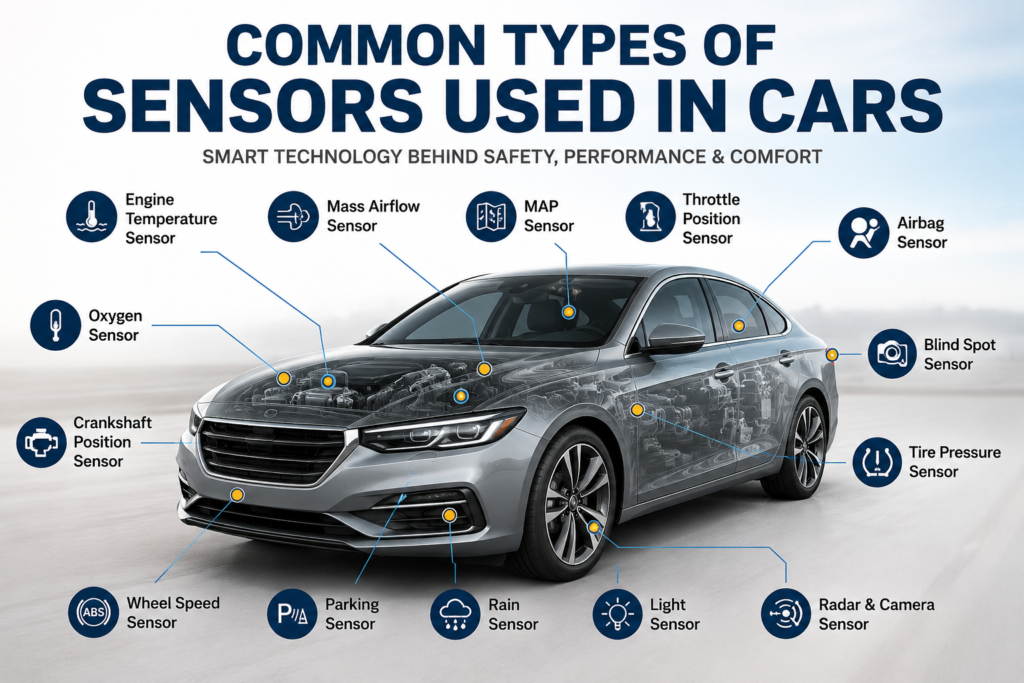
There are many types of sensors used in cars, and each one has a specific job. Some sensors monitor the engine, while others support safety systems or comfort features. In this article, I will explain the most common types of car sensors, how they work, and why they are important.
What Are Car Sensors?
A car sensor is an electronic device that detects changes in the vehicle or its surroundings. It measures information such as temperature, pressure, speed, oxygen levels, position, movement, and distance.
The sensor sends this information to the car’s electronic control unit, commonly known as the ECU. The ECU processes the information and sends instructions to different components.
For example, if an engine temperature sensor detects that the engine is getting too hot, the vehicle can adjust cooling functions or warn the driver. Similarly, a wheel speed sensor can detect how quickly each wheel is rotating and provide information to the ABS and stability control systems.
This process happens continuously, often without the driver noticing it.
1. Oxygen Sensor
The oxygen sensor is one of the most important sensors in a gasoline powered vehicle. It is usually installed in the exhaust system and measures the amount of oxygen present in exhaust gases.
The engine needs the correct mixture of air and fuel to operate efficiently. If there is too much fuel or too much air, combustion may not be ideal. The oxygen sensor sends information to the ECU so the engine can adjust the air and fuel mixture.
A properly working oxygen sensor can help improve fuel economy, engine performance, and emissions control.
When an oxygen sensor starts to fail, you may notice poor fuel economy, rough engine operation, or a check engine light.
2. Engine Temperature Sensor
The engine temperature sensor monitors the temperature of the engine coolant. The ECU uses this information to understand how hot or cold the engine is.
When the engine is cold, the computer may adjust fuel delivery to help the engine start and operate properly. As the engine reaches normal operating temperature, the system changes its settings.
This sensor also plays an important role in cooling system management. If the temperature becomes too high, the vehicle can activate warning systems and cooling components.
In my opinion, this is a simple but extremely important sensor because engine temperature has a direct effect on performance and reliability.
3. Mass Airflow Sensor
The mass airflow sensor measures the amount of air entering the engine. It is usually located in the air intake system between the air filter and the engine.
The ECU needs to know how much air is entering the engine so it can provide the correct amount of fuel. If the airflow measurement is incorrect, the engine may run too rich or too lean.
A dirty or damaged mass airflow sensor can cause poor acceleration, unstable idling, increased fuel consumption, and warning lights.
Regular air filter maintenance can help protect the airflow system and reduce the chance of contamination reaching the sensor.
4. Manifold Absolute Pressure Sensor
The manifold absolute pressure sensor, often called the MAP sensor, measures pressure inside the engine intake manifold.
The ECU uses MAP sensor information to understand engine load and operating conditions. This information can help the computer determine how much fuel should be delivered and how ignition timing should be adjusted.
MAP sensors are especially important in vehicles that use manifold pressure as a major part of their engine management strategy.
If the MAP sensor develops a problem, the engine may experience rough running, poor acceleration, or reduced fuel economy.
5. Throttle Position Sensor
The throttle position sensor monitors the position of the throttle valve. It tells the ECU how much the driver is opening the throttle.
When you press the accelerator pedal, the engine needs to know how much power you are requesting. The throttle position sensor provides information that helps the computer respond appropriately.
In modern vehicles, electronic throttle systems can use several related sensors to improve accuracy and safety.
A faulty throttle position sensor may cause hesitation, poor acceleration, or inconsistent engine response.
6. Crankshaft Position Sensor
The crankshaft position sensor monitors the position and speed of the crankshaft. This information is essential for engine control.
The ECU uses crankshaft position data to determine when fuel should be injected and when the spark should occur in a gasoline engine.
If this sensor fails, the engine may have difficulty starting or may stop running. In some cases, a vehicle may not start at all because the ECU cannot determine the crankshaft position correctly.
For this reason, I consider the crankshaft position sensor one of the most critical engine sensors.
7. Camshaft Position Sensor
The camshaft position sensor monitors the position and movement of the camshaft. The ECU uses this information together with crankshaft data to control engine timing.
It can help the vehicle determine which cylinder is in the correct position for fuel injection and ignition.
Modern engines often use variable valve timing systems, and camshaft position information can be especially important for controlling these systems.
A faulty camshaft position sensor may cause starting problems, poor engine performance, or reduced fuel efficiency.
8. Wheel Speed Sensors
Wheel speed sensors are extremely important for vehicle safety. They monitor the rotational speed of individual wheels.
These sensors provide information to systems such as anti lock braking systems, traction control, and electronic stability control.
If one wheel starts rotating much faster or slower than the others during braking or acceleration, the vehicle can recognize that something may be wrong. The safety system can then respond based on the available information.
A damaged wheel speed sensor can cause ABS, traction control, or stability control warning lights to appear on the dashboard.
9. Tire Pressure Sensor
Tire pressure monitoring sensors are used to measure tire pressure. In many vehicles, these sensors are installed inside the wheels and send pressure information to the vehicle.
Correct tire pressure is important for safety, handling, tire life, and fuel efficiency. If pressure becomes too low, the tire pressure monitoring system can warn the driver.
I think this is one of the most useful safety features because tire pressure can change gradually and drivers may not notice it while driving.
10. Knock Sensor
The knock sensor detects unusual vibrations caused by abnormal combustion inside the engine.
Engine knocking can occur when combustion happens in an undesirable way. If the ECU receives information that knocking is occurring, it can adjust engine settings to help protect the engine.
A functioning knock sensor can therefore help maintain engine performance while reducing the risk of damage caused by abnormal combustion.
11. Parking Sensors
Parking sensors are common in modern vehicles and are designed to help drivers when maneuvering at low speeds.
Many parking sensors use ultrasonic technology to detect objects near the vehicle. When an obstacle is detected, the system can provide warning sounds or visual information.
These sensors are particularly helpful in crowded parking areas, garages, and narrow spaces. They do not replace careful driving, but they can give the driver an additional layer of awareness.
12. Rain Sensor
Rain sensors are often found in vehicles with automatic windshield wipers. They detect moisture on the windshield and can automatically activate the wipers.
The system can adjust wiper operation depending on how much rain is detected. This means the driver does not always need to manually control the wipers when weather conditions change.
For me, this is a good example of how sensors can make everyday driving more convenient.
13. Light Sensor
A light sensor detects the amount of light around the vehicle. It is commonly used for automatic headlights and other lighting functions.
When the surrounding environment becomes dark, the vehicle can automatically turn on the headlights if the system is designed to do so.
Light sensors can be useful when driving through tunnels, at night, or during changing weather conditions.
14. Airbag Sensors
Airbag systems depend on sensors to detect sudden changes in vehicle movement. During a serious collision, these sensors can detect rapid deceleration and send information to the airbag control system.
The control unit evaluates the available information and determines whether airbags or other safety restraints should be activated.
Because airbags are safety devices, their sensors and control systems are highly important. Warning lights related to the airbag system should never be ignored.
15. Blind Spot Sensors
Many newer vehicles use sensors to help monitor areas that may be difficult for the driver to see.
Blind spot monitoring systems can detect vehicles approaching from certain areas beside or behind the car. The system may then provide a warning through a dashboard indicator, mirror light, sound, or other alert.
These sensors can make lane changes easier, but drivers should still check mirrors and surroundings before changing lanes.
16. Radar and Camera Sensors
Advanced driver assistance systems use cameras, radar sensors, or a combination of technologies to understand the vehicle’s surroundings.
These systems can support features such as adaptive cruise control, forward collision warnings, lane departure warnings, and automatic emergency braking.
Cameras can identify road markings and objects, while radar can help detect objects and estimate their distance and movement.
As automotive technology continues to develop, these sensors are becoming increasingly important.
Why Are Car Sensors So Important?
The importance of car sensors goes far beyond convenience. They allow the vehicle’s computer systems to understand what is happening and respond accordingly.
Sensors help control fuel delivery, ignition timing, engine temperature, braking systems, tire pressure, stability systems, airbags, and driver assistance features.
Without accurate sensor information, many modern vehicle systems would not work correctly.
Another important benefit is improved efficiency. Sensors allow the ECU to make precise adjustments instead of relying only on fixed mechanical settings. This can help modern engines deliver better performance while controlling fuel consumption and emissions.
Signs of a Bad Car Sensor
A failing sensor can produce different symptoms depending on its location and purpose. Some common signs include a check engine light, poor fuel economy, rough idling, slow acceleration, starting problems, unusual engine behavior, warning lights, and problems with safety or driver assistance systems.
However, these symptoms do not always mean that the sensor itself is defective. Wiring, connectors, power supply problems, mechanical issues, or other components can create similar symptoms.
For that reason, proper diagnosis is important before replacing an expensive sensor.
Final Thoughts
From my point of view, sensors are among the most important technologies inside a modern car. They work quietly in the background while we drive, constantly collecting information and helping different systems make decisions.
From oxygen sensors and temperature sensors to wheel speed sensors, tire pressure sensors, parking sensors, cameras, and radar systems, every sensor has a specific purpose. Together, they help improve vehicle performance, efficiency, safety, and comfort.
As cars become more advanced, the number and capabilities of automotive sensors will continue to increase. Understanding the common types of sensors used in cars can help drivers recognize warning signs, understand dashboard alerts, and appreciate the technology working behind the scenes every time they drive.
If you maintain your vehicle properly and take warning lights seriously, these small electronic components can continue doing their important jobs and help keep your vehicle running safely and efficiently.