Related Articles

When I started learning more about modern cars, one of the most useful things I came across was the OBD2 system. Many people have seen the small diagnostic port under the dashboard, but they may not know what it actually does. OBD2 is one of those technologies that works quietly in the background and becomes extremely useful when a warning light appears on the dashboard.
In my view, understanding OBD2 is important for every car owner because it can help you understand what is happening inside your vehicle before visiting a mechanic. It does not replace professional diagnosis, but it gives you valuable information about the vehicle and can make car troubleshooting much easier.
What Is OBD2?
OBD2 stands for On Board Diagnostics II. It is a standardized vehicle diagnostic system designed to monitor important systems and components in a car. The system uses sensors and electronic control modules to collect information about the engine and emissions related systems.
When the car detects a problem, OBD2 can store a diagnostic trouble code. A compatible OBD2 scanner can then read that code and help identify the area where the problem has been detected.
OBD2 became common in vehicles sold in many markets during the 1990s. Unlike older diagnostic systems, OBD2 introduced a more standardized communication system and diagnostic connector. This made it easier for technicians and vehicle owners to access information from the car.
Today, OBD2 is found in a wide range of cars, including many petrol and diesel vehicles.
Where Is the OBD2 Port Located?
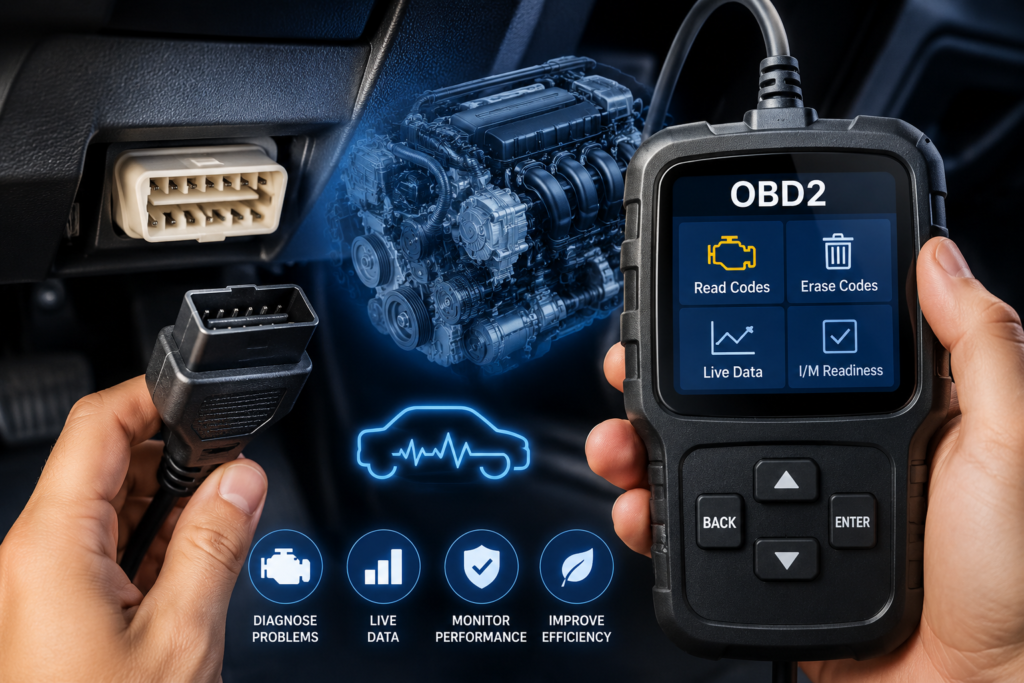
The OBD2 port is usually located inside the passenger compartment. In many vehicles, I have found it underneath the dashboard on the driver side, close to the steering column. However, its exact position can vary depending on the vehicle manufacturer and model.
The port normally has a 16 pin connector. An OBD2 scanner can be connected to this port to communicate with the vehicle’s electronic systems.
Some vehicles may have the connector behind a small cover or lower dashboard panel. If you cannot find it, checking the vehicle owner’s manual is usually the easiest option.
How Does OBD2 Work?
The basic working principle of OBD2 is quite simple. Modern vehicles have many sensors that constantly monitor different conditions. These sensors send information to electronic control modules, including the engine control unit.
The system compares sensor information with expected operating conditions. If something goes outside the acceptable range, the vehicle can record a diagnostic trouble code.
For example, the oxygen sensor monitors the oxygen content in exhaust gases. If the vehicle detects an unusual signal from this sensor or its circuit, the system may store a related trouble code.
When you connect an OBD2 scanner, the scanner communicates with the vehicle’s computer and retrieves available diagnostic information.
This information can include stored trouble codes, pending codes, sensor data and other diagnostic information depending on the vehicle and scanner.
What Are OBD2 Trouble Codes?
OBD2 trouble codes are often called Diagnostic Trouble Codes or DTCs. These codes help identify areas where the vehicle’s computer has detected a problem.
A common example is P0300, which is associated with random or multiple cylinder misfire detection. Another well known code family includes P0420, which can indicate that the catalytic converter system is not performing as expected.
However, I always recommend treating a trouble code as a starting point rather than a final diagnosis. A code does not necessarily mean that the component named in the code needs to be replaced.
For example, a sensor related code could be caused by damaged wiring, a poor electrical connection, a vacuum problem or another issue affecting the sensor reading.
That is why proper testing is important before replacing expensive parts.
What Does an OBD2 Scanner Do?
An OBD2 scanner is a diagnostic device that connects to the vehicle’s OBD2 port. Basic scanners can read and clear diagnostic trouble codes, while advanced scanners can provide much more information.
Depending on the scanner and vehicle, you may be able to view live sensor data, engine speed, coolant temperature, fuel system information and other parameters.
Some advanced diagnostic tools can also communicate with systems beyond basic engine diagnostics. The exact functions depend on the vehicle manufacturer, model year and diagnostic tool.
For everyday car owners, even a basic OBD2 scanner can be useful because it can provide a better understanding of why the check engine light has appeared.
OBD2 and the Check Engine Light
One of the most common reasons people use OBD2 is the check engine light. When the vehicle detects a problem that meets certain conditions, it may turn on the check engine light and store a diagnostic code.
A steady check engine light generally means the vehicle has detected a fault that should be checked. A flashing check engine light can indicate a more serious problem, such as an active engine misfire that could potentially damage the catalytic converter.
If the check engine light comes on, I would not recommend simply clearing the code and continuing to drive without finding the cause. Clearing a code removes useful diagnostic information but does not repair the underlying problem.
What Information Can OBD2 Provide?
The amount of information available depends on the vehicle and diagnostic scanner. However, OBD2 can provide several useful types of data.
One important category is diagnostic trouble codes. These codes give an indication of where the vehicle’s computer has detected an issue.
Another useful feature is live data. A scanner can sometimes show information from different sensors while the engine is running. This can help a technician understand how the vehicle is behaving in real time.
OBD2 can also provide information related to emissions readiness monitors. These monitors check whether certain emissions systems have completed their self tests.
This feature can be particularly useful during vehicle inspections or when checking whether a car has completed its required diagnostic tests.
Can OBD2 Diagnose Every Car Problem?
This is one area where I think people sometimes have unrealistic expectations. OBD2 is powerful, but it cannot diagnose every mechanical or electrical problem by itself.
A vehicle can have a mechanical problem without immediately storing an OBD2 trouble code. For example, certain suspension problems, brake issues or physical damage may not be detected through the standard engine diagnostic system.
Even when a code is stored, additional testing may be necessary to determine the real cause.
This is why I see OBD2 as a helpful diagnostic tool rather than a complete replacement for mechanical knowledge and professional testing.
Benefits of Using OBD2
There are several advantages to having access to an OBD2 scanner.
First, it can save time when troubleshooting. Instead of starting with no information, a technician can use the stored codes as a starting point.
Second, it can help vehicle owners understand warning lights. If the check engine light appears, reading the code can provide useful information about the affected system.
Third, OBD2 can help monitor vehicle performance. Some advanced scanners allow users to view live data and understand how different sensors are operating.
Another benefit is that OBD2 can help when buying a used car. A scanner may reveal stored or pending diagnostic codes that are not obvious during a normal visual inspection.
However, I would never rely on an OBD2 scan alone when purchasing a used vehicle. A proper mechanical inspection and road test are still very important.
OBD2 Bluetooth Scanners and Mobile Apps
Technology has made OBD2 even easier to use. There are now small Bluetooth and wireless OBD2 adapters that connect to smartphones through compatible applications.
These devices can display diagnostic codes and live vehicle information on a mobile phone. Some applications also provide additional features such as trip information, fuel related data and performance monitoring.
The quality of information depends on the adapter, application and vehicle. Some inexpensive devices may provide only basic functions, while professional equipment can offer much deeper diagnostic capabilities.
Before buying an OBD2 adapter, I recommend checking compatibility with your vehicle and smartphone.
Can You Clear an OBD2 Code?
Many OBD2 scanners allow you to clear stored trouble codes. This can turn off the check engine light if the conditions that caused the fault are no longer present.
However, clearing a code should not be considered a repair.
If the original problem still exists, the warning light may return after the vehicle performs its diagnostic checks again. In some cases, clearing codes also resets emissions readiness monitors, meaning the vehicle may need to be driven for a period of time before those tests are completed again.
For this reason, I prefer to identify and repair the underlying problem first and clear the code afterward when appropriate.
Is OBD2 Useful for Regular Car Owners?
In my opinion, yes. You do not need to be a professional mechanic to benefit from understanding OBD2.
A basic scanner can help you learn more about your vehicle and communicate more effectively with a mechanic. Instead of simply saying that a warning light appeared, you may be able to provide the diagnostic code and describe when the problem started.
This does not mean every car owner should attempt complex repairs. Some faults require professional diagnostic equipment, electrical testing and mechanical experience.
The biggest benefit is having more information.
Final Thoughts
OBD2 is an important part of modern vehicle diagnostics. It allows a car’s electronic systems to monitor various operating conditions, detect certain faults and store diagnostic information that can be accessed through a compatible scanner.
From my point of view, the most important thing to remember is that an OBD2 code is a clue, not always a complete answer. Understanding the code, checking the related components and finding the actual cause are all part of proper vehicle diagnosis.
Whether you are a car enthusiast, a regular driver or someone who simply wants to understand warning lights better, learning how OBD2 works can make vehicle ownership less confusing. A small diagnostic port under the dashboard can provide a surprising amount of useful information about what is happening inside a modern car.
As vehicles continue to become more computerized, OBD2 and other diagnostic technologies will remain important tools for maintaining, troubleshooting and understanding modern automobiles.