Related Articles

When I think about the transmission in a car, I see it as one of the most important systems after the engine. The engine produces power, but the transmission controls how that power reaches the wheels. Without a properly working transmission, a vehicle cannot use engine power efficiently or move smoothly.
Many drivers know that a car has a transmission, but they may not know what is actually inside it. Understanding the basic transmission parts can make it much easier to recognize problems, understand maintenance needs, and communicate with a mechanic.
In this article, I will explain the most important transmission parts every driver should know, what they do, and why they matter.
What Is a Transmission?
A transmission is a mechanical system that transfers power from the engine to the wheels. It changes the amount of torque and speed available at the wheels according to driving conditions.
When a car starts moving, it needs more torque and less speed. Once the vehicle is moving faster, it needs less torque and more speed. The transmission makes these changes possible by using different gear ratios.
Modern vehicles can have automatic, manual, continuously variable, or dual clutch transmissions. Although their designs are different, they all have the same basic purpose. They manage engine power and deliver it to the wheels in a useful way.
1. Transmission Gears
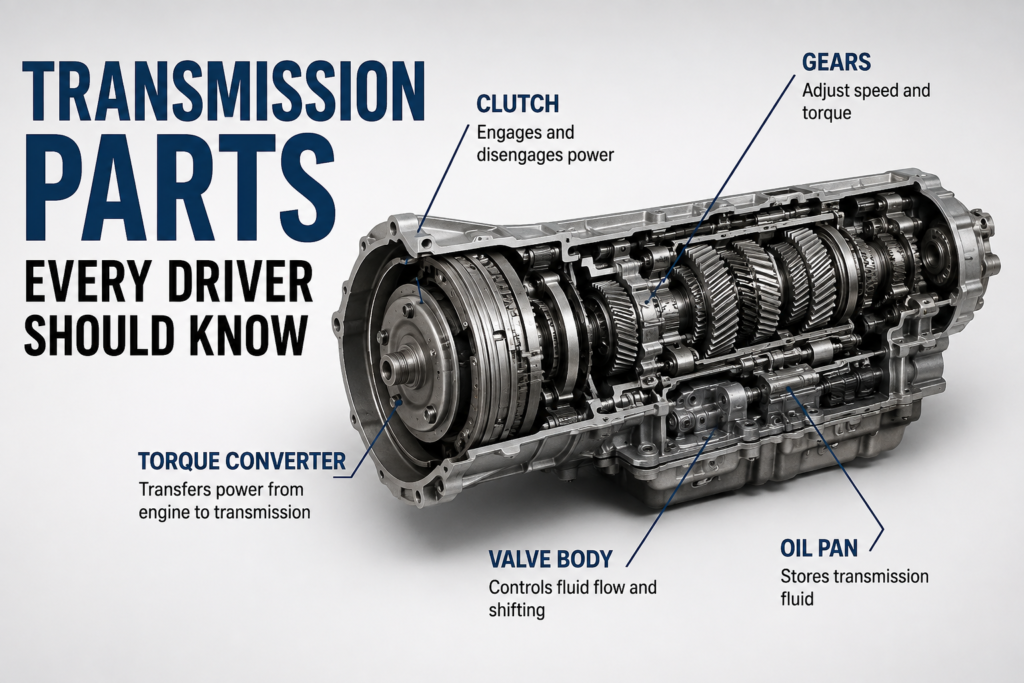
Gears are some of the most important transmission parts inside a vehicle. They control the relationship between engine speed and wheel speed.
In a traditional manual transmission, the driver selects different gears using the gear lever. Lower gears provide more torque for starting and climbing, while higher gears allow the vehicle to travel faster with lower engine speed.
Automatic transmissions also use gears, although the gear selection is controlled automatically.
If gears become damaged or worn, drivers may notice grinding, slipping, unusual noises, or difficulty changing gears. Regular transmission service can help reduce unnecessary wear.
2. Torque Converter
The torque converter is found mainly in automatic transmissions. It connects the engine to the transmission and transfers power through transmission fluid.
One thing I find interesting about the torque converter is that it allows the engine to keep running while the vehicle is stopped. This is why an automatic car can remain in Drive at a stop without immediately stalling.
The torque converter also multiplies torque when the vehicle starts moving. Inside it are several important components that work with transmission fluid to transfer power smoothly.
A damaged torque converter can cause shuddering, slipping, overheating, delayed engagement, or unusual noises.
3. Clutch
The clutch is especially important in manual transmissions. Its main job is to connect and disconnect the engine from the transmission.
When the driver presses the clutch pedal, the clutch separates the engine from the transmission. This allows the driver to change gears. When the pedal is released, the clutch connects the engine and transmission again.
The clutch contains parts such as the clutch disc, pressure plate, and release bearing.
Clutch wear is common because the friction material gradually becomes thinner. A worn clutch can cause engine RPM to increase without a matching increase in vehicle speed. This condition is commonly known as clutch slipping.
4. Transmission Fluid
Transmission fluid is one of the most important parts of transmission maintenance, even though it is not a mechanical component.
The fluid lubricates internal parts, helps control temperature, and allows hydraulic systems in automatic transmissions to operate correctly.
Different transmissions require different types of fluid. Using the wrong fluid can create serious problems, so I always recommend checking the vehicle manufacturer’s specifications before adding or replacing transmission fluid.
Old or contaminated transmission fluid can contribute to poor shifting, overheating, and internal wear.
5. Valve Body
The valve body is a major component in many automatic transmissions. I think of it as the control center of the transmission.
It contains passages, valves, and channels that direct transmission fluid to different parts of the system. This fluid pressure helps control gear changes.
Modern vehicles may also use electronic solenoids to control fluid flow. When the transmission computer decides that a gear change is needed, it sends signals that control these components.
Problems with the valve body can cause harsh shifting, delayed shifting, incorrect gear selection, or transmission warning lights.
6. Transmission Pump
The transmission pump creates the hydraulic pressure needed by an automatic transmission.
It circulates transmission fluid through the system and supplies pressure to components such as the valve body and clutch packs.
Without adequate fluid pressure, an automatic transmission cannot operate correctly. A failing transmission pump can result in delayed engagement, slipping, overheating, or complete loss of movement.
This is one reason transmission fluid level and condition should not be ignored.
7. Input Shaft
The input shaft transfers power from the engine into the transmission.
In a manual transmission, the clutch connects the engine to the input shaft. When the clutch is engaged, engine power turns the shaft and allows the transmission gears to transfer that power toward the wheels.
The input shaft is designed to handle considerable mechanical stress. Damage or excessive wear can produce vibrations, noises, or shifting problems.
8. Output Shaft
The output shaft transfers power from the transmission toward the drivetrain.
Once the transmission selects the appropriate gear ratio, power eventually reaches the output shaft. From there, it can travel through components such as the driveshaft, differential, or axle depending on the vehicle design.
A problem with the output shaft or its bearings can produce whining, vibration, or unusual mechanical noises.
9. Planetary Gear Set
Planetary gear sets are widely used in modern automatic transmissions. They are different from the simple gear arrangements many people imagine when they hear the word transmission.
A planetary gear set normally contains a sun gear, planet gears, a planet carrier, and a ring gear. By holding or driving different components, the transmission can create different gear ratios.
This compact design allows automatic transmissions to provide multiple forward gears while fitting into a relatively small housing.
10. Transmission Control Module
Modern automatic transmissions depend heavily on electronics. The transmission control module, often called the TCM, monitors information from different sensors and controls transmission operation.
It can consider factors such as vehicle speed, engine load, throttle position, and transmission temperature. Based on this information, it determines when the transmission should change gears.
If there is a problem with the control system, the vehicle may enter a protective mode. Drivers may notice warning lights, delayed shifting, or the transmission staying in one gear.
11. Solenoids
Transmission solenoids are small electrically controlled devices that regulate transmission fluid flow.
They work together with the transmission control system to control shifting. When a solenoid receives the appropriate electrical signal, it opens or closes to direct fluid pressure.
A faulty solenoid can cause hard shifts, delayed shifts, missed gears, or unexpected gear changes.
Because modern transmissions depend on several solenoids, diagnosing the exact problem often requires electronic testing rather than simply replacing the entire transmission.
12. Transmission Filter
The transmission filter helps keep contaminants out of the transmission fluid.
During normal operation, small particles can develop as internal components wear. The filter captures many of these contaminants before they circulate through sensitive components.
A clogged filter can restrict fluid flow and affect transmission performance. Some vehicles have serviceable filters, while others use different designs that require specific maintenance procedures.
Checking the manufacturer’s recommended service schedule is the best approach.
13. Transmission Pan
The transmission pan is located at the lower section of many automatic transmissions. It holds transmission fluid and provides access to certain internal components.
The pan can also collect debris and sediment. During some transmission services, the pan is removed so the fluid can be drained and the filter can be replaced.
A leaking transmission pan gasket can cause fluid loss. Since low transmission fluid can create serious operating problems, even a small leak should be investigated.
14. Bearings
Bearings support rotating transmission components and allow them to turn smoothly.
Inside a transmission, many shafts and gears rotate at high speeds. Bearings reduce friction and help keep these components correctly positioned.
Worn bearings can produce humming, whining, or grinding sounds. The noise may become louder as vehicle speed increases.
Ignoring these sounds can allow a relatively manageable problem to become more expensive.
15. Seals and Gaskets
Seals and gaskets help keep transmission fluid inside the transmission and prevent contaminants from entering.
Over time, rubber seals can become hard or damaged. Gaskets can also lose their ability to create a proper seal.
Transmission fluid leaks should never be ignored. Low fluid levels can increase friction and heat, potentially causing significant internal damage.
Common Transmission Problems Drivers Should Notice
Knowing the transmission parts is useful, but knowing the warning signs is equally important.
If your vehicle hesitates before moving, slips between gears, makes unusual noises, or shifts very harshly, the transmission may need attention.
Other warning signs include burning smells, leaking fluid, delayed gear engagement, vibration during acceleration, and a transmission warning light.
I believe one of the biggest mistakes drivers make is waiting until a vehicle stops moving before getting a transmission problem checked. Small symptoms can sometimes provide an early warning.
How to Take Care of Transmission Parts
Transmission maintenance depends on the vehicle and transmission type, but a few basic habits are useful.
First, check the owner’s manual for the correct transmission fluid and service intervals. Never assume every vehicle uses the same fluid.
Second, pay attention to fluid leaks. A transmission should not regularly lose fluid.
Third, avoid aggressive driving when the transmission is cold. Giving the vehicle a little time to warm up can help the fluid circulate properly.
For manual vehicles, avoid unnecessary clutch slipping. Keeping your foot resting on the clutch pedal can also create unnecessary wear.
Finally, do not ignore strange sounds or changes in shifting behavior. Getting a problem diagnosed early can potentially save money.
Final Thoughts
The transmission may look complicated from the outside, but understanding its main parts makes the system much easier to appreciate. Gears, the torque converter, clutch, transmission fluid, valve body, pump, shafts, solenoids, filters, bearings, seals, and electronic controls all have important jobs.
From my point of view, every driver does not need to become a transmission specialist. However, knowing the basics can help you understand your vehicle better and recognize problems before they become major repairs.
A well maintained transmission can provide smooth power delivery, better driving comfort, and reliable performance. Paying attention to fluid condition, leaks, unusual noises, and shifting behavior is one of the simplest ways to protect this important part of your vehicle.
When you understand the transmission parts every driver should know, you are better prepared to maintain your car, describe problems accurately, and make more informed decisions when repairs are needed.