Related Articles

When I think about the drivetrain of a car, the differential is one of those parts that does a very important job without getting much attention. Most drivers know that the engine produces power and the wheels use that power to move the car, but the differential is what helps the driven wheels work together properly, especially when the vehicle turns.
A differential allows the wheels on the same axle to rotate at different speeds while still receiving engine power. This simple idea makes a huge difference in vehicle handling, tire life, and drivetrain performance.
In this article, I will explain what a differential is, how a differential works, its main parts, different types of differentials, common problems, and why proper maintenance matters.
What Is a Differential?
A differential is a mechanical component found in the drivetrain of a vehicle. Its main purpose is to transfer engine power to the drive wheels while allowing those wheels to rotate at different speeds.
This difference in wheel speed becomes especially important when the vehicle turns. During a turn, the outside wheel travels a longer distance than the inside wheel. Because of this, the outside wheel needs to rotate faster.
If both wheels were forced to rotate at exactly the same speed, the tires would have to slip across the road during turns. This could cause uneven tire wear, poor handling, noise, and unnecessary stress on drivetrain components.
The differential solves this problem by allowing the drive wheels to rotate at different speeds when necessary.
From my point of view, this is one of the smartest mechanical solutions used in a traditional vehicle drivetrain. The system is relatively simple, but it makes normal driving much smoother.
How Does a Differential Work?
To understand how a differential works, imagine your car moving straight on a flat road. In this situation, both driven wheels usually travel approximately the same distance and can rotate at nearly the same speed.
The engine sends power through the transmission and driveshaft, depending on the vehicle design. That power eventually reaches the differential. Inside the differential are several gears that distribute power toward the two axle shafts.
When the car continues straight, the internal gears generally rotate together without creating a major speed difference between the wheels.
Now imagine turning the steering wheel to make a corner. The outside wheel has to travel farther than the inside wheel. The differential allows the outside wheel to rotate faster and the inside wheel to rotate slower.
This happens automatically through the movement of the differential gears.
The important thing is that the differential does not simply send power to one wheel and ignore the other. Instead, it manages the relationship between the two wheels so the vehicle can turn naturally.
Main Parts of a Differential
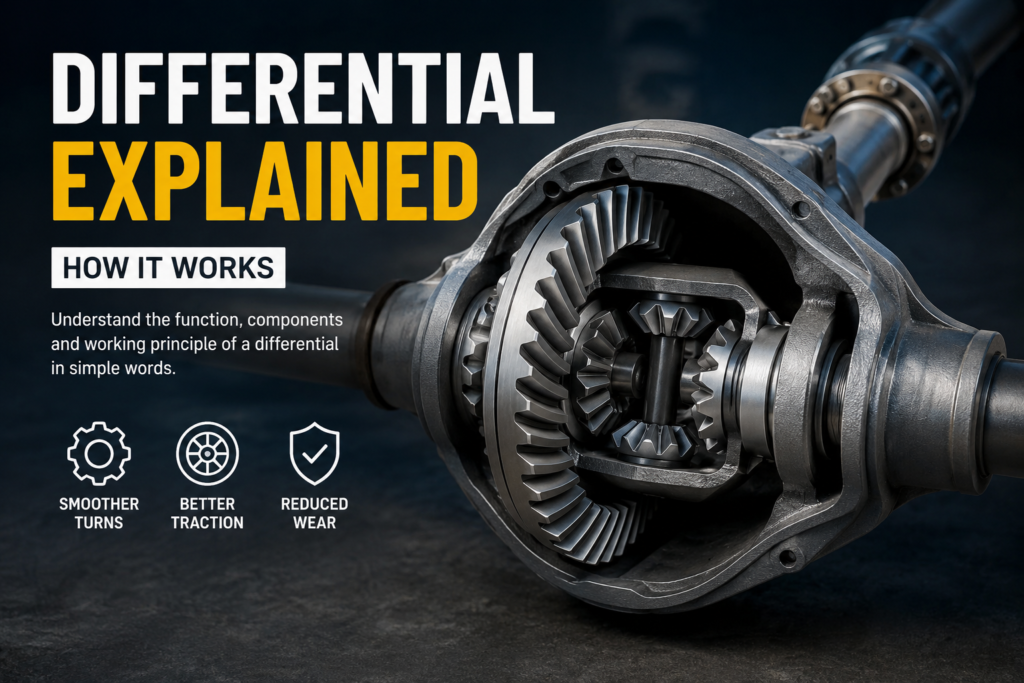
A differential contains several important components that work together. The exact design can vary depending on the vehicle, but the basic parts are similar.
Ring Gear
The ring gear is a large gear connected to the differential assembly. It receives rotational force from the pinion gear and transfers that force into the differential carrier.
The ring gear also helps create the final drive ratio that affects the relationship between engine speed and wheel speed.
Pinion Gear
The pinion gear receives power from the driveshaft in many rear wheel drive vehicles. It meshes with the ring gear and changes the direction of power flow.
The relationship between the pinion gear and ring gear is extremely important for proper drivetrain operation.
Differential Carrier
The differential carrier holds several internal gears and rotates with the ring gear. It provides the structure needed for the differential gears to distribute power between the axle shafts.
Side Gears
Side gears connect the internal differential mechanism to the axle shafts. They allow the two wheels to receive rotational force while still being able to rotate at different speeds.
Spider Gears
Spider gears are small gears located inside the differential carrier. They play an important role when there is a difference in speed between the two wheels.
When the vehicle is moving straight, their movement is limited. During a turn, they rotate in a way that allows the side gears to operate at different speeds.
Bearings
Bearings support the rotating components inside the differential. They help reduce friction and maintain correct positioning of the gears.
Worn bearings can create noticeable noise and can eventually contribute to more serious differential damage.
Differential Fluid
Differential fluid lubricates the gears and bearings inside the differential housing. It reduces friction, carries heat away, and protects the internal components from excessive wear.
Using the correct fluid is important because different differential designs may require different lubricant specifications.
Why Does a Car Need a Differential?
The biggest reason a car needs a differential is simple. The drive wheels do not always need to rotate at the same speed.
Think about making a tight corner. The inside wheel follows a smaller circle, while the outside wheel follows a larger circle. The outside wheel therefore needs to cover more distance.
If both wheels were locked together and forced to turn at the same speed, one or both tires would need to slip.
This can be particularly noticeable on dry pavement. You may experience tire scrubbing, steering resistance, or unusual tire wear.
A differential allows the wheels to accommodate this difference naturally. This makes cornering smoother and reduces unnecessary stress on the tires and drivetrain.
Types of Differentials
There are several types of differentials used in modern vehicles. Each design has advantages and disadvantages.
Open Differential
The open differential is one of the most common designs. It allows the two drive wheels to rotate at different speeds very easily.
For normal road driving, this design works well and provides smooth cornering. However, it has an important weakness.
If one wheel loses traction, the differential can allow that wheel to spin while the other wheel receives limited usable torque. This can make it difficult for the vehicle to move on slippery surfaces.
Limited Slip Differential
A limited slip differential is designed to reduce excessive wheel spin. It allows a difference in wheel speed during normal cornering but can limit that difference when one wheel begins losing traction.
This design is popular in performance vehicles, off road vehicles, and vehicles where better traction is important.
From my perspective, a limited slip differential provides a useful balance between comfortable cornering and improved traction.
Locking Differential
A locking differential can mechanically lock the two axle shafts together so both wheels receive equal rotational speed.
This can be very useful in off road conditions where one wheel may have very little traction. Locking the differential can help deliver power to both wheels and improve the vehicle’s ability to move through difficult terrain.
Electronic Differential Systems
Modern vehicles may use electronic systems to control wheel speed and traction. Sensors monitor wheel behavior and the vehicle control system can apply braking or adjust engine torque when wheel spin is detected.
These systems can work alongside traditional differentials to improve stability and traction.
Common Signs of Differential Problems
Like any mechanical component, a differential can develop problems over time. Recognizing the early signs can help prevent expensive repairs.
Whining Noise
A whining sound from the drivetrain can be a sign of gear wear, incorrect gear adjustment, or insufficient lubrication.
The noise may become more noticeable when accelerating or decelerating.
Grinding or Humming
Grinding, humming, or rumbling noises may indicate worn gears or bearings. If the sound becomes louder with vehicle speed, it is worth having the drivetrain inspected.
Fluid Leaks
Differential fluid leaks should not be ignored. Low fluid levels can increase friction and heat inside the housing.
A leak may develop around a seal, gasket, axle area, or other connection point.
Vibrations
Unusual vibrations can sometimes be related to differential problems, although driveshafts, axle shafts, wheel bearings, and tires can also cause similar symptoms.
A proper inspection is important before replacing parts.
Difficulty Turning
If a differential is damaged or has an internal problem, the vehicle may behave differently during turns. You may notice unusual resistance, noises, or jerking.
These symptoms should be checked before the problem becomes more serious.
Differential Maintenance
Differential maintenance is often overlooked because drivers usually do not think about the differential until something goes wrong.
One of the most important maintenance tasks is checking the differential fluid. The correct service interval depends on the vehicle, driving conditions, and manufacturer recommendations.
If the vehicle is regularly used for towing, heavy loads, off road driving, or severe conditions, the differential may experience more stress.
During maintenance, the fluid should be checked for proper level and condition. If the fluid is contaminated or has signs of excessive wear, replacement may be necessary.
It is also important to use the correct type of differential fluid. Using an unsuitable lubricant can affect the operation of certain differential designs, particularly limited slip systems.
Differential vs Axle
The differential and axle are related, but they are not exactly the same thing.
The differential is the mechanism that distributes power and allows the drive wheels to rotate at different speeds. The axle shafts transfer that rotational force from the differential toward the wheels.
In many modern vehicles, the differential and axle components are integrated into a larger drivetrain assembly.
Understanding this difference makes it easier to diagnose drivetrain problems because a noise from the axle area does not automatically mean the differential itself has failed.
How a Differential Improves Driving
A properly working differential makes a vehicle easier and more comfortable to drive.
When you turn a corner, the differential allows the inside and outside wheels to rotate at the speeds they need. This reduces tire scrubbing and helps maintain smooth vehicle movement.
It also protects drivetrain components from unnecessary stress.
Without a differential, everyday cornering would be much more difficult. Tires would be forced to slide or slip, especially during tighter turns.
This is why the differential is such an important part of the drivetrain even though most drivers never see it.
Final Thoughts
A differential may look complicated when you first see all of its gears, bearings, and internal components, but its basic purpose is easy to understand. It transfers engine power to the drive wheels while allowing those wheels to rotate at different speeds.
The differential becomes especially important when a vehicle turns because the inside and outside wheels travel different distances.
There are several differential designs, including open differentials, limited slip differentials, locking differentials, and electronically controlled systems. Each one is designed for a particular balance of traction, comfort, performance, and control.
In my view, understanding the differential is useful for anyone who wants to understand how a car actually transfers power to the road. Paying attention to differential noises, fluid leaks, vibrations, and maintenance requirements can also help protect the drivetrain and avoid expensive repairs.
A differential may not be the most visible part of a vehicle, but it plays a major role every time you accelerate, turn a corner, or drive on a changing road surface.