
Related Articles


When people talk about vehicle drivetrain parts, the words driveshaft and axle are sometimes used as if they mean the same thing. I have noticed this confusion quite often, especially when someone is trying to understand how power gets from the engine to the wheels. Although both parts are involved in transferring power and helping a vehicle move, they perform different jobs and are designed for different positions in the drivetrain.
In this article, I will explain the difference between a driveshaft and an axle in simple terms. I will also cover how each component works, where it is found, common problems, and why understanding the difference can help when diagnosing vehicle issues.
What Is a Driveshaft?
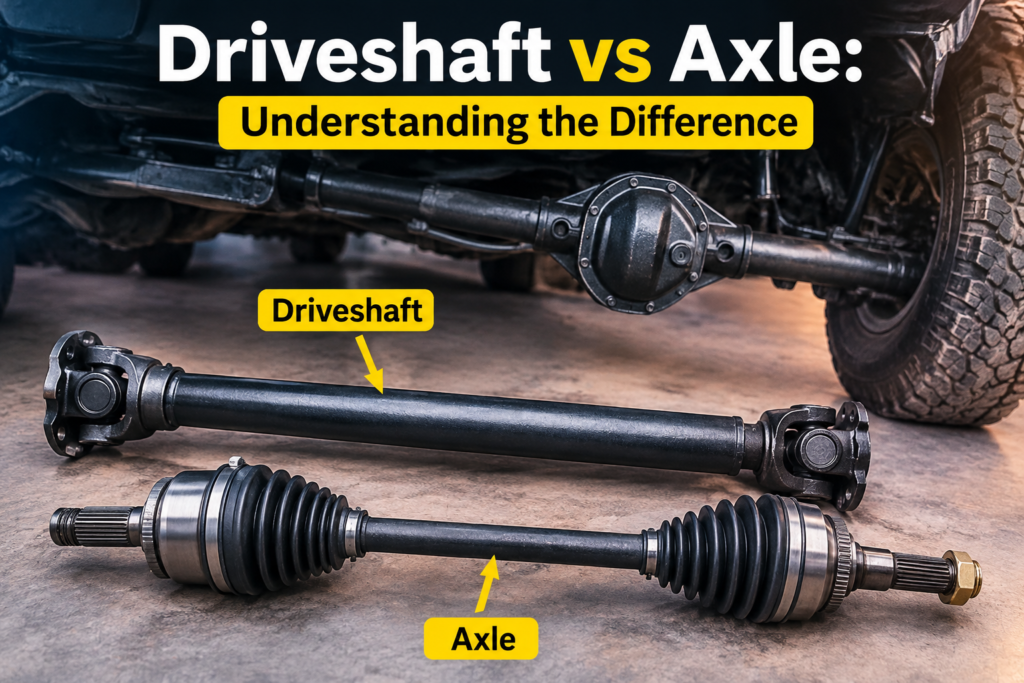
A driveshaft is a rotating mechanical component that transfers power from the transmission or transfer case to another part of the drivetrain. It is commonly found in rear wheel drive, four wheel drive, and all wheel drive vehicles.
The driveshaft is usually a long metal tube or shaft located underneath the vehicle. In a typical rear wheel drive car, the driveshaft connects the transmission to the rear differential. The differential then sends that power to the rear wheels.
One thing I find important to understand is that the driveshaft does not normally connect directly to the wheel. Its main job is to carry rotational power from one location to another.
Driveshafts can be made from steel, aluminum, or other strong materials. They need to handle considerable torque while spinning at high speeds. Depending on the vehicle design, a driveshaft may use universal joints, constant velocity joints, flexible couplings, or center support bearings.
What Is an Axle?
An axle is a component that connects the wheels to the vehicle drivetrain and helps transfer driving force to the wheels. The exact design depends on the type of vehicle and its drivetrain layout.
When most people hear the word axle, they imagine a solid shaft running between two wheels. That description is accurate for some vehicles, but modern vehicles use several different axle designs.
For example, many front wheel drive vehicles use CV axles. These axles connect the transmission or differential to the front wheels. They have constant velocity joints that allow the wheels to receive power while also moving up and down with the suspension and turning left or right.
In simple terms, an axle is much closer to the wheels than a driveshaft in many drivetrain layouts.
Driveshaft vs Axle: The Main Difference
The easiest way to understand the difference is to look at their position and purpose.
A driveshaft generally transfers rotational power over a longer distance between major drivetrain components. An axle transfers power to the wheels and supports or works with the wheel assembly depending on the design.
In a traditional rear wheel drive vehicle, the power path can look like this:
Engine → Transmission → Driveshaft → Differential → Axles → Wheels
This simple sequence makes the difference much easier to understand.
The driveshaft carries power from the transmission to the differential. The differential then distributes that power through the axle shafts to the wheels.
In a front wheel drive vehicle, the layout is different. The transmission and differential are usually combined into a transaxle, and CV axles transfer power from the transaxle to the front wheels.
So, while both components transfer rotational power, their location and role within the drivetrain are different.
How Does a Driveshaft Work?
The driveshaft receives rotational power from the transmission or transfer case. It then rotates and sends that power toward the differential or another drivetrain component.
One challenge with driveshafts is that they need to work even though the drivetrain components are not completely fixed in relation to each other. The suspension moves, the vehicle body flexes slightly, and the rear axle assembly can change position.
This is why driveshafts often use joints that allow controlled movement while the shaft continues rotating.
Universal joints are common on many rear wheel drive vehicles. Some vehicles use CV joints instead. A driveshaft may also have a slip joint that allows the shaft to change length slightly as the suspension moves.
Because the driveshaft spins rapidly, balance is extremely important. Even a small amount of imbalance can create vibration that becomes more noticeable as vehicle speed increases.
How Does an Axle Work?
An axle transfers driving force to the wheels. Its design depends heavily on whether it is used with a solid axle, independent suspension, front wheel drive system, rear wheel drive system, or all wheel drive system.
A CV axle is a good example. It normally has an inner CV joint and an outer CV joint. These joints allow the axle to operate at changing angles while maintaining smooth power delivery.
The outer CV joint allows the wheel to turn for steering. The inner joint accommodates changes caused by suspension movement.
The axle shaft itself transfers rotational force between these joints.
This is one reason CV axles are so important in modern front wheel drive vehicles. They have to deal with power, steering movement, suspension travel, and continuous rotation at the same time.
Where Is the Driveshaft Located?
The location of a driveshaft depends on the vehicle.
In a rear wheel drive vehicle, you will usually find it running from the transmission toward the rear differential. It is positioned underneath the center of the vehicle.
In four wheel drive and some all wheel drive vehicles, there can be more than one driveshaft. One may send power toward the front drivetrain while another sends power toward the rear.
Front wheel drive cars generally do not use a traditional long driveshaft running from the front of the vehicle to the rear because the engine, transmission, differential, and driven wheels are usually grouped together near the front.
Where Is the Axle Located?
Axles are located much closer to the wheels.
On a front wheel drive vehicle, the CV axles run from the transaxle to the front wheel hubs. On many independent rear suspension vehicles, rear axle shafts connect the differential to the rear wheel assemblies.
Traditional solid axle vehicles have a different arrangement. The axle housing can contain the differential and axle shafts, and the entire assembly can move with the suspension.
This shows why the word axle can describe several different designs. It is better to look at the vehicle’s specific drivetrain rather than assuming every axle looks the same.
Common Driveshaft Problems
Driveshaft problems can produce noticeable symptoms. One common warning sign is vibration, particularly at certain vehicle speeds. A damaged universal joint can also create a clunking noise when shifting between drive and reverse or when accelerating and releasing the accelerator.
Other possible driveshaft problems include damaged support bearings, worn joints, loose connections, and physical damage to the shaft.
A driveshaft can also develop balance problems. If the shaft becomes bent or loses a balancing weight, the resulting vibration can become uncomfortable and may eventually affect other drivetrain components.
From my point of view, unusual vibration underneath a vehicle should not be ignored. It is better to have the drivetrain inspected before a small problem becomes a more expensive repair.
Common Axle Problems
CV axle problems are also fairly common, especially as vehicles accumulate mileage.
One of the most recognizable signs is a clicking or popping sound while turning, particularly when accelerating through a turn. This can indicate wear in an outer CV joint.
A damaged CV boot is another common problem. The rubber boot protects the joint from dirt and keeps grease inside. If the boot cracks or tears, grease can escape and contaminants can enter the joint.
You may notice grease around the inside of a wheel or near the axle area when a CV boot has failed.
Other symptoms can include vibration during acceleration, clicking noises, unusual movement, or difficulty transferring power smoothly.
Driveshaft and Axle Maintenance
Neither component should be treated as a completely maintenance free part. Regular inspections can help identify problems before they become serious.
During routine servicing, it is useful to check driveshaft joints, mounting points, boots, seals, and support bearings where applicable.
For CV axles, inspecting the rubber boots is particularly important. A small boot crack may seem insignificant, but replacing a damaged boot early can sometimes prevent damage to the expensive CV joint.
It is also important to use the correct replacement parts. Driveshaft dimensions, joint types, axle lengths, spline counts, and mounting designs can vary significantly between vehicles.
Which One Is More Important?
I would not say that one is more important than the other because they perform different jobs. A vehicle needs its drivetrain components to work together properly.
A damaged driveshaft can prevent power from reaching the differential. A damaged axle can prevent power from reaching the wheel correctly.
The best way to think about the system is as a chain. The engine creates power, the transmission manages that power, the driveshaft or related components move it through the drivetrain, the differential distributes it, and the axles transfer it to the wheels.
If one important link in that chain fails, the vehicle may not operate correctly.
Driveshaft vs Axle: Quick Comparison
A driveshaft is generally a longer rotating shaft used to transfer power between major drivetrain components. An axle is generally located closer to the wheels and transfers power to the wheel assemblies.
Driveshafts commonly use universal joints, CV joints, slip joints, or support bearings depending on the vehicle. Axles may use CV joints, axle shafts, splines, and protective boots.
Driveshaft problems often cause vibration, clunking, or drivetrain noise. Axle problems commonly cause clicking during turns, vibration during acceleration, or grease leakage from damaged CV boots.
Both components are essential, but their functions are not identical.
Final Thoughts
Understanding the difference between a driveshaft and an axle makes vehicle drivetrain problems much easier to understand. The driveshaft mainly moves rotational power between drivetrain components, while the axle transfers that power closer to or directly to the wheels.
The exact design can vary from one vehicle to another, so it is always worth checking the specific drivetrain layout before diagnosing a problem. A rear wheel drive vehicle, front wheel drive car, four wheel drive truck, and all wheel drive crossover can all use these components in different ways.
In my view, knowing these basic differences is useful even if you are not a professional mechanic. When you understand where the driveshaft and axle are located and what each one does, unusual noises, vibrations, damaged boots, and other symptoms become easier to describe and investigate.
Most importantly, do not ignore new drivetrain noises or vibrations. Getting the vehicle inspected early can help identify worn components before they cause additional damage and turn a relatively simple repair into a much larger one.