
Related Articles



When I think about the important sensors inside a modern car engine, the mass airflow sensor is one of the parts that deserves more attention. It may look like a small and simple component, but it plays an important role in helping the engine run properly. If this sensor starts giving incorrect information, the engine may experience poor fuel economy, rough idling, weak acceleration, or other performance problems.
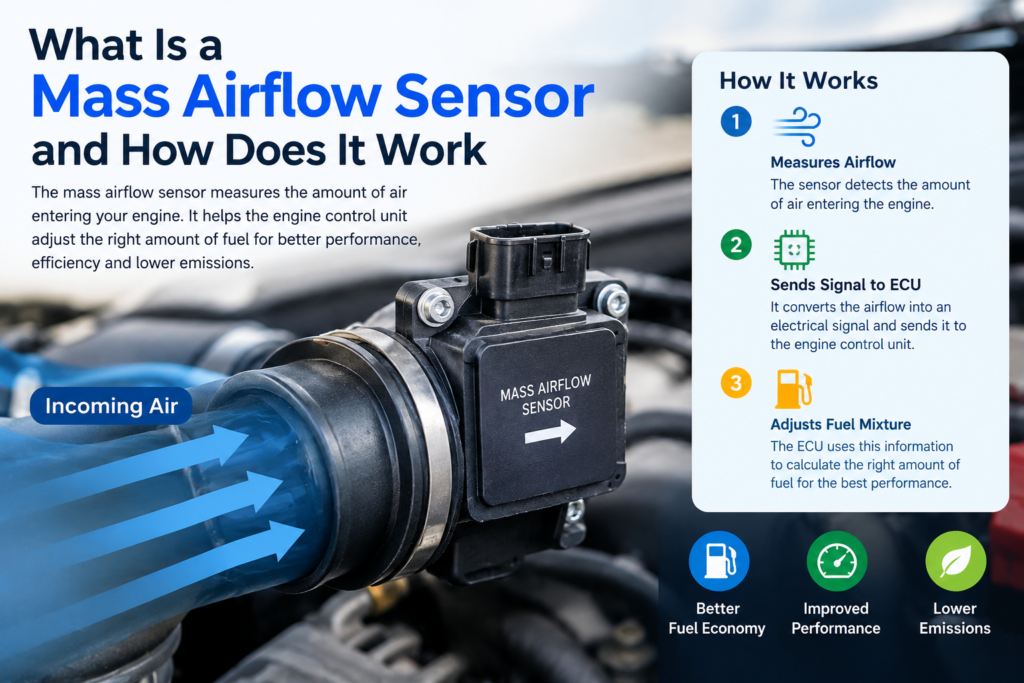
In simple words, a mass airflow sensor measures the amount of air entering the engine. The engine control unit uses this information to determine how much fuel should be delivered to the engine. This process helps maintain the correct air and fuel mixture for combustion.
In this article, I will explain what a mass airflow sensor is, how it works, where it is located, why it is important, and what signs can indicate that it may be having a problem.
What Is a Mass Airflow Sensor?
A mass airflow sensor, commonly called a MAF sensor, is an electronic device that measures the amount of air entering an engine. It is normally installed in the air intake system between the air filter housing and the engine intake.
The main job of the MAF sensor is to measure incoming air and provide this information to the engine control unit. The engine control unit then uses the information to calculate the appropriate amount of fuel needed for combustion.
From my point of view, this is one of the best examples of how modern engines depend on electronic sensors. Instead of relying only on mechanical components, the engine continuously receives information from different sensors and makes adjustments while the vehicle is running.
The MAF sensor is especially important because the amount of air entering an engine changes constantly. When you press the accelerator, airflow increases. When the engine is idling, airflow is much lower. The sensor helps the computer understand these changes.
How Does a Mass Airflow Sensor Work?
The working principle of a mass airflow sensor is actually quite interesting. Most modern MAF sensors use a heated wire or heated film to measure airflow.
Inside the sensor is a very small sensing element. When the engine is running, air passes over this element. The sensor monitors how much heat is removed by the incoming air.
When more air passes through the intake, more heat is carried away from the sensing element. The electrical system inside the sensor detects this change and converts it into a signal.
This signal is then sent to the engine control unit. The computer uses the information to determine the amount of air entering the engine and adjusts fuel delivery accordingly.
The process happens continuously while the engine is running. This means the computer can respond to changes in engine load, acceleration, and driving conditions.
Why Is the Mass Airflow Sensor Important?
The correct air and fuel mixture is extremely important for efficient combustion. An engine needs the right amount of air and fuel to operate properly.
If the engine receives too much fuel compared with the available air, the mixture can become too rich. If there is too much air compared with the amount of fuel, the mixture can become too lean.
The mass airflow sensor helps the engine control unit make better decisions about fuel delivery.
A properly working MAF sensor can contribute to smooth engine operation, good fuel economy, proper acceleration, and controlled emissions.
I personally consider the MAF sensor an important part of engine management because even a small measurement error can affect several aspects of vehicle performance.
Where Is the MAF Sensor Located?
The exact location can vary depending on the vehicle, but the mass airflow sensor is usually found in the engine air intake system.
If you follow the large intake tube from the air filter toward the engine, you will often find the MAF sensor installed somewhere along this path.
Many MAF sensors have an electrical connector attached to them. Their housing is designed to allow incoming air to pass through while the sensing element measures the airflow.
The exact design is different between vehicle manufacturers, so it is always better to check the vehicle service manual before attempting to remove or inspect the sensor.
Common Symptoms of a Bad Mass Airflow Sensor
A faulty or contaminated MAF sensor can cause several noticeable symptoms. These symptoms can sometimes be confused with other engine problems, so proper diagnosis is important.
Poor Fuel Economy
One common sign is a noticeable reduction in fuel economy. If the sensor sends incorrect airflow information to the engine computer, fuel delivery may not be properly optimized.
If I noticed that my vehicle was suddenly using more fuel than usual without a major change in driving habits, I would consider checking the air intake system and MAF sensor as part of the diagnosis.
Rough Engine Idle
A dirty or malfunctioning MAF sensor can sometimes cause an unstable or rough idle.
You may notice that the engine shakes, the RPM fluctuates, or the engine feels less smooth when the vehicle is stopped.
Weak Acceleration
Another possible symptom is poor acceleration. If the engine computer does not receive accurate airflow information, fuel delivery may not be correctly matched to the amount of air entering the engine.
This can make the vehicle feel less responsive when accelerating.
Engine Stalling
In some cases, a serious MAF sensor problem can contribute to engine stalling. The problem may be more noticeable when the engine is idling or when the vehicle is coming to a stop.
However, stalling can have many different causes, so I would not automatically blame the MAF sensor without proper testing.
Check Engine Light
A problem with the MAF sensor or its circuit can trigger the check engine light. Modern vehicles monitor sensor signals and may store a diagnostic trouble code when the readings are outside expected limits.
A diagnostic scanner can help identify whether the vehicle computer has detected a problem related to the MAF system.
What Causes a Mass Airflow Sensor to Fail?
One of the most common problems is contamination. Dust, dirt, oil vapor, and other particles can eventually affect the sensing element.
A damaged air filter or an improperly sealed intake system can allow unwanted particles to reach the sensor.
Electrical problems can also cause issues. A damaged connector, wiring problem, poor electrical connection, or internal sensor failure may prevent the MAF sensor from providing the correct signal.
Another possibility is an air intake leak. If unmetered air enters the engine after the MAF sensor, the computer may not have an accurate picture of the total amount of air reaching the engine.
This is why I think it is important to diagnose the entire intake system instead of immediately replacing the sensor.
Can a Dirty MAF Sensor Be Cleaned?
In some situations, a contaminated MAF sensor may be cleaned using a product specifically designed for MAF sensors. However, care is extremely important because the sensing element can be delicate.
I would avoid touching the sensing element with fingers, cloth, or tools. Using the wrong cleaning product or handling the sensor incorrectly can cause damage.
Before cleaning a MAF sensor, it is better to follow the vehicle manufacturer’s service instructions. If you are not comfortable working with engine sensors, professional inspection is a safer option.
Cleaning may help when contamination is the cause, but it will not repair an electrically damaged or internally failed sensor.
MAF Sensor vs MAP Sensor
The MAF sensor and MAP sensor are both used by modern engine management systems, but they measure different things.
A MAF sensor measures the amount of air entering the engine. A MAP sensor measures pressure inside the intake manifold.
Some vehicles use a MAF sensor, some use a MAP sensor, and some engine systems use information from both.
The purpose of these sensors is to provide the engine computer with information that helps it calculate engine conditions and control fuel delivery and other functions.
How to Maintain a Mass Airflow Sensor
There is usually no complicated maintenance routine required for a MAF sensor. However, keeping the air intake system in good condition can help.
I would start by using a good quality air filter and replacing it according to the vehicle manufacturer’s recommended service schedule.
It is also important to inspect the air intake system for cracks, loose connections, or damaged hoses. A properly sealed intake system helps prevent unwanted air and contaminants from entering the engine.
Avoid unnecessary handling of the sensor. If the sensor needs cleaning, use the correct cleaning method and follow the manufacturer’s instructions.
Should You Replace a MAF Sensor Yourself?
Replacing a MAF sensor can be relatively straightforward on some vehicles because it may be held in place with a few fasteners and an electrical connector.
However, the exact procedure depends on the vehicle. Before replacing it, I would first confirm that the sensor is actually the cause of the problem.
A check engine light, poor fuel economy, or rough running does not automatically mean the MAF sensor is defective. Problems with the air filter, intake hoses, wiring, vacuum system, fuel system, or other sensors can create similar symptoms.
Proper diagnosis can prevent unnecessary replacement and save money.
Final Thoughts
The mass airflow sensor is a small but important part of a modern vehicle’s engine management system. Its primary job is to measure the amount of air entering the engine and send this information to the engine control unit.
The computer uses this information to help determine the appropriate fuel delivery. When everything is working correctly, the system can support smooth engine operation, efficient fuel use, good performance, and controlled emissions.
From my perspective, understanding the MAF sensor is useful for anyone who wants to learn more about car maintenance. It also helps explain why modern vehicles can automatically adjust their operation under different driving conditions.
If you experience symptoms such as poor fuel economy, rough idling, weak acceleration, or a check engine light, the MAF sensor can be one possible area to investigate. However, proper diagnosis is always important because similar symptoms can come from many different engine problems.
Keeping the air filter, intake system, wiring, and related components in good condition is a simple way to support the reliable operation of the mass airflow sensor and the engine as a whole.