
Related Articles


When I think about how modern cars manage to start easily, deliver smooth power, save fuel, and control emissions at the same time, one component that stands out is the Engine Control Module. It is often called an ECM, and in many vehicles people also use the term Engine Control Unit or ECU. This small computer plays a very important role in the operation of a modern engine.
In my view, understanding the Engine Control Module makes it much easier to understand how today’s vehicles work. A car engine is no longer controlled only by mechanical parts. Electronic sensors and computer systems constantly collect information, process it, and make adjustments while the engine is running.
In this article, I will explain what an Engine Control Module is, how it works, what it controls, and what can happen when it develops a problem.
What Is an Engine Control Module?
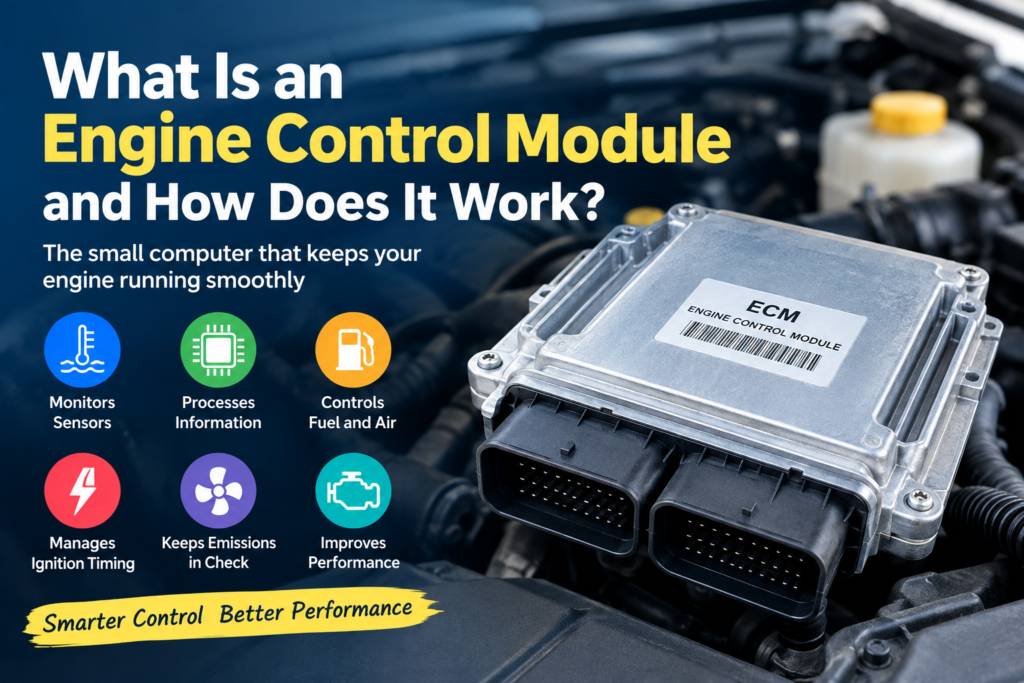
An Engine Control Module is an electronic computer that controls and monitors many important engine functions. It receives information from different sensors installed throughout the vehicle. After receiving this information, the ECM processes it using programmed instructions and sends commands to different engine components.
I like to think of the ECM as the brain of the engine. The sensors act like its eyes and ears, while various actuators carry out the commands that the ECM sends.
For example, the ECM can determine how much fuel the engine needs based on information such as engine temperature, air flow, throttle position, and engine speed. It can then adjust fuel injection to help the engine operate efficiently.
The exact functions of an ECM vary between vehicles, but its main purpose is to keep the engine running properly under different driving conditions.
How Does an Engine Control Module Work?
The working process of an Engine Control Module can be understood in three basic steps. First, it collects information. Second, it processes that information. Third, it sends commands.
When the engine is running, sensors continuously monitor different conditions. These sensors send electrical signals to the ECM. The module compares the information with its programmed data and calculates what the engine needs.
The ECM may then adjust fuel injection, ignition timing, idle speed, and other functions.
This process happens extremely quickly. The ECM can make many decisions while you are accelerating, braking, cruising, or sitting at a traffic light.
That is one reason modern engines can respond smoothly to changing driving conditions.
Sensors Used by the Engine Control Module
The Engine Control Module depends heavily on sensors. Without accurate sensor information, it would have difficulty controlling the engine correctly.
One important sensor is the mass airflow sensor. It measures the amount of air entering the engine. The ECM uses this information to help determine the appropriate amount of fuel.
The throttle position sensor tells the ECM how far the throttle is open. When you press the accelerator, the ECM can use this information along with other sensor readings to adjust engine operation.
The engine coolant temperature sensor measures the temperature of the engine coolant. This information helps the ECM determine how the engine should operate during cold starts and normal operating temperatures.
The oxygen sensor monitors oxygen levels in the exhaust. The ECM uses this information to adjust the air and fuel mixture and help control emissions.
The crankshaft position sensor and camshaft position sensor provide information about engine position and speed. This information is extremely important for proper fuel injection and ignition timing.
There are many other sensors depending on the vehicle, but these examples show how much information the ECM receives while the engine is running.
What Does an Engine Control Module Control?
The ECM can control many different engine functions. One of its most important responsibilities is fuel injection.
Modern engines need a carefully controlled mixture of air and fuel. Too much fuel can reduce fuel economy and increase emissions. Too little fuel can cause poor performance or other running problems. The ECM constantly adjusts fuel delivery according to operating conditions.
Another important function is ignition timing. The ECM determines when the spark plugs should fire in gasoline engines. Correct ignition timing helps the engine produce power efficiently.
The ECM can also help control idle speed. When your vehicle is stopped but the engine remains running, the module monitors engine conditions and adjusts systems that help maintain a stable idle.
It may also control components related to emissions, cooling, turbocharging, and other engine systems depending on the vehicle design.
Why Is the Engine Control Module Important?
I consider the ECM one of the most important electronic components in a modern vehicle because it helps different engine systems work together.
Without electronic engine management, it would be much more difficult to achieve the combination of performance, fuel economy, reliability, and emissions control expected from modern cars.
The ECM constantly responds to changes. For example, driving uphill requires different engine behavior than driving on a flat road. Starting a cold engine also requires different settings compared with driving after the engine reaches normal temperature.
The ECM makes these adjustments automatically, so the driver does not have to manually control them.
Common Symptoms of a Bad Engine Control Module
An ECM can experience problems, although many engine issues that appear to be related to the ECM are actually caused by sensors, wiring, connectors, power problems, or other components.
One possible warning sign is a check engine light. The ECM monitors the engine and can store diagnostic trouble codes when it detects abnormal conditions.
Another possible symptom is difficulty starting the vehicle. If the ECM cannot properly communicate with important engine components, starting and engine operation can be affected.
Poor fuel economy can also occur when engine management is not working correctly. However, fuel economy problems can have many different causes, so the ECM should not automatically be blamed.
Other possible symptoms include rough idling, poor acceleration, unexpected stalling, reduced engine performance, or unusual engine behavior.
Electrical problems can sometimes create symptoms that look like ECM failure. This is why proper diagnosis is important before replacing an expensive control module.
How Is an Engine Control Module Diagnosed?
When I would investigate an ECM related problem, I would not immediately assume that the module itself needs replacement. A proper diagnostic process is much more reliable.
A mechanic can connect a diagnostic scanner to the vehicle’s diagnostic port and check for stored trouble codes. These codes can provide useful information about the system that has detected a problem.
However, a trouble code does not always mean that the related component is defective. For example, a sensor code could be caused by damaged wiring, a poor electrical connection, or another engine problem.
Technicians may also check battery voltage, fuses, grounds, wiring, connectors, sensor readings, and communication between control modules.
This step by step approach can prevent unnecessary parts replacement.
Can an Engine Control Module Be Repaired?
In some situations, an ECM may be repairable, while in other cases replacement may be the better option. It depends on the type of failure and the vehicle.
Some problems may involve damaged connectors, electrical issues, or internal electronic components. Specialized automotive electronics professionals may be able to diagnose and repair certain modules.
If an ECM is replaced, the replacement module may need programming or configuration for the specific vehicle. Modern vehicles often use security and communication systems that require proper setup.
For this reason, replacing an ECM is not always as simple as unplugging the old module and installing another one.
Engine Control Module vs Engine Control Unit
The terms ECM and ECU can sometimes create confusion. In everyday automotive discussions, people may use them interchangeably.
ECM usually means Engine Control Module and specifically refers to the computer responsible for engine management.
ECU can mean Engine Control Unit and is sometimes used as a general term for an engine computer. In some vehicles, there can be several electronic control units responsible for different systems.
The terminology depends on the vehicle manufacturer and the context. The important thing is to understand the function of the module rather than focusing only on the name.
How to Keep the Engine Control Module Healthy
There is no special maintenance routine that requires opening the ECM. However, taking care of the vehicle’s electrical and engine systems can help prevent problems.
Keeping the battery and charging system in good condition is important because unstable voltage can affect electronic systems.
It is also useful to address warning lights and engine problems instead of ignoring them for a long time. A small electrical or sensor problem can sometimes create additional issues if it is left unresolved.
Water and moisture can also be harmful to electronic components. If an ECM is installed in an area where moisture can reach it, keeping the relevant seals and protective components in good condition is important.
Professional diagnosis is also valuable when an engine develops an unexplained electrical problem.
Final Thoughts
The Engine Control Module is basically the computer that helps coordinate many of the most important functions inside a modern engine. It receives information from sensors, processes that information, and sends commands to various components so the engine can operate correctly.
From fuel injection and ignition timing to idle control and emissions management, the ECM has an important role in keeping the engine efficient and responsive.
In my opinion, the most interesting thing about an ECM is how quickly it can react to changing conditions. Every time you start the car, press the accelerator, climb a hill, or drive at a steady speed, the engine management system is constantly making adjustments in the background.
If an engine develops symptoms such as poor performance, difficult starting, rough running, or a check engine light, the ECM can be an important part of the diagnostic process. At the same time, it is important not to assume that the ECM itself has failed without proper testing.
Understanding how an Engine Control Module works gives us a better appreciation of the technology behind modern vehicles and explains why electronic engine management has become such an important part of automotive engineering.