Related Articles

Modern cars are becoming smarter every year, and one of the safety features I find especially useful is Automatic Emergency Braking, commonly called AEB. This technology is designed to help drivers avoid or reduce the severity of a collision when the vehicle detects that an accident may happen.
In my view, Automatic Emergency Braking is one of those car technologies that many drivers may not notice during normal driving, but it can become extremely valuable in an unexpected situation. The system continuously watches the road, identifies potential obstacles, and can apply the brakes when the driver does not react quickly enough.
In this article, I will explain how Automatic Emergency Braking systems work, what sensors they use, when they activate, and what drivers should know about this modern vehicle safety technology.
What Is Automatic Emergency Braking?
Automatic Emergency Braking is an advanced driver assistance system designed to help prevent or reduce collisions. The system monitors the area in front of the vehicle and looks for objects such as other vehicles, pedestrians, cyclists, or certain obstacles.
When the system determines that a collision may be about to happen, it can first warn the driver. If the driver does not respond and the system determines that braking is necessary, it can automatically apply the brakes.
The exact operation depends on the vehicle manufacturer and the specific AEB system installed in the car. Some systems work mainly at lower speeds, while more advanced systems can operate across a wider range of driving conditions.
How Does Automatic Emergency Braking Work?
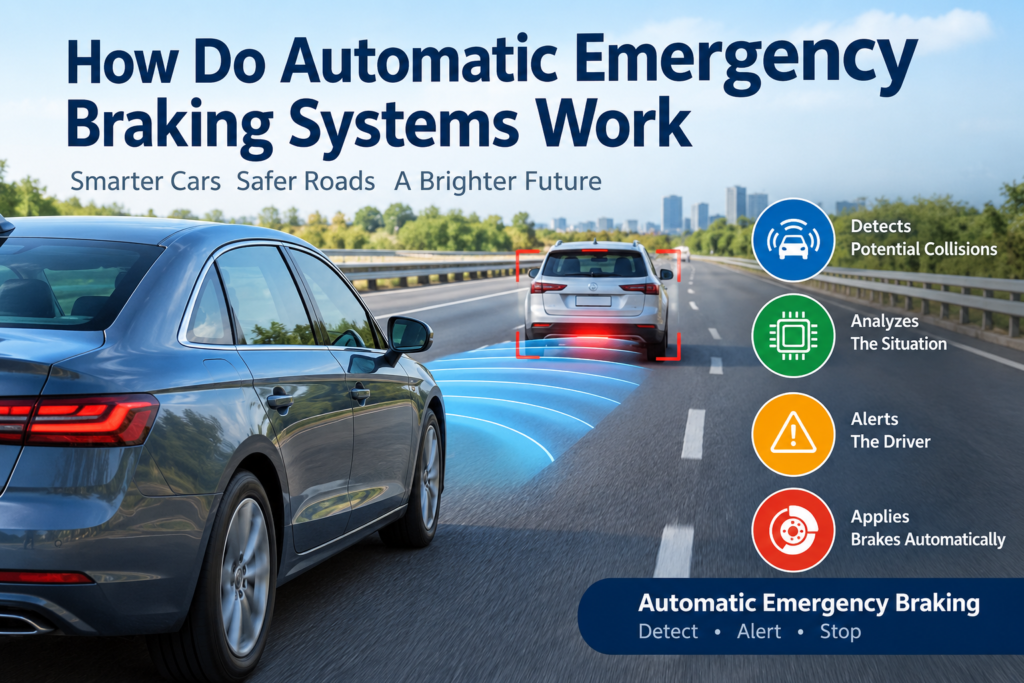
The basic idea behind Automatic Emergency Braking is actually quite simple. The vehicle uses sensors to understand what is happening around it, software to analyze the situation, and the braking system to slow or stop the vehicle when necessary.
I like to think of the process as four main steps.
First, the sensors detect something in the vehicle’s path. Second, the computer analyzes the distance and movement of the object. Third, the system determines whether there is a serious risk of collision. Finally, it can warn the driver and apply the brakes if necessary.
All of this can happen extremely quickly.
Sensors Used by Automatic Emergency Braking
One of the most important parts of an Automatic Emergency Braking system is its ability to detect objects. Modern vehicles can use different types of sensors for this purpose.
Cameras
Many modern cars use cameras mounted near the windshield or around the vehicle. A forward facing camera can identify vehicles, pedestrians, cyclists, road markings, and other visual information.
The camera provides important information to the vehicle’s computer. Software then analyzes the images and determines what objects are present.
Radar
Radar sensors are also commonly used in modern vehicle safety systems. Radar can measure the distance between the vehicle and objects ahead and can help determine how quickly those objects are moving.
Radar can be particularly useful because it does not depend entirely on visible images. This makes it an important part of many advanced safety systems.
Combination of Sensors
Some vehicles combine cameras and radar instead of depending on only one sensor. Using multiple sources of information can help the vehicle understand the driving environment more effectively.
For example, a camera may identify an object while radar provides information about its distance and movement. The vehicle’s computer can combine this information when deciding whether emergency braking may be necessary.
How Does the System Know a Collision Is Possible?
This is one of the most interesting parts of Automatic Emergency Braking.
The vehicle continuously calculates information such as distance, vehicle speed, and the movement of objects around it. The system can estimate how much time is available before the vehicle could reach an object.
If the vehicle is approaching another vehicle too quickly, the system may recognize a potential collision.
For example, imagine driving through city traffic when the vehicle ahead suddenly stops. If you are distracted for a moment and do not press the brake pedal quickly enough, the AEB system may detect the rapidly decreasing distance between the two vehicles.
The system can then issue a warning. If you still do not react, it may apply the brakes automatically.
Driver Warning Comes Before Automatic Braking
Automatic Emergency Braking does not always immediately apply the brakes. In many systems, the vehicle first tries to get the driver’s attention.
The warning can appear on the instrument display, and some vehicles may produce an audible warning or vibration. The purpose is to tell the driver that immediate action may be required.
If the driver responds by braking or steering away from the danger, the system may not need to apply automatic braking.
I think this is an important part of the technology because AEB is generally designed to assist the driver rather than replace the driver.
What Happens When Automatic Braking Activates?
If the system determines that a collision is likely and the driver has not responded sufficiently, the vehicle can automatically activate the brakes.
The amount of braking can vary depending on the vehicle, speed, system design, and situation.
In some situations, the system may apply strong braking to reduce the vehicle’s speed before impact. In other situations, it may be able to stop the vehicle completely if conditions allow.
Even when the system cannot prevent a collision, reducing the vehicle’s speed before impact can potentially reduce the seriousness of the accident.
Can Automatic Emergency Braking Detect Pedestrians?
Many newer AEB systems are designed to detect more than just other vehicles.
Depending on the vehicle and its safety system, Automatic Emergency Braking may recognize pedestrians and cyclists. This can be particularly useful in urban areas where people frequently cross roads or travel close to moving vehicles.
However, performance can vary between different systems. Detection may also be affected by lighting, weather, road conditions, object position, and other factors.
For this reason, I would never treat pedestrian detection as a reason to stop paying attention while driving.
Does AEB Work at Every Speed?
No. Automatic Emergency Braking systems do not all operate in exactly the same way.
Some systems are designed primarily for lower speed situations, while others can provide assistance at higher speeds. The operating range depends on the vehicle manufacturer and the specific safety system.
Drivers should check their vehicle owner’s manual to understand exactly what their AEB system can and cannot do.
This is something I consider important because many people assume that every safety feature works in every driving situation. That is not necessarily true.
What Can Affect Automatic Emergency Braking?
Although Automatic Emergency Braking is an advanced technology, it has limitations.
Bad weather can make detection more difficult. Heavy rain, fog, snow, dust, or strong sunlight may affect cameras and sensors.
A dirty windshield can also interfere with a camera located near the windshield. Dirt, snow, mud, or other materials covering radar sensors may affect their ability to detect objects.
Road conditions and unusual objects can also create challenges.
For these reasons, keeping the vehicle clean and following the manufacturer’s maintenance instructions is important.
Why AEB Is Useful in Everyday Driving
Automatic Emergency Braking can be useful in situations where a driver reacts too slowly.
A moment of distraction can happen to almost anyone. A driver might look at a mirror, become focused on traffic around them, or simply fail to notice that the vehicle ahead has stopped.
AEB provides another layer of protection in these situations.
It is especially useful because braking distance depends on vehicle speed, road conditions, tire condition, and driver reaction time. A system that can recognize a danger and react very quickly may provide valuable assistance.
AEB Does Not Replace the Driver
One point I always keep in mind with modern car safety technology is that these systems are designed to assist the driver.
Automatic Emergency Braking should not be treated as a replacement for safe driving. Drivers still need to watch the road, maintain a safe following distance, obey traffic laws, and remain ready to control the vehicle.
Technology can provide assistance, but it cannot remove the driver’s responsibility.
How to Maintain an AEB System
There is usually no special daily maintenance procedure for AEB, but there are several things drivers can do.
First, keep the windshield clean, especially around the camera area. Second, keep radar sensors and other exterior sensors free from dirt, mud, snow, or other obstructions.
If the vehicle displays a warning that a camera, radar sensor, or driver assistance system is unavailable, it is worth checking the owner’s manual and having the system inspected when necessary.
After certain repairs, such as windshield replacement or front end repairs, some vehicles may also require camera or sensor calibration.
What Happens If AEB Stops Working?
Modern vehicles can monitor their safety systems and may display a warning when a sensor is blocked or a system has a problem.
If an AEB warning appears, I would not ignore it. The vehicle may still drive normally, but a particular driver assistance feature may not be available.
The correct response is to check the owner’s manual and arrange an inspection if the warning remains.
Automatic Emergency Braking and Other Safety Features
AEB is often part of a larger group of driver assistance technologies.
For example, some vehicles combine Automatic Emergency Braking with forward collision warning, adaptive cruise control, lane departure warning, blind spot monitoring, and other systems.
These technologies can work together to provide the driver with additional information and assistance.
However, each system has its own purpose and limitations. Understanding those differences can help drivers use the technology more responsibly.
Final Thoughts
Automatic Emergency Braking is an impressive example of how automotive technology is being used to improve vehicle safety. The system uses sensors such as cameras and radar to monitor the road, analyzes potential hazards, warns the driver, and can automatically apply the brakes when a collision appears imminent.
From my point of view, the biggest benefit of AEB is that it can provide an additional reaction when a driver does not respond quickly enough. It does not make a car completely safe, and it should never encourage drivers to become distracted or careless.
The best approach is to think of Automatic Emergency Braking as an extra safety layer. The driver remains responsible for controlling the vehicle, while AEB can provide valuable assistance during certain emergency situations.
As automotive technology continues to develop, systems like Automatic Emergency Braking are becoming an increasingly common part of modern vehicle safety. Understanding how they work can help drivers use these features properly and appreciate the technology built into today’s cars.