Related Articles
When I drive on a busy road, one of the things I pay close attention to is the area around my car that I cannot see clearly. This area is commonly known as the blind spot. Even with properly adjusted mirrors, there can be a small section beside and slightly behind the vehicle that remains difficult to see. This is where modern blind spot detection technology can be very helpful.
Modern cars use sensors, cameras, computer software, and warning systems to monitor areas that may not be visible to the driver. The technology can detect another vehicle approaching from the side and warn the driver before changing lanes becomes dangerous.
In this article, I will explain how modern cars detect blind spots, what technology they use, how the warning system works, and why drivers should still check their mirrors and surroundings.
What Is a Blind Spot?
A blind spot is an area around a vehicle that the driver cannot see directly through the windshield, side windows, or mirrors. The size of this area can depend on the shape and size of the vehicle as well as the driver’s seating position.
For example, when another car travels beside you, it may disappear from your side mirror for a short moment before becoming visible through your side window. During this time, the other vehicle can be difficult to see.
This can become especially important when changing lanes on a highway. If a driver moves into another lane without noticing a vehicle in the blind spot, a collision can occur.
This is why I believe understanding blind spot detection technology is important for anyone who drives a modern vehicle.
How Does Blind Spot Detection Work?
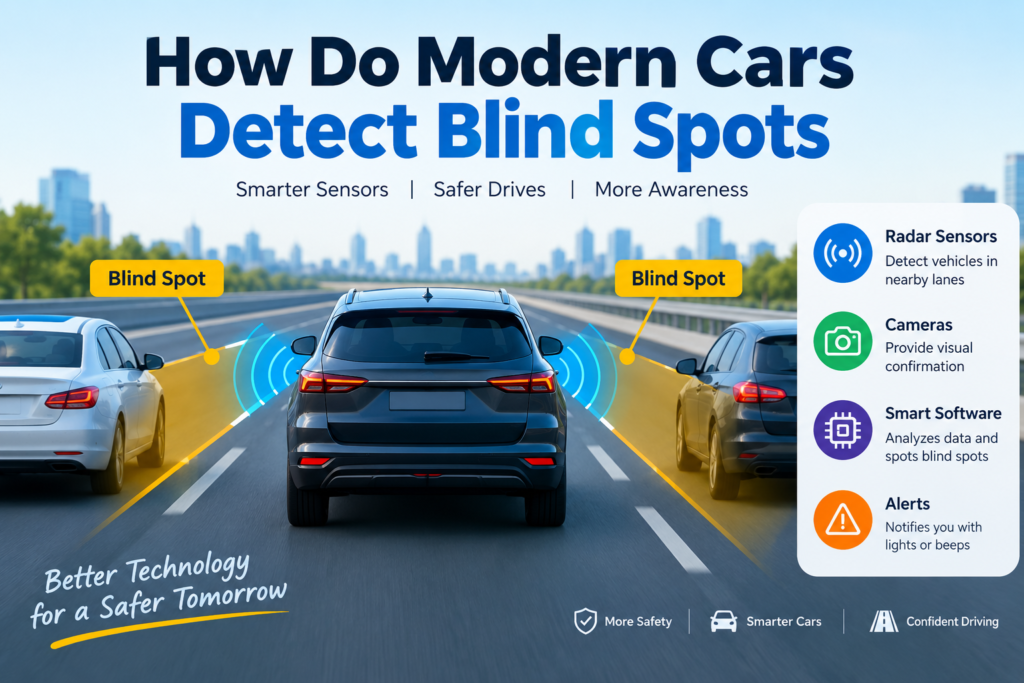
Modern blind spot detection systems normally use sensors installed around the vehicle. These sensors continuously monitor nearby areas and look for vehicles or other objects.
The most common technology is radar. Some vehicles also use cameras and other sensors to improve the system.
The sensors send information to the vehicle’s computer. The computer analyzes the information and determines whether another vehicle is present in a monitored area.
If the system detects a vehicle in the blind spot, it can provide a warning to the driver. Depending on the vehicle, the warning may appear as a small light on the side mirror, a sound inside the cabin, or a message on the vehicle display.
The important point is that the system works continuously while the vehicle is moving. The driver does not need to manually activate the sensor every time another car approaches.
Radar Sensors
Radar is one of the most important technologies used in modern blind spot monitoring systems.
Radar sensors send radio waves toward the surrounding area. When those waves encounter another vehicle or object, some of the energy is reflected back toward the sensor.
The vehicle’s computer can analyze this information to estimate the location and movement of the object.
This allows the system to determine whether another vehicle is traveling beside the car.
Radar can be useful because it can operate in different weather and lighting conditions. It does not depend entirely on visible light, so it can continue working when it is dark outside.
However, radar is not perfect. Its performance can vary depending on the vehicle design, sensor placement, road conditions, and other factors.
Cameras Used for Blind Spot Detection
Some modern vehicles also use cameras to monitor areas around the car.
Cameras can provide visual information about nearby vehicles, road markings, and other objects. The vehicle’s software can analyze the camera images and identify objects that may be relevant to the driver.
Camera based systems can be especially useful when combined with other sensors. Instead of depending on only one source of information, the vehicle can compare information from multiple sensors.
This can help the system make a more informed decision about what is happening around the vehicle.
How the Warning System Alerts the Driver
Once the vehicle detects another vehicle in a blind spot, it needs a way to communicate the information to the driver.
One of the most common warning methods is a small indicator light located inside or near the side mirror. If another vehicle is detected beside your car, the indicator may illuminate.
If you activate the turn signal while another vehicle is still in the monitored area, some systems provide an additional warning. This may be a flashing light, sound, vibration, or message on the dashboard.
I find this feature particularly useful because it provides an extra reminder when a driver is preparing to change lanes.
Blind Spot Detection and Lane Changes
Blind spot detection is closely connected with lane changing.
Imagine that you are traveling on a highway and want to move into the lane beside you. You check the rearview mirror and side mirror, but another vehicle is positioned slightly behind your car.
The vehicle may be difficult to see from the normal mirror view. A blind spot monitoring system can detect the nearby vehicle and warn you.
The warning does not mean that the car will stop you from changing lanes. In many vehicles, the system simply gives you information so that you can make a safer decision.
Some newer vehicles can provide additional steering or braking assistance, depending on the specific safety system and vehicle model.
What Happens Inside the Car?
The process may look simple from the driver’s seat, but several steps can happen very quickly inside the vehicle.
First, sensors monitor the areas around the car. Next, the sensors collect information about nearby objects.
That information is sent to the vehicle’s electronic control system. Software then analyzes the information and determines whether an object is inside a relevant detection area.
The system can consider factors such as distance, position, movement, and whether the object is moving relative to your vehicle.
If the conditions match the system’s warning criteria, an alert is sent to the driver.
All of this can happen within a very short period of time, allowing the driver to receive a warning while there is still time to react.
Does Blind Spot Detection See Everything?
One important thing I always keep in mind is that blind spot detection should not be treated as a replacement for careful driving.
The system may not detect every object in every situation. Very small objects, bicycles, motorcycles, unusual road conditions, parked objects, or certain vehicles may sometimes be difficult for a particular system to detect.
Sensor performance can also be affected by dirt, snow, ice, heavy rain, or damage around the sensor area.
For this reason, drivers should continue using mirrors and looking over their shoulder when appropriate.
The technology is designed to provide additional information, not to remove the driver’s responsibility.
Why Sensor Location Matters
The location of the sensors is important because the vehicle needs to monitor specific areas around its sides and rear.
Many blind spot sensors are installed near the rear corners of the vehicle. Their position allows them to monitor vehicles approaching from nearby lanes.
Because the sensors are part of the vehicle’s safety system, it is important to keep the sensor areas clean and avoid covering them with objects or accessories.
If a sensor is blocked or damaged, the system may provide a warning or may not work as intended.
Blind Spot Detection in Different Vehicles
Blind spot detection is available in many types of modern vehicles. It can be found in some small cars, family vehicles, SUVs, pickup trucks, and luxury vehicles.
The exact technology can vary between manufacturers and models.
Some systems only provide a visual warning. Others combine visual warnings with sounds or steering assistance.
This means that drivers should read the owner’s manual to understand exactly how the blind spot monitoring system in their vehicle operates.
It is also important to learn where the sensors are located and what the warning indicators mean.
Benefits of Blind Spot Detection
The biggest benefit of blind spot detection is improved driver awareness.
It can provide useful information when another vehicle is difficult to see. This can be especially helpful during highway driving, where vehicles can approach quickly.
The system can also reduce some of the stress involved in monitoring several lanes of traffic at the same time.
For new drivers, the technology can serve as an additional layer of awareness while they continue developing good mirror checking habits.
However, I would never rely on the system alone. Good driving habits remain essential.
How Drivers Should Use Blind Spot Technology
I think the best way to use blind spot detection is as an extra safety tool.
Before changing lanes, I recommend checking the rearview mirror, checking the appropriate side mirror, using the turn signal, and checking the surrounding area.
If the blind spot warning light is active, take it seriously and wait until the nearby vehicle has moved away.
Drivers should also avoid assuming that no warning means the road is completely clear. The system has limitations, and conditions can change quickly.
Final Thoughts
Modern cars detect blind spots by using technologies such as radar sensors, cameras, and computer software. These systems continuously monitor areas around the vehicle and can warn drivers when another vehicle is detected in a difficult to see position.
For me, the most useful part of this technology is the extra awareness it provides. A small warning light or sound can remind a driver that another vehicle is nearby before a lane change.
At the same time, blind spot detection should never replace mirrors, turn signals, careful observation, and responsible driving.
As vehicle technology continues to improve, safety systems are becoming more advanced and helpful. Understanding how these systems work can help drivers use them correctly and get the most benefit from modern vehicle safety technology.