
Related Articles

Car voice control systems have become one of the most useful features in modern vehicles. Instead of reaching for the infotainment screen or pressing several buttons, drivers can simply speak a command and let the car handle it. From changing the music to finding a destination, making a phone call, adjusting the temperature, or checking vehicle information, voice control can make everyday driving more convenient.
In my view, the biggest advantage of car voice control is that it can reduce the need to take your eyes away from the road. Touchscreens are useful, but using them while driving can sometimes require more attention than necessary. A well designed voice control system allows the driver to communicate with the vehicle more naturally.
But how does this technology actually understand what we say? The process involves several different technologies working together, including microphones, voice recognition software, natural language processing, and the vehicle’s infotainment system.
What Is a Car Voice Control System?
A car voice control system is a technology that allows drivers and passengers to control certain vehicle functions using spoken commands. Instead of manually selecting an option from a screen, the user can say what they want the vehicle to do.
For example, a driver might say, “Call Sarah,” “Play my favorite music,” “Set the temperature to 22 degrees,” or “Take me to the nearest fuel station.”
The exact features depend on the vehicle, software, and connected services. Some systems are designed mainly for basic commands, while newer systems can understand more natural conversations.
Car voice control is usually integrated into the infotainment system. It may also work with smartphone assistants and connected services depending on the vehicle.
How Car Voice Control Works
The process may appear simple from the driver’s perspective, but several steps happen after a voice command is spoken.
First, the system needs to hear the driver’s voice. This is where the vehicle’s microphones become important. After receiving the audio, the voice recognition software processes the speech and converts it into digital information.
The system then tries to understand the meaning behind the words. This is handled through natural language processing and command recognition. Once the system understands the request, it sends the instruction to the appropriate vehicle function or connected service.
Finally, the car performs the requested action and may provide a voice or visual response.
The complete process can happen within a few seconds.
The Role of Microphones
Microphones are one of the most important parts of a car voice control system. They are usually positioned around the cabin so the system can capture the driver’s voice clearly.
A major challenge is that a vehicle is rarely completely quiet. There may be road noise, engine sounds, air conditioning, music, conversations, and outside traffic. Modern systems use audio processing technologies to help separate the driver’s voice from surrounding sounds.
Some vehicles use multiple microphones rather than relying on a single microphone. This can help the system determine where the voice is coming from and improve speech recognition.
Microphone quality can make a noticeable difference. If the system cannot clearly hear the speaker, even advanced voice recognition software may struggle to understand the command.
Voice Recognition Technology
Once the microphone captures the driver’s speech, the system needs to convert the spoken words into information that a computer can understand. This is where automatic speech recognition comes into play.
Automatic speech recognition, commonly called ASR, analyzes the audio and identifies the words being spoken. Modern systems use sophisticated software and machine learning models to recognize different accents, speaking speeds, and variations in pronunciation.
For example, someone may say “navigate to the airport” quickly or slowly. A capable system should recognize the same basic request despite the difference in speaking style.
Voice recognition has improved considerably over the years. Older systems often required users to memorize specific commands. Modern systems are generally more flexible and can understand everyday language more effectively.
Natural Language Processing
Recognizing individual words is only part of the process. The vehicle also needs to understand what the driver actually means.
This is where natural language processing, or NLP, becomes important.
Imagine saying, “I am feeling cold.” A basic voice system might not know what to do with that sentence. A more advanced system could understand that the driver may want the cabin temperature increased.
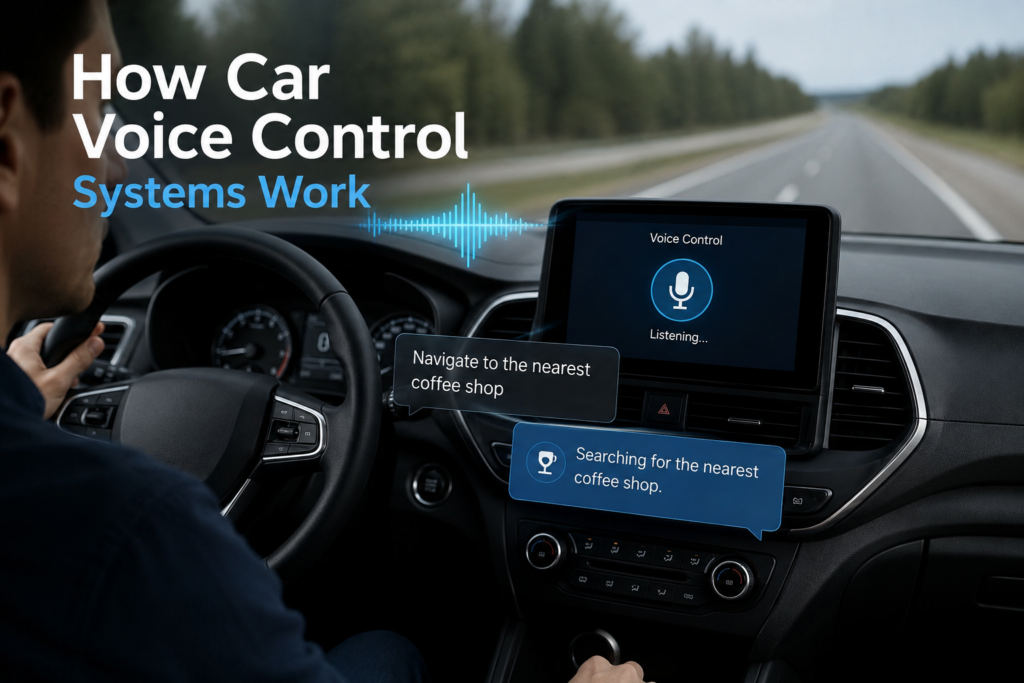
Similarly, if a driver says, “Find me a coffee shop nearby,” the system needs to understand the purpose of the request and connect it with the navigation or location service.
Natural language processing helps the vehicle interpret the intent behind a command instead of simply matching individual words.
Voice Commands and Wake Words
Many car voice control systems use a wake word or activation phrase. The driver may press a voice button on the steering wheel or say a specific phrase to activate the assistant.
The wake word tells the system that the driver is about to give a command.
Some systems are designed to listen for their activation phrase continuously. However, they typically process the command only after detecting the appropriate activation signal.
This makes the interaction feel more natural because the driver does not always need to reach for the infotainment screen.
What Can You Control With Your Voice?
The number of voice controlled features varies between vehicles. However, common functions include navigation, phone calls, music, radio, climate control, and basic vehicle settings.
Navigation is one of the most useful applications. A driver can request directions to a particular location without manually entering an address.
Phone control is another important feature. Voice commands can allow drivers to make calls, read or respond to messages where supported, and access contacts.
Entertainment controls can include changing radio stations, selecting songs, adjusting volume, or choosing different media sources.
Some vehicles also allow voice commands for climate settings. Depending on the model, you may be able to adjust the temperature, fan speed, or airflow.
More advanced vehicles can offer additional controls, although the available functions depend heavily on the manufacturer.
Voice Control and Navigation
Voice control has changed the way many drivers interact with navigation systems. Entering a complete address on a touchscreen can take time, especially while the vehicle is moving.
With voice control, the driver can simply provide a destination.
For example, a driver could say, “Take me to the nearest hospital.” The system can process the request, identify suitable locations, and display or provide directions.
Connected navigation systems can sometimes use online information to find businesses, traffic conditions, and other location based information.
This makes voice control particularly useful during long journeys when drivers may need to change destinations or search for services along the route.
Voice Control and Smartphone Integration
Modern vehicles often work with smartphones through systems such as Apple CarPlay and Android Auto. These platforms can bring compatible voice assistants and applications into the vehicle.
This means drivers can use voice commands to interact with navigation, messages, phone calls, music, and other supported services.
The smartphone may handle part of the processing while the vehicle provides the microphones, speakers, display, and physical controls.
This combination can provide a more familiar experience because drivers can use services they already know from their phones.
Cloud Based Voice Recognition
Some modern car voice control systems use cloud computing. Instead of processing every request entirely inside the vehicle, the system can send certain information to remote servers for processing.
Cloud based systems can provide access to powerful speech recognition and language processing technology. They can also receive software improvements without requiring major changes to the vehicle’s hardware.
However, cloud based voice control can depend on an internet connection. If connectivity is poor, some advanced features may not work as expected.
Other systems use a combination of local and cloud processing. Basic commands may work inside the vehicle, while more complex requests may use online services.
Why Voice Control Is Useful While Driving
The main benefit of car voice control is convenience, but I think its potential safety benefit is equally important.
Every time a driver looks away from the road to operate a touchscreen, attention is temporarily divided. Voice control can reduce the amount of physical interaction required for many common tasks.
For example, changing a destination or making a phone call through voice commands may be easier than manually navigating through several menus.
However, voice control should not be treated as a replacement for responsible driving. A voice assistant can misunderstand a request, provide an incorrect result, or require the driver to confirm something on the screen.
Drivers should always prioritize the road and follow local driving laws.
Problems With Car Voice Control Systems
Although modern systems are much better than older voice recognition technology, they are not perfect.
Background noise can affect recognition. Strong accents, unusual names, unclear pronunciation, or multiple people speaking at the same time can also cause problems.
Another issue is connectivity. Some advanced features require an internet connection, so performance may change when the vehicle is in an area with weak network coverage.
Voice assistants can also misunderstand commands because spoken language is naturally flexible. Two people may use completely different sentences to request the same thing.
For this reason, I think it is better to view car voice control as a helpful assistant rather than a completely independent system.
The Future of Car Voice Control
Car voice control technology is likely to become more advanced as artificial intelligence and language processing continue to improve.
Future systems may understand longer conversations and remember the context of previous requests. Instead of giving one command at a time, drivers may be able to have a more natural conversation with the vehicle.
For example, a driver might ask for a restaurant, then ask whether it is open, and then request directions without repeating the location each time.
Voice systems may also become better at understanding different accents, languages, and natural speaking styles.
Another possible development is deeper integration with vehicle settings. As automotive software becomes more advanced, voice assistants may be able to control more functions while maintaining appropriate safety restrictions.
Final Thoughts
Car voice control systems are a combination of microphones, speech recognition, natural language processing, vehicle software, and sometimes cloud based services. When a driver speaks, the system captures the voice, converts it into recognizable information, identifies the driver’s intention, and sends the command to the appropriate function.
From my perspective, voice control is one of the technologies that has made modern car interiors more convenient. It reduces the need to interact with complicated menus and can make navigation, entertainment, phone calls, and other functions easier to access.
The technology still has limitations, especially when there is background noise or poor connectivity. However, voice recognition continues to improve, and future vehicles are likely to provide much more natural communication between drivers and their cars.
For anyone interested in modern automotive technology, understanding how car voice control systems work is a good example of how software and artificial intelligence are becoming an important part of the driving experience.