
Related Articles

When I think about modern electric and hybrid cars, one of the most interesting technologies is regenerative braking. At first, it may sound like a complicated engineering feature, but the basic idea is actually quite simple. Instead of allowing all the energy created during braking to disappear as heat, a vehicle with regenerative braking can recover part of that energy and turn it into electricity.
This technology is one of the main reasons electric and hybrid vehicles can be so efficient in everyday driving. Every time the driver slows down, especially in city traffic, the vehicle has an opportunity to recover some energy that would otherwise be wasted.
In this article, I will explain how regenerative braking works, what happens inside the electric motor, how the battery stores recovered energy, and why this technology is important for modern vehicles.
What Is Regenerative Braking?
Regenerative braking is a system that allows an electric or hybrid vehicle to recover some of its kinetic energy when the vehicle slows down.
In a traditional car, pressing the brake pedal causes the brake pads to press against the brake discs. The friction slows the wheels, but the vehicle’s kinetic energy is converted mainly into heat. That heat then escapes into the surrounding air.
Regenerative braking takes a different approach. When the driver slows the vehicle, the electric motor can work in reverse. Instead of using electrical energy to turn the wheels, it uses the movement of the wheels to generate electrical energy.
That electricity can then be sent back to the vehicle’s battery.
I find this concept particularly useful because the vehicle is effectively recovering energy from a process that normally wastes energy. It does not recover everything, but even recovering a portion can improve overall efficiency.
How Regenerative Braking Works
The easiest way to understand regenerative braking is to look at what happens when a driver releases the accelerator or presses the brake pedal.
While the vehicle is moving, the wheels have kinetic energy. In an electric vehicle, an electric motor is connected to the drivetrain. During normal acceleration, electricity from the battery powers the motor, and the motor produces torque that turns the wheels.
During regenerative braking, the process is reversed.
The rotating wheels drive the electric motor. The motor then operates as a generator. As the motor generates electricity, it creates resistance against the movement of the wheels. This resistance slows the vehicle.
The electrical energy produced by the motor is sent through the vehicle’s power electronics and then stored in the battery.
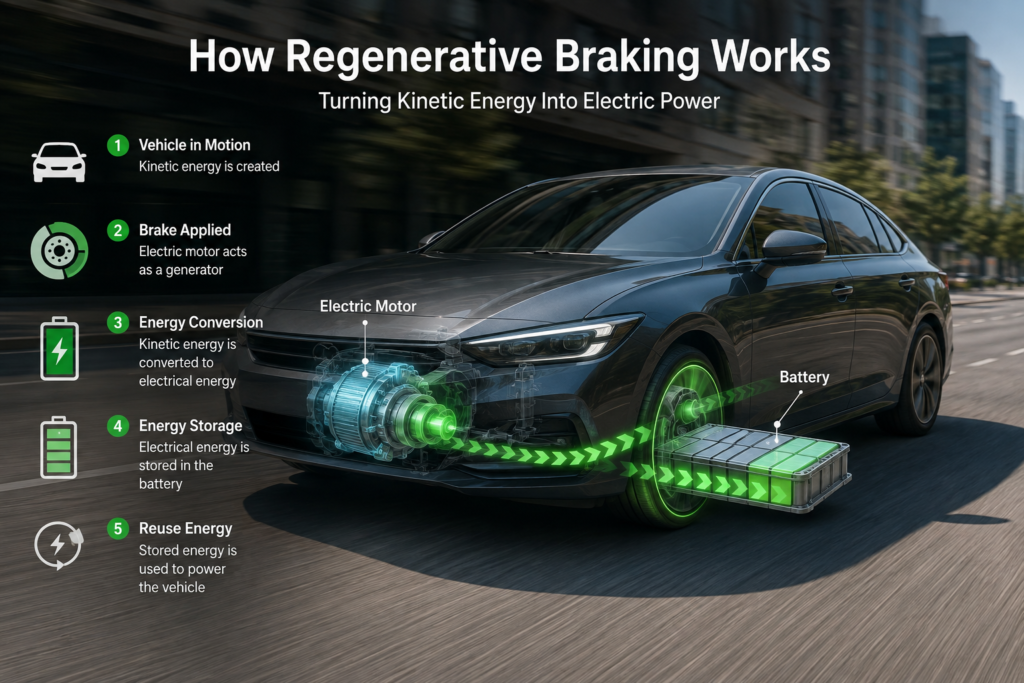
So, in simple terms, the process looks like this:
Vehicle movement produces kinetic energy.
The wheels turn the electric motor.
The motor operates as a generator.
The generator produces electrical energy.
The battery stores the recovered energy.
The stored energy can later help power the vehicle.
This process happens very quickly and is controlled automatically by the vehicle’s electronic systems.
The Role of the Electric Motor
The electric motor is one of the most important parts of regenerative braking.
What makes an electric motor interesting is that it can usually operate in two directions from an energy perspective. It can consume electrical energy and produce mechanical movement, or it can use mechanical movement to produce electrical energy.
During acceleration, the motor receives electricity from the battery. It creates magnetic forces that rotate the motor shaft, which eventually turns the vehicle’s wheels.
During regenerative braking, the wheels keep rotating because of the vehicle’s momentum. That rotation drives the motor. The motor now acts as a generator and produces electricity.
At the same time, the motor creates resistance. This resistance helps slow the vehicle down.
This is why regenerative braking can sometimes feel different from braking in a conventional petrol or diesel car. When I drive a vehicle with strong regenerative braking, releasing the accelerator can produce noticeable deceleration without immediately pressing the conventional brake pedal.
What Happens to the Recovered Energy?
The electricity generated during regenerative braking does not simply flow directly into the battery without control.
The vehicle uses sophisticated power electronics to manage the electricity. The system controls the voltage and current so that the energy can be safely transferred to the battery.
The battery then stores the recovered electrical energy as chemical energy.
Later, when the driver accelerates, that stored energy can be used to power the electric motor.
This creates a useful energy cycle. The battery provides electricity to move the vehicle, and some of the energy associated with that movement can be recovered when the vehicle slows down.
It is important to understand that regenerative braking is not a way to create free energy. Some energy is always lost because no mechanical or electrical system is perfectly efficient. There are losses in the motor, power electronics, battery, tires, drivetrain, and other components.
Still, recovering some energy is much better than losing all of it as heat through conventional friction braking.
Regenerative Braking and Conventional Brakes
Regenerative braking does not completely replace conventional brakes in most vehicles.
Electric and hybrid vehicles generally use a combination of regenerative braking and friction braking.
At lower braking demands, the vehicle may rely heavily on regenerative braking. If the driver needs stronger braking, the conventional friction brakes can also be activated.
This combination is often called blended braking.
For example, if I am approaching a traffic signal and gently press the brake pedal, the vehicle may first increase regenerative braking. If I press harder because I need to stop quickly, the friction brakes can provide additional stopping force.
This is important because regenerative braking has limits. The electric motor can only generate a certain amount of braking force, and the battery cannot accept unlimited electrical power at any moment.
The conventional braking system remains an essential safety feature.
Why Regenerative Braking Is Useful in City Driving
One of the biggest advantages of regenerative braking becomes clear in stop and go traffic.
In a city, vehicles frequently accelerate, slow down, and stop. A traditional car loses a significant amount of its movement energy whenever it brakes.
An electric or hybrid vehicle can recover part of that energy.
Imagine driving through a busy city. You accelerate away from a traffic light, travel for a short distance, and then slow down for another light. With conventional brakes, much of the energy used to accelerate the car is eventually converted into heat during braking.
With regenerative braking, some of that energy can be converted back into electricity.
This does not mean the vehicle gets all of its energy back. It simply reduces the amount of energy wasted.
That is one reason electric and hybrid vehicles can perform particularly well in urban driving conditions.
What Happens When the Battery Is Full?
There is an interesting limitation with regenerative braking when the battery is already highly charged.
A battery cannot accept unlimited energy. If it is near its maximum charge level, the vehicle may reduce regenerative braking to protect the battery.
In that situation, the vehicle can rely more heavily on conventional friction brakes.
Temperature can also affect regenerative braking. Batteries and electric motors operate within specific temperature ranges. When the battery is extremely cold or otherwise unable to accept high charging power, the vehicle may temporarily reduce the amount of regenerative braking available.
Modern vehicles manage these conditions automatically, so the driver generally does not need to worry about the technical details.
Does Regenerative Braking Charge the Battery?
Yes, regenerative braking can charge the battery, but the amount of energy recovered depends on several factors.
Vehicle speed is important. The amount of available kinetic energy increases with speed, so braking from a higher speed can provide more recoverable energy than slowing from a very low speed.
The amount of braking also matters. Gentle slowing may recover less energy than stronger deceleration.
Road conditions, battery temperature, battery charge level, vehicle weight, and the design of the electric motor can also influence energy recovery.
This means regenerative braking is not always operating at exactly the same level.
One Pedal Driving
Some electric vehicles take regenerative braking a step further with a feature commonly known as one pedal driving.
With one pedal driving, releasing the accelerator can create substantial regenerative braking. The vehicle slows down noticeably without the driver needing to press the brake pedal in many normal situations.
I think this is one of the most interesting changes in the driving experience offered by electric vehicles.
Once a driver becomes familiar with it, controlling speed with the accelerator pedal can feel natural. The driver can accelerate by pressing the pedal and slow down by reducing pressure.
However, one pedal driving does not mean the brake pedal becomes unnecessary. Drivers still need to use the conventional brakes when stronger braking is required or when road conditions demand it.
Advantages of Regenerative Braking
Regenerative braking provides several important benefits.
The first advantage is improved energy efficiency. Some energy that would normally be lost during braking can be recovered and reused.
The second advantage is reduced wear on conventional brake components. Because regenerative braking can handle part of the vehicle’s slowing process, brake pads and discs may experience less use under certain driving conditions.
The third advantage is improved range for electric vehicles. Recovered energy can be used later to help move the vehicle, which can reduce overall energy consumption.
Another benefit is reduced heat generation from friction braking during situations where regenerative braking handles much of the deceleration.
For hybrid vehicles, regenerative braking is especially useful because recovered energy can help reduce the amount of fuel required over a driving cycle.
Limitations of Regenerative Braking
Although regenerative braking is very useful, it has limitations.
The biggest limitation is that it cannot recover all of the energy used to move a vehicle.
Energy losses occur throughout the process. The motor has electrical and mechanical losses, the power electronics have losses, and the battery also loses some energy during charging and later discharging.
Regenerative braking can also be limited by battery charge level and temperature.
Another limitation is that regenerative braking cannot always provide enough stopping power for emergency braking. Conventional friction brakes are still required for situations where rapid and strong stopping is necessary.
For this reason, regenerative braking should be viewed as an efficiency technology rather than a complete replacement for traditional braking systems.
How Regenerative Braking Improves Efficiency
The real value of regenerative braking becomes clearer when we look at the entire energy cycle.
A vehicle requires energy to accelerate. Some of that energy becomes kinetic energy as the vehicle moves. When the vehicle slows down, regenerative braking can capture part of that kinetic energy.
Without regeneration, much of the energy would be lost as heat.
With regeneration, some of it becomes electrical energy and returns to the battery.
The vehicle can then use that energy again.
This repeated recovery process can make a meaningful difference over thousands of kilometers, especially when the vehicle operates in traffic where frequent braking is common.
Final Thoughts
In my view, regenerative braking is one of the smartest technologies introduced in modern electric and hybrid vehicles. Its basic principle is simple, but the engineering behind it is quite advanced.
Instead of treating braking only as a way to stop a vehicle, regenerative braking treats deceleration as an opportunity to recover energy.
The electric motor changes its role from a device that uses electricity to move the vehicle into a generator that produces electricity from the vehicle’s movement. That electricity is managed by power electronics and stored in the battery for later use.
Regenerative braking cannot recover every bit of energy, and it does not eliminate the need for conventional brakes. However, it can improve efficiency, reduce brake wear, and help electric and hybrid vehicles make better use of the energy they already have.
As electric vehicle technology continues to develop, regenerative braking will remain an important part of making vehicles more efficient and practical. For anyone interested in understanding how electric cars work, learning how regenerative braking works is a great place to start.
Frequently Asked Questions
Does regenerative braking save energy?
Yes. Regenerative braking can recover part of the vehicle’s kinetic energy and convert it into electrical energy. The recovered energy can then be stored in the battery and used later.
Does regenerative braking replace normal brakes?
No. Most electric and hybrid vehicles use regenerative braking together with conventional friction brakes. Traditional brakes are still necessary for strong and emergency braking.
Does regenerative braking increase electric vehicle range?
It can help improve efficiency and range by recovering some energy that would otherwise be lost during braking. The actual benefit depends on driving conditions and vehicle design.
Is regenerative braking available in hybrid cars?
Yes. Regenerative braking is commonly used in hybrid and electric vehicles because both types of vehicles have electric motors capable of generating electricity during deceleration.
Does regenerative braking work at every speed?
The amount of regenerative braking available can vary with vehicle speed, battery condition, temperature, and other factors. The vehicle automatically manages the system to maintain safe and efficient operation.