Related Articles

When I think about the technology that has made modern driving more comfortable and convenient, adaptive cruise control is one of the features that stands out. Many newer cars now come with this system, and it is often presented as an important driver assistance feature. However, a lot of people still wonder what adaptive cruise control actually does and how it is different from traditional cruise control.
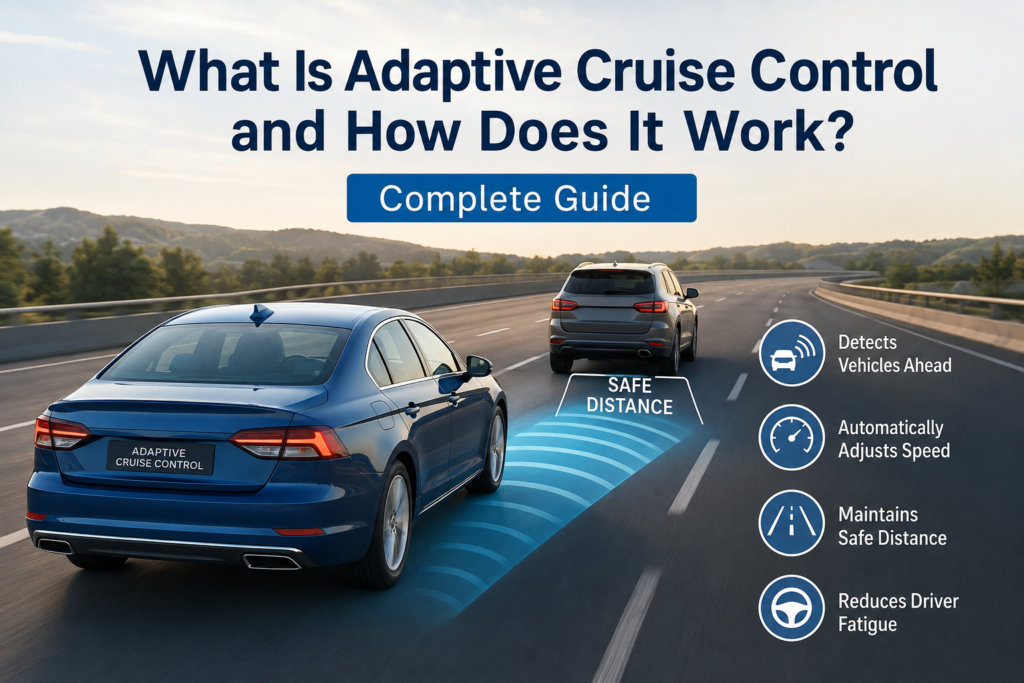
In simple words, adaptive cruise control, commonly called ACC, is an advanced version of cruise control that can automatically maintain a selected speed while also keeping a safe following distance from the vehicle ahead. Instead of simply maintaining one fixed speed, the system can slow the car down when traffic becomes slower and accelerate again when the road becomes clear.
In my view, adaptive cruise control is especially useful on highways and long journeys because it can make driving less tiring. At the same time, it is important to understand that ACC is a driver assistance system, not a replacement for the driver.
What Is Adaptive Cruise Control?
Adaptive cruise control is a driver assistance technology designed to control a vehicle’s speed according to the traffic around it. Traditional cruise control allows a driver to select a speed, such as 100 kilometers per hour, and the vehicle tries to maintain that speed until the driver brakes or turns the system off.
Adaptive cruise control works differently. It monitors the road ahead and detects vehicles traveling in the same direction. If there is no slower vehicle ahead, the car can maintain the speed selected by the driver. If another vehicle enters the lane and is traveling more slowly, ACC can reduce the vehicle’s speed.
Once the road ahead becomes clear, the system can gradually accelerate back toward the selected speed.
This is what makes adaptive cruise control different from conventional cruise control. It does not only think about the speed of your car. It also considers the traffic directly ahead.
How Does Adaptive Cruise Control Work?
The basic operation of adaptive cruise control may sound complicated, but the idea is quite simple. The vehicle uses sensors and computer systems to understand what is happening in front of it.
Depending on the vehicle, ACC can use radar sensors, cameras, or a combination of different sensors. These sensors continuously monitor the road ahead and help identify vehicles and their distance from your car.
For example, imagine that you are driving on a highway at 100 kilometers per hour with ACC activated. If the road is clear, your car can continue traveling at the selected speed.
Now imagine another vehicle appears ahead and is traveling at 80 kilometers per hour. Instead of continuing at 100 kilometers per hour, the adaptive cruise control system detects the slower vehicle and reduces your speed.
The system then attempts to maintain the following distance selected by the driver. When the vehicle ahead moves away or changes lanes, ACC can increase your speed again, usually until it reaches the speed you originally selected.
Sensors Used by Adaptive Cruise Control
Sensors are one of the most important parts of adaptive cruise control. Without them, the vehicle would not know whether there is another vehicle ahead.
Radar is commonly used because it can measure the distance between vehicles and detect objects in front of the car. Radar can also work in different lighting conditions, which makes it useful for vehicle detection.
Cameras are another important technology used in modern driver assistance systems. A camera can help identify vehicles, lane markings, road signs, and other visual information.
Some advanced vehicles use multiple sensors together. Combining information from radar and cameras can help the vehicle’s computer create a better understanding of the road environment.
The exact technology depends on the manufacturer and vehicle model, so not every adaptive cruise control system works in exactly the same way.
How to Use Adaptive Cruise Control
Using ACC is generally straightforward once a driver becomes familiar with the controls. First, the driver normally activates the cruise control system and selects a desired speed.
The driver can also choose a following distance in vehicles that provide this option. Depending on the car, this may be represented using different distance levels.
Once activated, the system monitors traffic ahead. If there is no slower vehicle, the car maintains the selected speed. If traffic slows down, the system reduces the vehicle’s speed to maintain the desired gap.
When traffic becomes faster or clears from the lane, the vehicle can accelerate toward the selected speed.
However, the driver still needs to pay attention to the road. I consider this one of the most important things to understand about ACC. The system is designed to assist the driver, not take complete responsibility for driving.
Adaptive Cruise Control in Traffic
One of the most useful features of modern adaptive cruise control is its ability to work in traffic. Some systems are designed to operate at relatively low speeds and can help during slow moving traffic.
For example, if vehicles ahead are moving slowly, ACC can automatically reduce your speed. In some vehicles, the system can even bring the car to a complete stop.
Certain advanced systems can then resume driving when traffic starts moving again. The exact capabilities depend on the vehicle.
This can be particularly useful during long highway journeys where traffic frequently speeds up and slows down. Instead of constantly adjusting the accelerator and brake pedals, the system can handle some of these repetitive speed changes.
Benefits of Adaptive Cruise Control
There are several reasons why adaptive cruise control has become popular in modern cars.
One major advantage is convenience. On long highway trips, maintaining speed manually can become tiring. ACC can reduce the amount of repetitive accelerator and brake adjustments required from the driver.
Another benefit is maintaining a more consistent following distance. When used correctly, the system can help drivers avoid getting too close to the vehicle ahead.
ACC can also make highway driving more comfortable. If traffic is moving at a steady pace, the driver can concentrate more on monitoring the road instead of constantly adjusting speed.
From my perspective, the biggest benefit is reduced driver workload. It does not make driving completely automatic, but it can make certain parts of a journey less stressful.
Is Adaptive Cruise Control Safe?
Adaptive cruise control can be a useful safety and convenience feature, but it should never be treated as a fully autonomous driving system.
The driver remains responsible for controlling the vehicle and monitoring the road. There can be situations where the system does not respond exactly as a human driver would.
For example, poor weather, unusual road layouts, stopped objects, motorcycles, pedestrians, or vehicles suddenly entering the lane can create situations that require immediate human attention.
Drivers should always follow the instructions provided by their vehicle manufacturer and remain ready to brake or take control.
This is why I believe it is better to think of ACC as an assistant rather than a driver.
Adaptive Cruise Control vs Traditional Cruise Control
The difference between traditional cruise control and adaptive cruise control is easy to understand.
Traditional cruise control mainly maintains the speed selected by the driver. If you select 100 kilometers per hour, the vehicle attempts to stay around that speed.
Adaptive cruise control can maintain the selected speed when the road is clear, but it can also adjust the speed according to traffic ahead.
For example, traditional cruise control may continue toward 100 kilometers per hour even if a slower vehicle is ahead until the driver intervenes. Adaptive cruise control can detect the slower vehicle and reduce speed to maintain a suitable distance.
This makes ACC more advanced and better suited to changing highway traffic.
Does Adaptive Cruise Control Brake Automatically?
Yes, many adaptive cruise control systems can automatically reduce speed and apply the brakes when necessary to maintain the selected following distance.
However, the braking capability varies between vehicles. Some systems are designed mainly for highway use, while more advanced systems can operate across a wider range of speeds.
It is important to remember that automatic braking through ACC should not be confused with emergency automatic braking. These are separate driver assistance functions, although modern vehicles may use several systems together.
The driver should always remain prepared to brake manually if the situation requires it.
Does Adaptive Cruise Control Save Fuel?
Adaptive cruise control may help support smoother driving, which can sometimes contribute to better fuel efficiency. Maintaining a steady speed and avoiding unnecessary acceleration and braking can be beneficial for fuel consumption.
However, there is no guarantee that using ACC will always reduce fuel consumption. Factors such as traffic, road conditions, vehicle weight, driving speed, weather, and the vehicle’s engine or electric powertrain all influence efficiency.
For me, the main reason to use ACC would be comfort and convenience rather than expecting a major fuel saving.
Limitations of Adaptive Cruise Control
Like any technology, adaptive cruise control has limitations.
The system depends on sensors and software to understand its surroundings. Heavy rain, fog, snow, dirt covering sensors, sharp curves, or unusual traffic situations may affect performance.
ACC may also behave differently depending on the road and vehicle. A system designed mainly for highways may not be suitable for every type of road.
Another important limitation is that ACC does not remove the need for driver attention. Even if the car is automatically adjusting its speed, the driver must continue watching the road.
Final Thoughts
Adaptive cruise control is one of the most useful modern car technologies for drivers who frequently travel on highways or deal with changing traffic. It improves on traditional cruise control by monitoring vehicles ahead and automatically adjusting speed to maintain a selected following distance.
From my point of view, the biggest advantage of adaptive cruise control is that it reduces some of the repetitive work involved in driving. It can make long journeys more comfortable while helping maintain a consistent speed and distance from traffic.
Still, ACC should always be used with proper attention and understanding. It is not a system that allows you to stop paying attention to the road. The driver remains responsible for making decisions and taking control whenever necessary.
As vehicle technology continues to improve, adaptive cruise control will likely become even more common. Understanding how it works today can help drivers use this technology more confidently and responsibly.