Related Articles
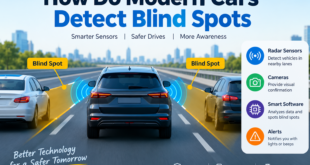
When I think about modern car safety, one feature that I find especially useful is the Blind Spot Monitoring System. Driving is not only about watching the road ahead. A driver also needs to know what is happening on both sides and behind the vehicle. This becomes difficult when another car enters an area that is not clearly visible through the side mirrors.
A Blind Spot Monitoring System is designed to help with exactly this problem. It uses sensors to detect vehicles that may be traveling in the blind spot and gives the driver a warning. In my view, this technology is a simple but valuable addition to modern vehicles because it can provide an extra level of awareness when changing lanes.
What Is a Blind Spot?
Before understanding how Blind Spot Monitoring works, it is important to understand what a blind spot actually is.
A blind spot is an area around a vehicle that the driver cannot see clearly through the normal rearview and side mirrors. Even when the mirrors are adjusted correctly, there can still be a small area beside or slightly behind the vehicle where another car may remain hidden.
This is especially noticeable when changing lanes on a busy highway. You may check the side mirror and think the lane is clear, but another vehicle could be positioned just outside your normal viewing area.
This is where a Blind Spot Monitoring System can be helpful. Instead of depending only on your eyes and mirrors, the vehicle uses technology to monitor these areas.
How Does a Blind Spot Monitoring System Work?
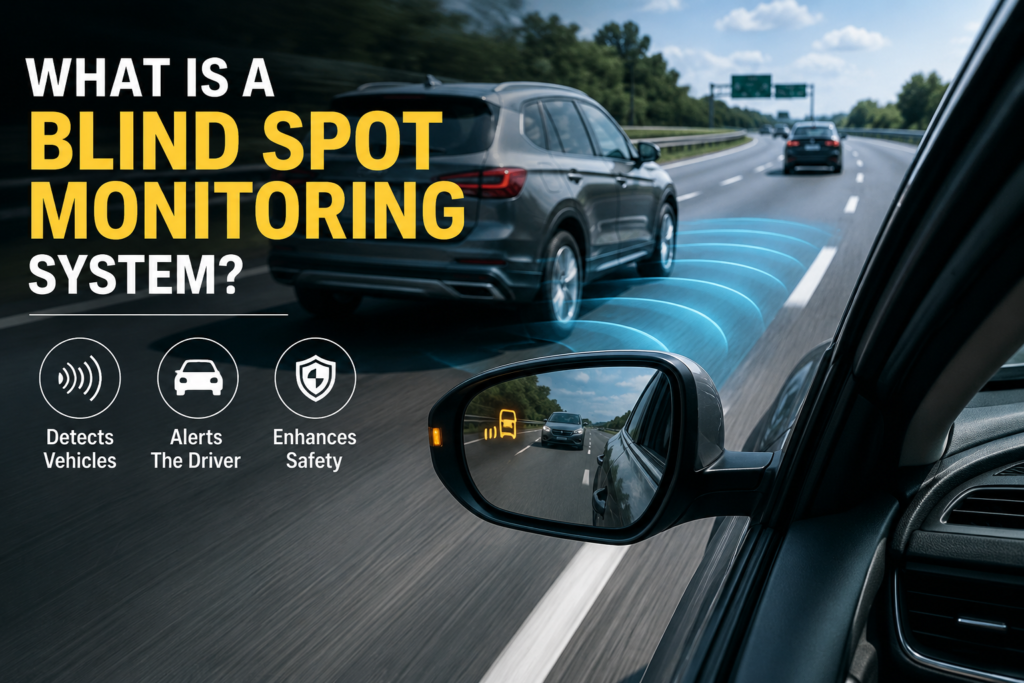
A Blind Spot Monitoring System normally uses sensors installed around the vehicle. In many modern cars, radar sensors are placed near the rear bumper or other suitable areas of the vehicle.
These sensors continuously monitor the areas beside and behind the car. When another vehicle enters a monitored blind spot, the system can recognize its presence.
If the system determines that the vehicle may be a potential risk, it usually provides a visual warning. In many cars, a small warning light appears on the side mirror or near the A pillar.
For example, if I am driving on a highway and another car approaches from behind on my left side, I may not immediately see it in my mirror. If that vehicle enters the monitored area, the Blind Spot Monitoring System can illuminate a warning indicator on the left side.
If I activate the left turn signal while another vehicle is still in the blind spot, some systems provide an additional warning. Depending on the vehicle, this warning can be an audible alert, a vibration, or another visual notification.
Why Is Blind Spot Monitoring Important?
In my opinion, the biggest advantage of Blind Spot Monitoring is improved driver awareness.
Changing lanes is something most drivers do many times during a normal journey. However, it can become risky when traffic is heavy or when vehicles are moving quickly.
A driver may check the rearview mirror and side mirror but still miss a vehicle in the blind spot. The monitoring system provides another source of information that can help the driver notice the nearby vehicle.
This does not mean the driver should stop checking mirrors. I believe the system should be treated as an additional safety feature rather than a replacement for responsible driving.
The driver still needs to check the mirrors, look around when appropriate, use turn signals, and make sure the lane is safe before changing direction.
Main Features of a Blind Spot Monitoring System
Different car manufacturers use different names and technologies, but the basic purpose is usually similar.
One common feature is the blind spot warning light. This light is often placed on the side mirror. When another vehicle is detected in the monitored area, the light turns on.
Another useful feature is lane change warning. If the driver signals toward a lane where another vehicle is detected, the system may provide a stronger warning.
Some advanced vehicles also have Rear Cross Traffic Alert. This feature can be helpful when reversing out of a parking space because it can detect vehicles approaching from the side.
Some advanced systems may also work together with other driver assistance technologies. Depending on the vehicle, the system may provide steering assistance or braking intervention when a dangerous lane change is detected.
However, the exact features depend on the vehicle model and manufacturer.
Blind Spot Monitoring vs Blind Spot Detection
You may hear both terms Blind Spot Monitoring and Blind Spot Detection when researching car safety technology.
In everyday use, these terms are often used to describe similar systems. Both are designed to help detect vehicles in areas that may not be easily visible to the driver.
The important thing for me is not the name used by the manufacturer. What matters is how the system works and what type of warning it provides.
When buying a vehicle, I would recommend checking the manufacturer’s specifications to understand exactly what the system can and cannot do.
Benefits of Blind Spot Monitoring
There are several reasons why I consider Blind Spot Monitoring a useful safety feature.
First, it can improve awareness during lane changes. A warning can remind the driver that another vehicle is nearby.
Second, it can be particularly useful on highways. Vehicles can approach quickly, and drivers may not always notice them immediately.
Third, it can reduce some of the stress associated with changing lanes in busy traffic. Knowing that the vehicle is monitoring certain areas can give the driver additional confidence.
Another benefit is that it can be useful in different driving conditions. Whether you are driving on a highway, in city traffic, or in a busy parking area, additional information about nearby vehicles can be valuable.
Still, I would never depend entirely on this technology. No electronic system can replace careful driving.
What Are the Limitations?
Like every driver assistance technology, Blind Spot Monitoring has limitations.
The sensors may not detect every object in every situation. Performance can also be affected by weather, dirt, road conditions, sensor placement, or the design of the vehicle.
For example, motorcycles and bicycles can sometimes be more difficult for certain systems to detect compared with larger vehicles. Stationary objects may also be handled differently depending on the system.
Another important point is that a warning does not automatically mean it is safe or unsafe to change lanes. The driver must understand the situation and make the final decision.
I think this is one of the most important things to remember about modern car safety technology. These systems are designed to assist the driver, not replace the driver.
How Should Drivers Use Blind Spot Monitoring?
The best way to use Blind Spot Monitoring is as part of a complete driving routine.
Before changing lanes, I would check the rearview mirror first and then the appropriate side mirror. I would use the turn signal and make sure the lane is clear. The Blind Spot Monitoring warning can then provide another layer of awareness.
Drivers should also keep the sensors clean and pay attention to any warning messages from the vehicle. If the system becomes unavailable because of blocked or dirty sensors, the driver should not assume that blind spots are being monitored.
It is also important to understand the specific system installed in your car. Reading the owner’s manual can explain where the sensors are located, what the warning lights mean, and what situations may affect system performance.
Is Blind Spot Monitoring Worth It?
From my point of view, Blind Spot Monitoring is one of those features that can become very useful once you start using it regularly.
It does not make a vehicle completely safe, and it does not eliminate the need for careful driving. However, it can provide information that the driver might otherwise miss.
If I were comparing two similar vehicles, I would consider Blind Spot Monitoring a useful safety feature, especially if I regularly drove on highways or in heavy traffic.
The value of the system is not only in the warning itself. It is also about giving the driver better awareness of what is happening around the vehicle.
Final Thoughts
A Blind Spot Monitoring System is a modern driver assistance feature designed to help detect vehicles in areas that may not be clearly visible through the mirrors. It normally uses sensors to monitor areas beside and behind the vehicle and alerts the driver when another vehicle is detected.
In my opinion, it is a practical technology because blind spots are a natural limitation of vehicle design. Even an experienced driver can sometimes miss a vehicle when changing lanes.
At the same time, I believe drivers should always remember that Blind Spot Monitoring is an assistance system, not an automatic replacement for mirrors, proper signaling, and careful observation.
Used correctly, Blind Spot Monitoring can make everyday driving more comfortable and can provide an extra layer of awareness when changing lanes. As vehicle safety technology continues to improve, features like this are becoming an important part of the modern driving experience.