
Related Articles



Parking a car can look simple when there is plenty of open space, but it can become difficult when you are driving into a tight parking spot, reversing near a wall, or trying to judge the distance between your car and another vehicle. This is where parking sensors become very useful. Modern cars use parking sensors to help drivers understand what is around their vehicle and reduce the chances of small accidents while parking.
In my view, parking sensors are one of those car features that people may not think much about until they actually need them. They do not replace careful driving, but they can make parking easier, especially in crowded areas where space is limited.
What Are Parking Sensors?
Parking sensors are electronic devices installed around a vehicle to detect nearby objects. They are commonly found on the front and rear bumpers of modern cars. Their main purpose is to warn the driver when the vehicle gets close to an obstacle.
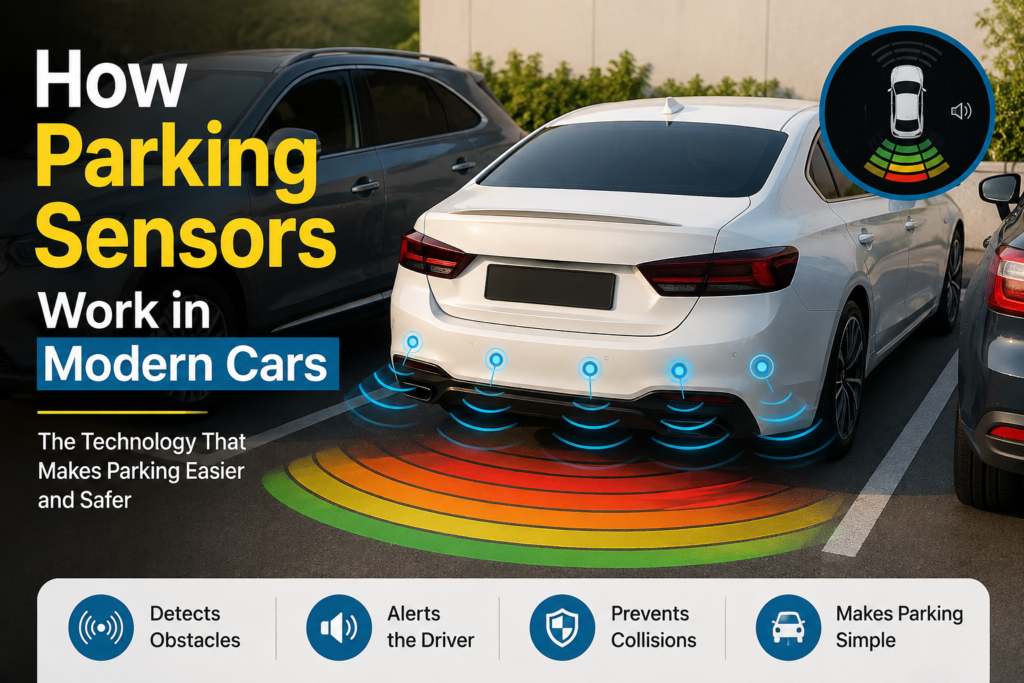
When the system detects an object, it usually gives an audio warning through beeps. In many modern vehicles, the warning may also appear on the infotainment screen or digital instrument display. Some systems show the approximate location of the object and the distance between the vehicle and the obstacle.
The basic idea is simple. The sensors detect something close to the car, the vehicle computer processes the information, and the driver receives a warning.
How Do Parking Sensors Work?
Most parking sensors in modern cars use ultrasonic technology. An ultrasonic sensor sends out a sound wave at a frequency that humans normally cannot hear. This sound wave travels away from the vehicle and can bounce back when it reaches an object.
The sensor then receives the reflected sound wave. The car’s electronic control system measures how long it took for the signal to return. From this information, the system can estimate how far the object is from the vehicle.
For example, if you are slowly reversing toward a wall, the rear parking sensors continuously measure the distance. As the car gets closer, the warning sound becomes more frequent. When the distance becomes very small, the system may produce a nearly continuous tone.
This process happens very quickly, which allows the parking sensor system to provide information while the vehicle is moving.
Ultrasonic Parking Sensors
Ultrasonic sensors are among the most common parking sensors used in modern cars. You can usually identify them as small circular sensors built into the bumper.
These sensors are designed specifically for short distance detection. They are especially useful when parking because the driver needs to know about objects that may be difficult to see through the mirrors or rear window.
Ultrasonic sensors can detect objects such as walls, parked vehicles, poles, gates, and other obstacles. However, their performance can vary depending on the shape and material of the object.
For example, a large flat wall can be relatively easy for the system to detect. A very thin pole or an unusual shaped object may be more difficult for some systems to recognize accurately.
What Happens When You Reverse?
One of the most common situations where parking sensors are useful is reversing.
When you select reverse gear, the rear parking sensor system may automatically become active. The sensors begin scanning the area behind the vehicle. If an object is detected, the system provides a warning.
At a greater distance, you may hear occasional beeps. As you move closer to the object, the beeps usually become faster. When the vehicle gets extremely close, the system may provide a continuous warning tone.
This makes it easier for the driver to judge distance without constantly turning around to check the surroundings.
However, I believe drivers should never depend completely on the sound from parking sensors. Looking around, checking mirrors, using the rear camera, and being aware of pedestrians are still extremely important.
Front Parking Sensors
Many modern cars also have front parking sensors. These sensors work in a similar way to rear sensors but help the driver when moving forward.
Front parking sensors can be particularly useful when parking close to another vehicle, approaching a wall, or entering a narrow garage. The front of a car can be difficult to judge from the driver’s seat, so these sensors provide additional information.
Some vehicles activate front sensors automatically at low speeds, while others may activate them when the driver selects a parking assistance function.
Parking Sensors and Rear View Cameras
Parking sensors and rear view cameras perform different jobs, but they work very well together.
A rear camera gives the driver a visual view of the area behind the vehicle. It can help the driver see parking lines, vehicles, walls, and other objects.
Parking sensors, on the other hand, provide distance information through sound and sometimes visual graphics.
When both systems are available, the driver can use the camera to see what is behind the vehicle and the sensors to understand how close the vehicle is to an object.
Some modern vehicles combine sensor information and camera images on the same screen. This creates a more complete parking assistance system.
What Do the Beeps Mean?
The warning sounds from parking sensors are designed to give the driver an idea of distance.
A slow beeping sound normally means that an object has been detected but there is still some space available. As the car moves closer, the warning usually becomes faster.
A rapid beeping sound means the vehicle is getting close to the detected object. A continuous tone generally indicates that the vehicle is extremely close and the driver should stop or take extra care.
The exact warning pattern can be different from one vehicle manufacturer to another. Therefore, it is always a good idea to understand the parking assistance system in your particular car.
Do Parking Sensors Detect Everything?
No parking sensor system can detect every object perfectly.
Parking sensors are designed to assist the driver, not replace the driver’s attention. Their performance can be affected by the shape, size, position, and material of an object.
Very low objects, very thin objects, certain angled surfaces, and objects outside the sensor’s detection area may not always be detected correctly.
Weather and dirt can also affect sensor performance. Mud, dust, ice, snow, or other material covering the sensor may interfere with its operation.
This is why I always consider parking sensors an extra set of eyes rather than a replacement for the driver’s own observation.
Why Do Parking Sensors Sometimes Give False Warnings?
You may sometimes notice that parking sensors start beeping even when there does not appear to be a dangerous obstacle. This can happen for several reasons.
A dirty sensor is one possible cause. Water, mud, dust, or other debris can interfere with the sensor’s ability to send and receive signals correctly.
The system can also react to objects that are close to the vehicle but not necessarily in the path you expected. Uneven surfaces, walls, plants, or other nearby objects may sometimes trigger a warning.
If a sensor is damaged or malfunctioning, it may also produce unusual warnings. In some cars, the vehicle displays a warning message when the parking sensor system detects a fault.
How Parking Sensors Improve Driving Safety
Parking sensors are mainly designed to make low speed maneuvering easier, but they can also help reduce minor parking accidents.
Small collisions can happen when a driver cannot see a low wall, pole, vehicle corner, or other obstacle. Even a small impact can result in scratches, dents, or expensive bumper repairs.
Parking sensors provide an additional warning before the vehicle reaches an obstacle. This can give the driver more time to stop.
They can be especially helpful in busy parking lots, shopping centers, narrow streets, garages, and crowded residential areas.
Parking Sensors in Modern Driver Assistance Systems
Modern vehicles are becoming more advanced, and parking sensors are now often connected with other driver assistance technologies.
Some vehicles use parking sensors together with cameras, automatic parking systems, and other electronic assistance features. In certain cars, the vehicle can even control steering during a parking maneuver while the driver controls speed and braking.
These technologies are designed to make parking more convenient. However, the driver still needs to remain attentive and ready to take control.
Technology can provide useful information, but it cannot always understand every situation in the same way a careful human driver can.
How to Keep Parking Sensors Working Properly
Taking care of parking sensors is generally simple. The most important thing is to keep the sensor surfaces clean.
When washing your car, gently clean the bumper sensors and remove dirt or mud. Avoid hitting the sensors with hard objects or using aggressive cleaning methods.
If your car starts giving unusual warnings, check whether the sensors are dirty or blocked. If the problem continues, it may be worth having the system inspected by a qualified technician.
It is also important to remember that bumper damage can affect parking sensors. Even if the sensor itself looks fine, an impact can change its position or damage its wiring.
Are Parking Sensors Worth Having?
In my opinion, parking sensors are a very useful feature for everyday driving. They are not complicated from the driver’s point of view, but the technology behind them provides valuable assistance during low speed maneuvering.
They can make parking less stressful and help drivers judge distances that are difficult to see from inside the vehicle.
I especially find them useful in tight parking spaces where there may be very little room between vehicles. Instead of relying only on mirrors and eyesight, the driver receives an additional warning when an obstacle gets close.
Still, parking sensors should always be treated as an assistance feature. They cannot see everything, and they cannot make decisions for the driver in every situation.
Final Thoughts
Parking sensors have become an important feature in many modern cars because they make parking and low speed maneuvering easier. Using ultrasonic technology, these sensors detect nearby objects and provide warnings based on the distance between the vehicle and the obstacle.
The technology is simple in concept but extremely useful in everyday situations. Front and rear parking sensors can help drivers avoid obstacles, while cameras and other parking assistance systems can provide additional information.
From my point of view, the best way to use parking sensors is to combine them with careful observation. Check your mirrors, look around the vehicle, use the camera when available, and pay attention to the sensor warnings.
Parking sensors are there to support the driver. When used correctly, they can make modern cars easier, safer, and more comfortable to park.