Related Articles

When a car starts showing a check engine light, many drivers immediately think the problem is serious and expensive. In my experience, that is not always the case. A check engine light can be caused by something as simple as a loose fuel cap, a faulty sensor, an ignition problem, or an issue with the emissions system. The good thing is that modern vehicles give us a useful way to understand what may be happening through the OBD2 system.
OBD2 stands for On Board Diagnostics II. It is a system that allows a vehicle to monitor different components and systems and store diagnostic trouble codes when it detects a problem. With a basic OBD2 scanner, you can read these codes and get a better idea of where to start looking.
Learning how to read basic OBD2 car trouble codes can save time, reduce unnecessary trips to a mechanic, and help you understand your vehicle better. However, I always recommend treating a trouble code as a starting point rather than a final diagnosis.
What Is an OBD2 System?
OBD2 is a vehicle diagnostic system found in most modern cars. It monitors important systems such as the engine, fuel system, ignition system, emissions system, and various sensors.
When the vehicle computer detects a problem, it can store a diagnostic trouble code. This code helps identify the general system or component related to the problem.
The OBD2 port is usually located underneath the dashboard, often near the steering column. Once an OBD2 scanner is connected, the scanner communicates with the vehicle computer and retrieves stored information.
One important thing to understand is that the code does not always tell you exactly which part needs to be replaced. For example, an oxygen sensor related code does not automatically mean the oxygen sensor itself is defective. There could be wiring problems, an exhaust leak, a vacuum leak, or another issue causing the sensor reading to become abnormal.
What Do OBD2 Trouble Codes Look Like?
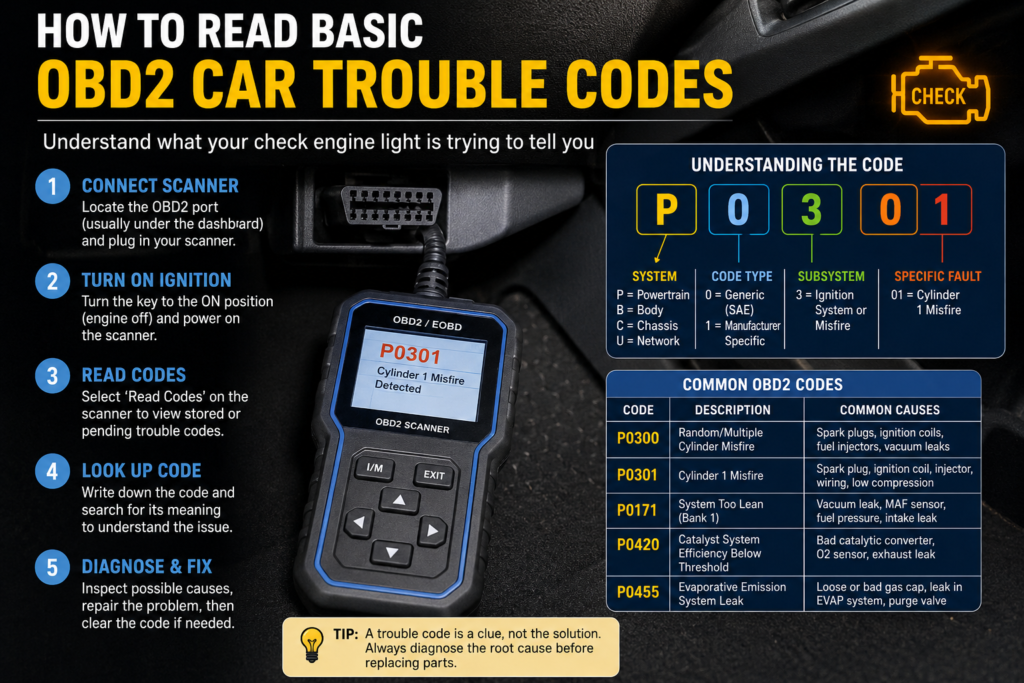
Most basic OBD2 trouble codes contain one letter followed by four numbers. A common example is P0301.
The first letter tells you which part of the vehicle is involved.
P means Powertrain. These codes usually relate to the engine, transmission, fuel system, or emissions system.
B means Body. These codes can relate to systems such as airbags, power seats, lighting, and other body related components.
C means Chassis. These codes can involve systems such as steering, suspension, or braking.
U means Network or communication. These codes can indicate communication problems between electronic control modules.
For most drivers, P codes are the ones they will encounter most often when the check engine light comes on.
Understanding the Numbers in an OBD2 Code
After the first letter, the four numbers provide more information about the problem.
For example, take the code P0301.
The P tells us that the problem is related to the powertrain.
The first number after the letter helps indicate whether the code is a generic code or manufacturer specific code.
The remaining numbers identify the general area of the fault.
P0301 is commonly associated with a cylinder one misfire. This tells us that the engine computer has detected a misfire involving cylinder one.
This does not necessarily mean that the spark plug is bad. The cause could be a spark plug, ignition coil, fuel injector, wiring problem, compression issue, or another engine problem.
That is why I believe reading the code is only the first step.
How to Use an OBD2 Scanner
Using a basic OBD2 scanner is usually quite simple.
First, park the vehicle safely and turn off the engine. Locate the OBD2 diagnostic port underneath the dashboard.
Plug the scanner into the port. Some scanners receive power directly through the diagnostic connector, while others may have additional power requirements.
Turn the vehicle ignition to the appropriate position. Depending on the scanner and vehicle, you may need to turn the ignition on without starting the engine.
The scanner should communicate with the vehicle computer. Follow the instructions displayed on the scanner and select the option to read diagnostic trouble codes.
The scanner may show one or several codes.
Write down every code before clearing anything. I strongly recommend keeping a record of the codes because this information can be useful if you need further diagnosis.
Common OBD2 Trouble Codes
Some OBD2 codes appear frequently across many vehicles.
P0300 Random or Multiple Cylinder Misfire
P0300 generally indicates that the engine computer has detected random or multiple cylinder misfires.
Possible causes include worn spark plugs, ignition problems, fuel delivery issues, vacuum leaks, or engine problems.
If the check engine light is flashing while the engine is running poorly, I would not continue driving unnecessarily. A serious misfire can potentially damage the catalytic converter.
P0301 Cylinder One Misfire
P0301 usually indicates a misfire detected on cylinder one.
The first things to investigate can include the spark plug, ignition coil, injector, wiring, and compression.
The exact cylinder location can vary depending on the engine design, so it is important to confirm the cylinder numbering for your specific vehicle.
P0171 System Too Lean
P0171 generally means the engine is running with too much air or not enough fuel according to the computer’s calculations.
Possible causes include vacuum leaks, intake leaks, dirty or faulty sensors, fuel delivery problems, or other issues affecting the air fuel mixture.
Replacing a sensor immediately is not always the correct solution. Checking for air leaks and examining the related data can be much more useful.
P0420 Catalyst System Efficiency Below Threshold
P0420 is commonly associated with catalytic converter efficiency.
This code can be caused by a catalytic converter that is no longer working efficiently. However, other problems can sometimes trigger it, including exhaust leaks or sensor related issues.
This is a good example of why an OBD2 code should not automatically be treated as a parts replacement instruction.
P0455 Evaporative Emission System Leak
P0455 usually indicates a large leak in the evaporative emissions system.
One of the simplest things to check is the fuel cap. If the cap is loose, damaged, or not sealing properly, the vehicle may detect an evaporative emissions leak.
This is one reason I always recommend checking simple possibilities before assuming that an expensive repair is required.
What Is a Pending Code?
Sometimes an OBD2 scanner shows a pending trouble code.
A pending code means the vehicle computer has detected a condition that may indicate a problem but has not necessarily confirmed it strongly enough to turn on the check engine light.
For example, the computer may notice an unusual sensor reading during one driving cycle. If the problem does not happen again, the vehicle may not turn on the warning light.
Pending codes can still be useful because they may provide an early clue about a developing problem.
Stored Codes and Active Problems Are Different
A stored code does not always mean the problem is happening right now.
A vehicle computer can store a code after detecting a problem. The issue may later disappear, but the code can remain stored until certain conditions are met or the memory is cleared.
This is especially important when buying a used car. Simply checking whether the check engine light is off is not enough. A scanner can sometimes reveal stored or pending information that deserves further investigation.
Should You Clear an OBD2 Code?
Most basic scanners allow you to clear diagnostic trouble codes.
However, I do not recommend clearing a code simply to turn off the check engine light without finding out why it appeared.
When you clear the codes, you may erase useful diagnostic information. You can also reset some of the vehicle’s emissions readiness monitors.
If the underlying problem remains, the warning light may return.
A better approach is to record the code, investigate the likely causes, repair the problem, and then clear the code if appropriate.
Read the Code Before Replacing Parts
This is probably the most important lesson when using an OBD2 scanner.
Do not assume that the code automatically identifies the failed component.
If your scanner reports an oxygen sensor related code, do not immediately buy a new oxygen sensor. First check the wiring, connectors, exhaust system, intake system, and sensor readings if you have the equipment to do so.
The vehicle computer is telling you that it detected an abnormal condition. Your job is to determine why that condition occurred.
This approach can prevent unnecessary parts replacement and save money.
What Should You Do After Reading a Code?
Once you have the code, search for the exact meaning for your specific vehicle. The vehicle’s year, engine, and model can make a difference.
Next, look for common causes associated with that code.
Then perform basic visual checks. Look for disconnected hoses, damaged wires, loose electrical connectors, damaged vacuum lines, or obvious leaks.
If the problem requires advanced testing, it may be better to have a qualified technician diagnose it.
A basic OBD2 scanner is excellent for gathering information, but it does not replace professional diagnostic equipment or mechanical experience.
Can You Drive With an OBD2 Code?
It depends on the code and the symptoms.
If the check engine light is on but the vehicle is running normally, the problem may not require immediate towing. However, it should still be investigated.
If the check engine light is flashing, the engine is shaking badly, there is a significant loss of power, unusual smoke, overheating, or other serious symptoms, I would avoid unnecessary driving and get the vehicle checked.
The warning light is useful, but the vehicle’s actual behavior is also an important part of diagnosis.
Final Thoughts
Learning how to read basic OBD2 car trouble codes is one of the easiest ways to become more informed about your vehicle. You do not need to be a professional mechanic to understand the basics.
An inexpensive OBD2 scanner can show you stored and pending diagnostic trouble codes and give you a starting point when the check engine light appears.
The most important thing is to remember that an OBD2 code is a clue, not always a direct instruction to replace a part. Read the code carefully, understand what system it refers to, check the simple possibilities first, and consider the vehicle’s symptoms before making a repair decision.
In my view, the real benefit of an OBD2 scanner is not simply turning off a warning light. It is being able to understand what your car is trying to tell you. With a little knowledge and careful diagnosis, basic OBD2 troubleshooting can help you make better repair decisions and avoid spending money on parts you may not actually need.