Related Articles
Connected cars are becoming an important part of modern transportation. When I think about how quickly vehicles have changed, one of the biggest differences is that cars are no longer limited to mechanical parts and basic electronic systems. Today, many vehicles can connect to the internet, communicate with smartphones, receive information from cloud services, and even share data with other systems.
This technology is commonly known as connected car technology. It allows a vehicle to stay connected while driving and gives drivers access to features that were difficult or impossible to provide in older cars. From real time traffic information to remote vehicle control, internet connected vehicles are changing the way we use and maintain our cars.
In this article, I will explain how connected cars work, what technologies they use, what benefits they offer, and what drivers should know about privacy and security.
What Is a Connected Car?
A connected car is a vehicle that can communicate with external networks and devices through wireless technology. The connection may use a cellular network, Wi Fi, Bluetooth, GPS, or other communication systems.
The main idea is simple. A connected vehicle collects information through its sensors and electronic control systems. That information can then be processed inside the vehicle or sent to a cloud platform through an internet connection.
For example, a car may send information about its location, fuel level, battery condition, tire pressure, or engine performance to a connected service. The driver may then see some of this information through a smartphone application or the vehicle’s infotainment screen.
In my view, the most useful part of connected car technology is that it brings information together. Instead of relying only on what the driver can see or hear, the vehicle can use digital information to provide a better understanding of what is happening around and inside the car.
How Internet Connected Vehicles Work
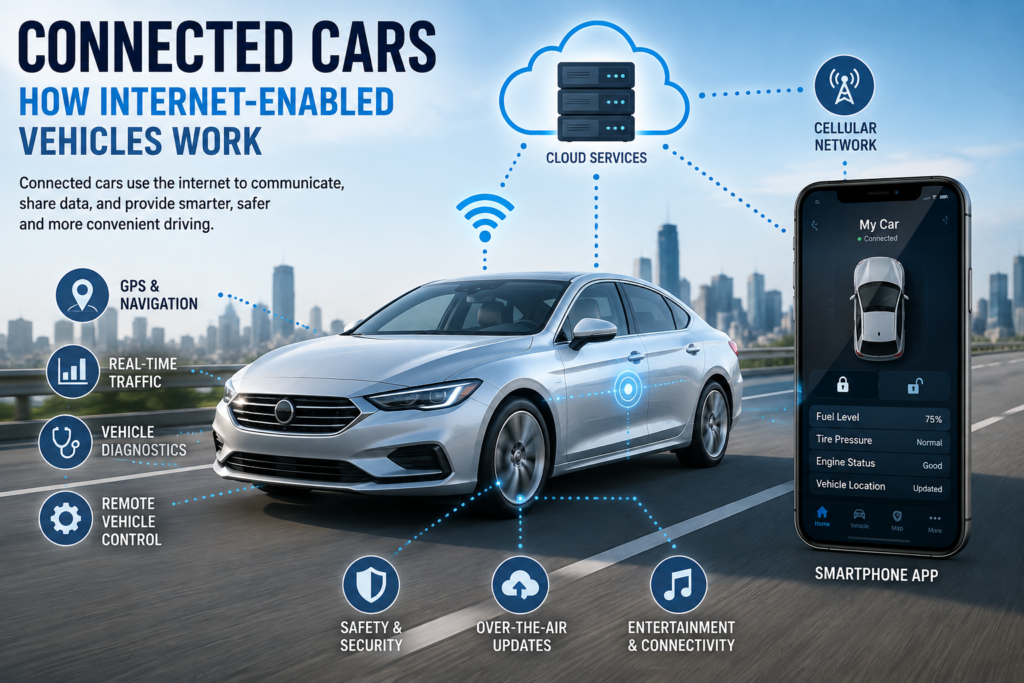
Connected cars depend on several technologies working together. The vehicle usually has sensors, electronic control units, a communication module, software, and access to a network.
The sensors collect information from different parts of the vehicle. These sensors can monitor things such as engine temperature, wheel speed, tire pressure, fuel level, battery condition, and vehicle position.
The electronic control units process much of this information. Modern vehicles may contain many control modules that manage the engine, transmission, safety systems, climate control, lighting, and other functions.
A communication module allows the car to send and receive information. Many connected vehicles use cellular networks in a similar way to smartphones. Some vehicles can also connect to Wi Fi networks and nearby devices.
Once the information reaches a cloud server, software can analyze it and return useful information to the vehicle or driver’s smartphone.
The Role of Cellular Networks
Cellular connectivity is one of the most important technologies behind connected cars. A vehicle equipped with a built in cellular modem can communicate with remote servers even when there is no Wi Fi connection available.
This is useful because cars travel over large areas. A vehicle cannot depend on a home Wi Fi network when it is driving across a highway or traveling between cities.
The cellular connection can support navigation updates, emergency communication, remote vehicle services, traffic information, software updates, and other connected features.
The quality of these services depends on network coverage. If a vehicle enters an area with weak cellular coverage, some connected functions may become slower or temporarily unavailable.
Cloud Computing and Connected Cars
Cloud computing plays a major role in modern connected vehicle systems. Instead of processing every piece of information inside the vehicle, some data can be sent to remote servers for processing and storage.
For example, a vehicle manufacturer may collect diagnostic information from many vehicles. Software can analyze this information to identify common problems or patterns.
Cloud systems can also provide services such as traffic information, navigation data, weather information, entertainment content, and account based vehicle settings.
From my perspective, cloud technology makes connected cars much more flexible. A vehicle can receive new information without requiring every function to be physically changed.
Smartphone Integration
One of the easiest ways to understand connected car technology is through smartphone integration. Many modern vehicles can communicate with a driver’s smartphone using Bluetooth, Wi Fi, or internet based services.
A smartphone application may allow the owner to check the vehicle’s location, lock or unlock doors, check fuel or battery status, schedule maintenance, or start certain vehicle functions remotely.
Some vehicles can also send alerts to the driver’s phone. For example, the application might notify the owner if the vehicle has a low tire pressure warning or if a maintenance issue has been detected.
These features can be particularly convenient because the driver does not always need to be sitting inside the car to access important information.
GPS and Location Services
GPS is another important part of connected vehicles. Navigation systems use satellite positioning to determine the vehicle’s location and provide directions.
Connected cars can combine GPS information with internet based services to offer more advanced navigation features. These may include live traffic information, road conditions, parking information, and updated points of interest.
A connected navigation system can also receive map updates without requiring the driver to manually install new map data.
Location information can be extremely useful, but it also raises privacy questions. Drivers should understand what location information their vehicle collects and how that information is used.
Remote Vehicle Functions
Internet connectivity can allow drivers to control certain vehicle functions from a distance. Depending on the vehicle and service package, remote functions may include locking doors, checking vehicle status, activating climate control, or starting the engine.
These features can be helpful in everyday situations. For example, a driver may want to check whether the vehicle was locked after walking away from it.
Remote functions are controlled through secure communication between the smartphone application, cloud platform, and vehicle. Because these functions can affect the vehicle directly, manufacturers need to use strong security systems to prevent unauthorized access.
Connected Cars and Vehicle Diagnostics
One of the most useful applications of connected car technology is remote vehicle diagnostics. Modern vehicles constantly monitor their systems using sensors and electronic control modules.
When a problem occurs, the vehicle may store a diagnostic trouble code. In some connected vehicles, relevant information can also be transmitted to a manufacturer’s service platform.
This can help drivers understand that a maintenance issue may need attention before it becomes a major problem.
For example, a vehicle could detect an abnormal engine condition and send a warning to the driver. Some systems can also help service centers prepare for an appointment by identifying possible problems in advance.
I believe this is one of the areas where connected cars can provide real practical value. Early information can make vehicle maintenance easier and potentially reduce unexpected breakdowns.
Over The Air Software Updates
Another important feature of connected cars is over the air software updating. Traditionally, software updates often required a visit to a dealership or service center.
Internet connected vehicles can receive certain software updates through their communication systems. These updates may improve vehicle functions, fix software problems, improve security, or introduce new features.
The exact capabilities depend on the manufacturer and vehicle model. Safety critical systems may still require professional service in some situations.
Over the air updates show how cars are becoming more like connected electronic devices. The vehicle can continue receiving software improvements after it leaves the factory.
Connected Cars and Road Safety
Connected technology can also contribute to safer driving. Real time traffic information can help drivers avoid congested roads. Navigation systems can provide information about road conditions and possible hazards.
Some connected vehicles can communicate with emergency services after a serious accident. Depending on the system, information such as vehicle location and crash related details may be transmitted to help emergency responders.
Vehicle communication technology may also support future systems in which cars communicate with infrastructure and other vehicles. This could help warn drivers about hazards that are difficult to see directly.
However, connected technology should support safe driving rather than distract the driver. Drivers should always focus on the road and use vehicle technology responsibly.
Privacy and Security Concerns
Connected cars provide many benefits, but they also create new privacy and security concerns. A vehicle can generate a large amount of information, including location data, vehicle status, usage information, and information about connected devices.
Drivers should understand the privacy policies associated with their vehicle and connected services. It is also important to use strong passwords and protect smartphone accounts that are connected to the vehicle.
Manufacturers have a major responsibility to protect vehicle communication systems against unauthorized access. Software security should be treated as an important part of vehicle design.
As connected cars become more common, I think consumers will need to pay more attention to digital privacy in the same way they already consider fuel economy, safety, and maintenance costs.
The Future of Connected Cars
Connected vehicle technology is still developing. Future cars are expected to communicate more effectively with cloud services, smart cities, charging networks, traffic systems, and other vehicles.
Electric vehicles are also benefiting from connectivity. Drivers can use connected services to check battery levels, find charging stations, monitor charging progress, and manage charging schedules.
Artificial intelligence may make connected systems even more useful by analyzing large amounts of vehicle and road information. This could improve navigation, maintenance predictions, personalization, and safety features.
At the same time, manufacturers will need to focus strongly on cybersecurity, privacy, reliability, and responsible data use.
Final Thoughts
Connected cars represent a major change in automotive technology. A modern vehicle is no longer just a machine that transports people from one place to another. It can also act as a connected computer that communicates with smartphones, cloud platforms, road systems, and other digital services.
Internet connectivity allows vehicles to provide real time information, remote functions, navigation improvements, vehicle diagnostics, software updates, and emergency services.
In my opinion, the biggest advantage of connected car technology is convenience combined with useful information. When these systems are designed properly, they can make driving and vehicle ownership easier.
However, drivers should not ignore privacy and security. Understanding what information a connected vehicle collects and how it is protected is becoming just as important as understanding the mechanical side of a car.
As technology continues to improve, connected cars will likely become even more common. The vehicles of the future will not simply be smarter machines. They will be part of a much larger digital transportation network.