
Related Articles

When we talk about modern cars, the engine is often the first thing that comes to mind. However, there is another important part working quietly in the background that helps the engine run smoothly, efficiently, and safely. This part is called the Engine Control Unit, commonly known as the ECU. In my view, the ECU is one of the most important electronic components in a modern vehicle because it constantly monitors what is happening inside the engine and makes adjustments within seconds.
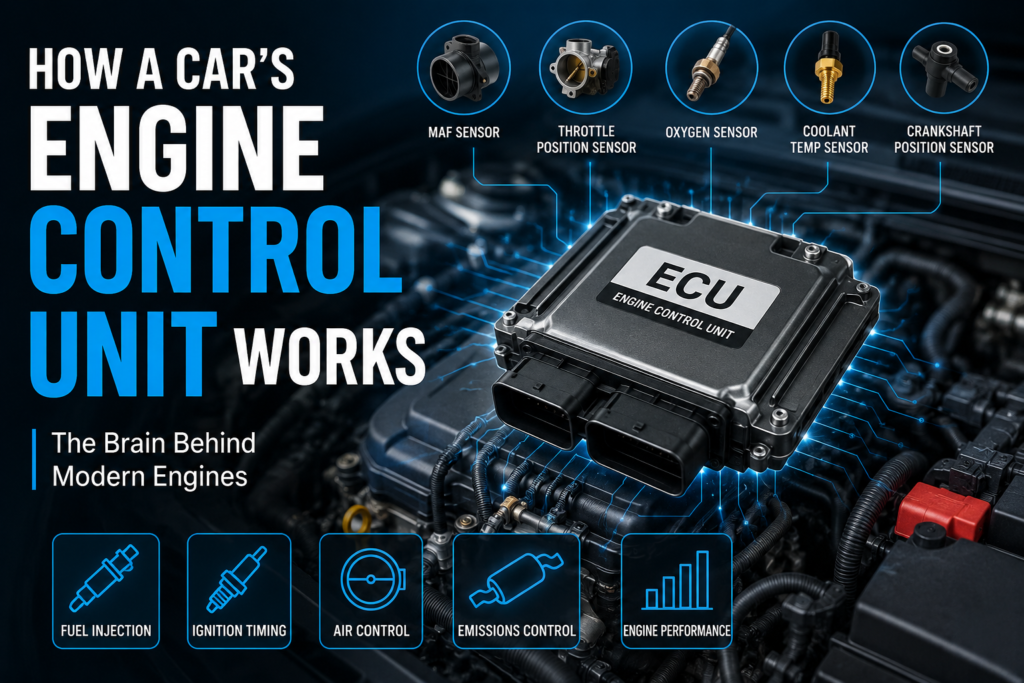
The Engine Control Unit works like the brain of the engine. It receives information from different sensors, processes that information, and then sends commands to components such as fuel injectors, ignition systems, throttle controls, and other engine systems. Without the ECU, most modern fuel injected engines would not be able to operate with the same level of accuracy and efficiency.
In this article, I will explain how a car’s Engine Control Unit works, what it does, which sensors provide information to it, and why the ECU is so important for modern vehicles.
What Is an Engine Control Unit?
An Engine Control Unit is a small electronic computer installed inside a vehicle. Its main purpose is to control and manage different functions of the engine. Depending on the vehicle, it may also be called an Engine Control Module or ECM.
The ECU contains a processor, memory, electrical circuits, and software designed specifically for controlling engine operations. It receives signals from sensors located throughout the engine and uses those signals to determine what the engine needs at a particular moment.
For example, when I press the accelerator, the ECU does not simply increase fuel delivery. It looks at information such as engine speed, air entering the engine, throttle position, engine temperature, and oxygen levels in the exhaust. It then calculates how much fuel and ignition timing are required.
This process happens extremely quickly, allowing the engine to respond smoothly to changes in driving conditions.
How Does an Engine Control Unit Work?
The basic operation of an ECU can be understood in three simple stages. First, it collects information. Second, it processes that information. Third, it sends instructions to different engine components.
Sensors constantly provide information to the ECU. These sensors measure things such as air temperature, engine temperature, crankshaft position, throttle position, oxygen levels, and engine speed.
The ECU compares this information with programmed values stored in its software. Based on the information it receives, it decides what action is required.
For example, if the engine needs more fuel, the ECU can increase the amount of time that the fuel injectors remain open. If the engine is cold, it can adjust the fuel mixture and ignition timing to help the engine start and warm up properly.
This continuous communication between sensors, the ECU, and engine components is what allows modern engines to operate efficiently.
Important Sensors Connected to the ECU
The Engine Control Unit depends heavily on sensors. Without accurate sensor information, the ECU cannot make correct decisions.
One important sensor is the Mass Airflow Sensor. It measures the amount of air entering the engine. The ECU uses this information to determine how much fuel should be injected.
The Throttle Position Sensor monitors the position of the throttle. When the driver presses the accelerator, the throttle position changes, and the sensor reports this change to the ECU.
The Engine Coolant Temperature Sensor tells the ECU how hot or cold the engine is. This information helps the ECU adjust fuel delivery, ignition timing, cooling functions, and other operations.
The Crankshaft Position Sensor monitors the position and speed of the crankshaft. This information is extremely important because the ECU uses it to determine when fuel should be injected and when the spark plugs should fire.
The Oxygen Sensor measures oxygen levels in the exhaust gases. The ECU uses this information to adjust the air and fuel mixture and help maintain efficient combustion.
There are also other sensors, including the Manifold Absolute Pressure Sensor, Camshaft Position Sensor, Knock Sensor, and Intake Air Temperature Sensor. All of these sensors provide information that helps the ECU make accurate decisions.
How the ECU Controls Fuel Injection
Fuel control is one of the most important jobs performed by an Engine Control Unit.
Modern engines use fuel injectors to deliver fuel into the engine. The ECU controls when these injectors open and how long they remain open.
If the engine needs more power, the ECU can increase fuel delivery. During lighter driving conditions, it can reduce fuel delivery to improve fuel economy.
The ECU also considers air entering the engine. Maintaining the correct air and fuel mixture is essential for efficient combustion. Too much fuel can reduce fuel economy and increase emissions, while too little fuel can cause poor performance and engine hesitation.
This is why the ECU continuously adjusts fuel injection while the vehicle is running.
How the ECU Controls Ignition Timing
Another major responsibility of the ECU is controlling ignition timing.
In a gasoline engine, spark plugs ignite the air and fuel mixture inside the cylinders. The exact timing of this spark is extremely important.
The ECU uses information from sensors to determine when the spark should occur. Engine speed, load, temperature, and other conditions can affect the ideal ignition timing.
The ECU can advance or delay the ignition timing depending on what the engine needs. This helps improve performance, fuel efficiency, and smooth operation.
The Knock Sensor is especially important here. If the engine detects abnormal combustion, the ECU can adjust ignition timing to help protect the engine.
The ECU and Engine Performance
The ECU plays a major role in how a car feels while driving. Acceleration, idle quality, fuel consumption, and overall engine response can all be influenced by ECU decisions.
When everything is working correctly, the driver may never notice the ECU. The engine starts easily, idles smoothly, responds properly to the accelerator, and maintains good fuel economy.
In my opinion, this is one of the most interesting things about modern vehicle technology. A driver may only see the accelerator pedal, but behind that simple action there is a complicated electronic process happening almost instantly.
The ECU is constantly calculating what the engine needs and adjusting its operation accordingly.
ECU and Fuel Economy
Fuel economy is another area where the Engine Control Unit makes a significant difference.
The ECU constantly works to provide the engine with the amount of fuel it needs. During steady cruising, the engine may require relatively little fuel. During acceleration or heavy loads, more fuel may be required.
By adjusting fuel injection based on real time information, the ECU helps prevent unnecessary fuel consumption.
Oxygen sensors also play an important role because they allow the ECU to monitor combustion results through the exhaust. The ECU can then make adjustments to maintain an appropriate air and fuel mixture.
A properly functioning ECU can therefore contribute to better fuel efficiency.
ECU and Emissions Control
Modern vehicles are designed to meet strict emissions requirements, and the ECU is an important part of this process.
The ECU monitors engine operation and works with systems designed to reduce harmful exhaust emissions. It uses information from oxygen sensors and other sensors to maintain proper combustion.
The ECU can also control components related to emissions management, depending on the vehicle design. These may include the Exhaust Gas Recirculation system, evaporative emissions system, and other emission control components.
When an emissions related problem occurs, the ECU may detect unusual sensor readings and store a diagnostic trouble code.
What Happens When the ECU Detects a Problem?
One of the useful features of a modern ECU is its ability to detect problems.
If a sensor sends an unusual signal or an engine component operates outside its expected range, the ECU can store a diagnostic trouble code. In many situations, this can also cause the Check Engine Light to appear on the dashboard.
A mechanic can use an OBD diagnostic scanner to communicate with the vehicle’s computer and read stored codes.
It is important to understand that a trouble code does not always identify the exact failed part. It usually provides information about a system or condition that needs further investigation.
For example, an oxygen sensor related code does not automatically mean that the oxygen sensor itself is defective. There may be wiring problems, exhaust leaks, or other issues causing the unusual reading.
Can an ECU Be Reprogrammed?
Yes, many modern ECUs can be reprogrammed. This process is commonly known as ECU tuning or ECU remapping.
Manufacturers program the ECU with specific software that controls engine operation. In some situations, updated software can be installed to correct problems or improve certain aspects of vehicle operation.
Performance tuning can also change ECU settings. However, I believe ECU modifications should be approached carefully. Incorrect software changes can cause poor engine operation, increased fuel consumption, excessive emissions, or even mechanical damage.
For everyday drivers, keeping the original ECU software updated and maintaining the vehicle properly is usually more important than making performance modifications.
Common Signs of ECU Related Problems
An ECU itself is generally reliable, but electronic or software related problems can occur.
Possible signs of an ECU or engine management problem include difficulty starting the engine, rough idling, poor acceleration, reduced fuel economy, unexpected warning lights, or unusual engine behavior.
However, these symptoms can also be caused by faulty sensors, wiring problems, fuel system issues, ignition problems, or mechanical faults.
That is why proper diagnosis is important. Replacing an ECU without testing the rest of the system can be expensive and may not solve the original problem.
Why the ECU Is Important in Modern Cars
The Engine Control Unit has changed the way modern engines operate. Older engines relied much more heavily on mechanical systems, while modern vehicles use electronic control to achieve greater precision.
The ECU can react to changing conditions almost instantly. Whether the vehicle is starting on a cold morning, climbing a hill, cruising on a highway, or accelerating onto a busy road, the ECU continuously adjusts engine operation.
From my point of view, the biggest advantage of the ECU is its ability to make thousands of small decisions while the driver simply focuses on driving.
Final Thoughts
The Engine Control Unit is essentially the brain behind many of the functions that make a modern car engine work properly. It receives information from sensors, processes that information using programmed software, and sends instructions to fuel injectors, ignition components, throttle systems, and other engine related components.
Its job is not limited to improving performance. The ECU also helps control fuel economy, emissions, engine reliability, starting, and overall drivability.
Understanding how a car’s Engine Control Unit works makes it easier to appreciate the technology inside modern vehicles. What looks like a simple engine from the outside is actually a highly coordinated system of mechanical and electronic components.
As automotive technology continues to develop, the role of electronic control systems will become even more important. For anyone interested in cars, learning about the ECU is a great way to understand how modern engines achieve smooth performance, efficient fuel consumption, and reliable operation.
I can also create an AdSense friendly featured image for WordPress related to this article.