
Related Articles

Electronic Stability Control, commonly known as ESC, is one of the most important safety technologies found in modern cars. It is designed to help drivers maintain control when a vehicle starts to lose stability, especially during sudden turns, slippery road conditions, or emergency situations.
In my view, ESC is one of those car safety features that many drivers do not think about until they actually need it. You may drive for years without noticing the system working, but when your car begins to slide or move in an unexpected direction, Electronic Stability Control can make a meaningful difference.
In this article, I will explain what Electronic Stability Control is, how it works, why it is important, and what drivers should know about the ESC warning light.
What Is Electronic Stability Control?
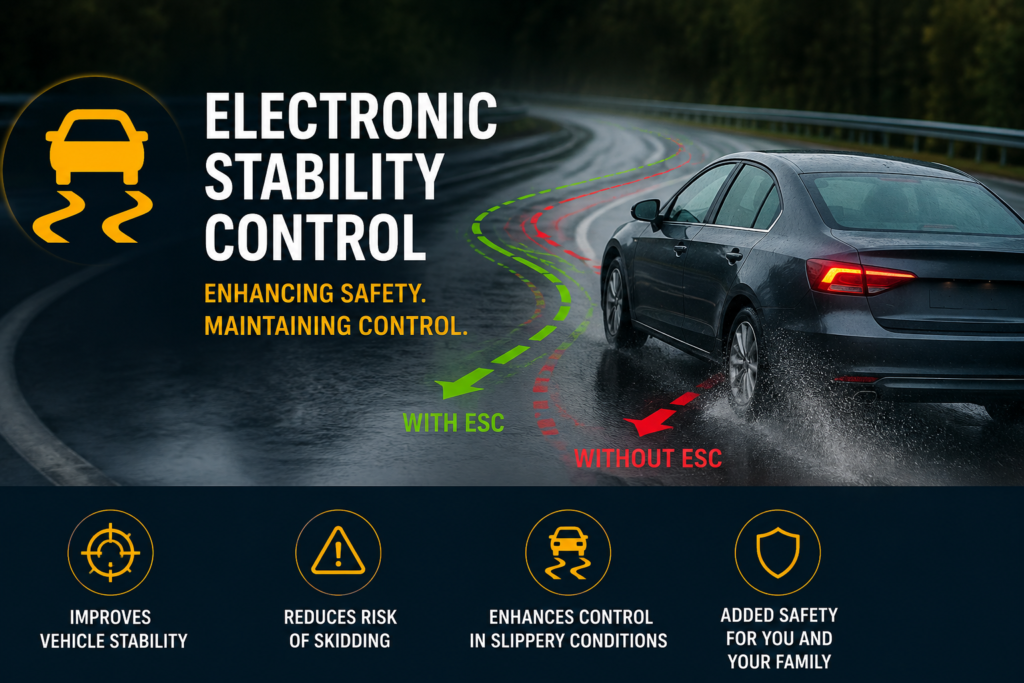
Electronic Stability Control is an active vehicle safety system that helps a driver maintain control of a car when the vehicle begins to lose stability. The system constantly monitors the direction of the vehicle and compares it with the direction the driver wants to travel.
If ESC detects that the car is not following the intended path, it can automatically apply braking force to individual wheels and, in many vehicles, reduce engine power. This helps bring the vehicle back toward the driver’s intended direction.
For example, imagine you are driving around a corner and the road is wet. If the vehicle starts sliding toward the outside of the corner, ESC can detect the change and respond quickly. The system may apply the brakes to selected wheels to help stabilize the car.
This happens very quickly, often before the driver has enough time to react.
How Does Electronic Stability Control Work?
Electronic Stability Control uses several sensors and control systems to understand what the vehicle is doing.
The system can monitor steering wheel movement, wheel speed, vehicle rotation, and sideways movement. A central electronic control unit processes information from these sensors many times per second.
The steering angle sensor tells the system where the driver wants the car to go. Wheel speed sensors monitor how quickly each wheel is rotating. A yaw rate sensor measures how much the vehicle is rotating around its vertical axis. Other sensors can help measure sideways acceleration and overall vehicle movement.
The computer compares the driver’s steering input with the actual movement of the car.
If everything matches, ESC does not need to interfere. However, if the system detects a significant difference, it can take action.
The system may apply the brake to one or more individual wheels. It may also reduce engine power when necessary. By doing this, ESC can help the vehicle return to a more stable path.
Why Is Electronic Stability Control Important?
The main purpose of Electronic Stability Control is to reduce the possibility of losing control.
A vehicle can become unstable for many reasons. Wet roads, loose gravel, snow, ice, high speed, sudden steering, and unexpected obstacles can all affect vehicle stability.
A driver may react quickly but still be unable to correct a slide. ESC provides an additional layer of assistance by monitoring the vehicle continuously.
I consider this especially useful during emergency situations. A driver may suddenly need to avoid another vehicle, an animal, a pothole, or an object on the road. A quick steering movement can sometimes cause the vehicle to become unstable.
ESC can help control that movement and reduce the severity of the situation.
Electronic Stability Control and Skidding
One of the most important jobs of ESC is helping when a vehicle begins to skid.
There are two common types of vehicle skidding. One happens when the front tires lose grip and the car continues moving toward the outside of a turn. Another happens when the rear of the vehicle begins moving sideways.
ESC can detect these changes by comparing steering input with actual vehicle movement.
When the system identifies a stability problem, it can brake individual wheels to create a corrective force. This may help the vehicle follow the intended direction.
However, ESC does not create additional tire grip. If the road is extremely slippery or the vehicle is being driven too fast for the conditions, the system may not be able to prevent a loss of control.
This is an important point that every driver should understand. Electronic Stability Control is a safety aid, not a replacement for careful driving.
ESC, Traction Control, and ABS
Many drivers confuse Electronic Stability Control with traction control and Anti lock Braking System.
These systems are related, but they perform different jobs.
Anti lock Braking System helps prevent the wheels from locking during hard braking. This allows the driver to maintain better steering control while braking heavily.
Traction control helps reduce wheel spin when a vehicle accelerates on a surface with limited grip.
Electronic Stability Control focuses mainly on vehicle stability and directional control. It can use braking intervention and engine power reduction to help keep the vehicle on its intended path.
Modern vehicles often combine these systems because they work together to improve overall driving safety.
What Does the ESC Warning Light Mean?
The ESC warning light can behave differently depending on the vehicle and manufacturer.
If the ESC light flashes briefly while driving, it may simply mean that the system is actively working. For example, if your car begins to lose traction on a wet road, the ESC system may activate and the warning light can flash.
If the ESC light remains illuminated continuously, it may indicate that the system has been turned off or that there is a fault that needs attention.
Some vehicles display a message such as ESC OFF. This usually means the stability control system has been manually disabled or has temporarily been switched off under certain conditions.
If the warning light stays on unexpectedly, I would recommend checking the vehicle owner’s manual and having the car inspected if necessary. A problem with a wheel speed sensor, steering angle sensor, wiring, or another related component can sometimes affect the ESC system.
Can You Drive With the ESC Light On?
Whether you can continue driving depends on why the light is illuminated.
If the ESC system has simply been switched off, the vehicle may continue operating normally, but you will not have the same level of electronic stability assistance.
If the light comes on because of a system fault, other safety systems may also be affected depending on the vehicle.
For normal driving, I prefer to have ESC fully operational because unexpected road conditions can happen at any time.
If the warning light appears together with other serious warning lights, unusual braking behavior, steering problems, or other symptoms, it is better to stop somewhere safe and have the vehicle checked.
Should You Turn Electronic Stability Control Off?
Most drivers should leave ESC turned on.
There are certain situations where some vehicles allow the driver to reduce or disable stability control. This can sometimes be useful when a vehicle is stuck in snow, mud, or loose material because a small amount of wheel spin may help the vehicle move.
However, turning ESC off during normal road driving removes an important safety feature.
I would only use the ESC off function when there is a specific reason and when the vehicle manufacturer recommends doing so.
Once the difficult situation is over, the system should normally be switched back on.
Does ESC Improve Tire Grip?
Electronic Stability Control does not physically increase tire grip.
Your tires still depend on the condition of the road surface and the quality of the tires. If your tires are badly worn or incorrectly inflated, ESC cannot completely compensate for the loss of grip.
This is why tire maintenance remains extremely important.
Good tires, correct tire pressure, proper wheel alignment, and responsible driving all work together with ESC to improve vehicle safety.
ESC should be viewed as another layer of protection rather than a system that makes a vehicle impossible to skid.
Electronic Stability Control in Modern Cars
ESC has become a common safety feature in modern vehicles. Many newer cars also combine ESC with other technologies such as automatic emergency braking, lane assistance, adaptive cruise control, and advanced driver assistance systems.
The exact operation can vary between manufacturers and vehicle models, but the basic goal remains similar. The vehicle monitors its movement and helps the driver maintain stability when necessary.
As automotive technology continues to improve, stability control systems are becoming more advanced and can work together with other safety systems to provide better protection.
How Drivers Can Get the Most From ESC
The best way to benefit from Electronic Stability Control is to understand its limitations.
First, drive at a safe speed for the road and weather conditions. Speed has a major effect on how much control a vehicle has during an emergency.
Second, maintain your tires properly. Check tire pressure regularly and replace tires when the tread becomes too worn.
Third, pay attention to warning lights. If the ESC warning light stays on when you have not intentionally switched the system off, do not simply ignore it.
Finally, remember that ESC cannot overcome the laws of physics. A vehicle traveling too quickly on an extremely slippery surface can still lose control.
Final Thoughts
Electronic Stability Control is an important part of modern vehicle safety. It works quietly in the background and monitors vehicle movement to help keep the car traveling in the direction intended by the driver.
From my point of view, the biggest advantage of ESC is that it provides an extra level of protection during moments when normal driving control may not be enough. Whether you are dealing with a wet road, a sudden obstacle, or an unexpected loss of traction, the system can respond much faster than a human driver can sometimes react.
Still, ESC should never encourage risky driving. Safe speed, good tires, proper maintenance, and careful attention remain essential.
Understanding what Electronic Stability Control does can help you become a more informed driver. The next time you see the ESC light flash briefly while driving, you will know that the system may simply be doing its job and helping maintain vehicle stability when you need it most.