
Related Articles

The automobile industry is changing quickly, and electric cars and hybrid cars are becoming more common every year. Both technologies are designed to reduce fuel consumption and make driving more efficient, but they work in very different ways. If you are thinking about buying a modern vehicle, understanding the difference between electric cars and hybrid cars can help you make a better decision.
In my view, the choice between an electric car and a hybrid car mainly depends on your driving habits, budget, charging access, and the type of driving you normally do. An electric car can be an excellent choice for someone who wants completely electric driving, while a hybrid can be more practical for drivers who want better fuel economy without depending completely on charging stations.
What Is an Electric Car?
An electric car, also known as an EV, uses electricity as its main source of power. Instead of a traditional gasoline engine, an electric vehicle uses an electric motor powered by a rechargeable battery pack.
The battery stores electrical energy, which is sent to the motor when the driver presses the accelerator. The motor then turns the wheels and moves the vehicle. Electric cars do not need gasoline or diesel to operate.
One of the biggest advantages of electric cars is their simple powertrain. There are fewer moving mechanical parts compared with a traditional gasoline vehicle. This can reduce the need for certain types of maintenance.
Electric cars also produce no tailpipe emissions while driving. This is one of the main reasons they are considered an important part of the transition toward cleaner transportation.
What Is a Hybrid Car?
A hybrid car combines two different power sources. Usually, these are a gasoline engine and one or more electric motors.
The electric motor can help the gasoline engine during acceleration, while the gasoline engine can provide power when the battery needs assistance or when the vehicle is traveling at higher speeds. Depending on the hybrid system, the car can sometimes drive using electric power alone for short distances.
Hybrid cars use a battery that is charged through the vehicle’s regenerative braking system and by the gasoline engine. Some hybrid models are also plug in hybrids, which can be connected to an external charging source to provide more electric driving range.
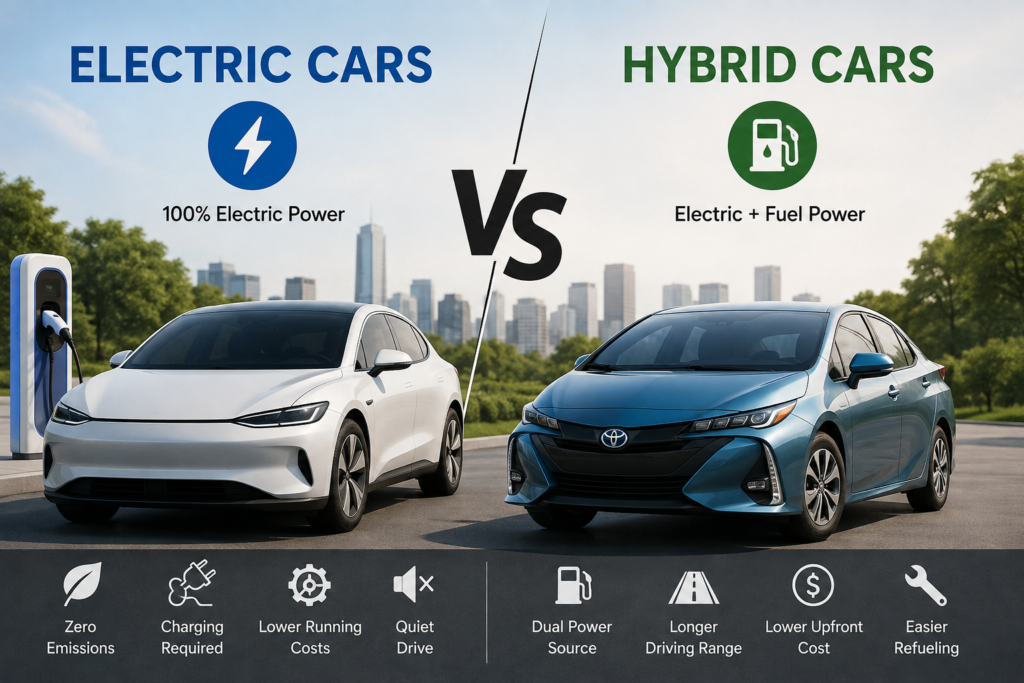
In simple terms, a hybrid car gives you a combination of gasoline and electric power, while a fully electric car depends entirely on electricity.
Electric Cars vs Hybrid Cars: Power Source
The biggest difference between electric cars and hybrid cars is the power source.
An electric car relies entirely on electricity stored in its battery. You charge the battery using a home charger, wall outlet, or public charging station. Once charged, the vehicle uses that stored energy to power the electric motor.
A hybrid car has both an internal combustion engine and an electric motor. The gasoline engine can operate for longer journeys, while the electric motor helps improve efficiency, especially during city driving.
From my point of view, this difference is important because it changes how you use the vehicle every day. With an EV, charging becomes part of your routine. With a hybrid, you can continue using fuel stations like a conventional car.
Charging and Refueling
Charging is another major difference.
Electric cars need to be charged when their battery becomes low. Charging time depends on the vehicle, battery size, charger type, and charging conditions. Home charging can be convenient because you can charge the vehicle while it is parked overnight.
Public fast chargers can provide energy much more quickly, although charging is still different from filling a gasoline tank.
Traditional hybrid cars generally do not need to be plugged in. Their batteries are charged through regenerative braking and the gasoline engine. This makes a hybrid very convenient for people who do not have easy access to a home or public charger.
Plug in hybrid cars are different because they can be connected to an external power source. This allows them to use electric power for longer distances before the gasoline engine becomes necessary.
Driving Range
Driving range is an important consideration when comparing electric cars vs hybrid cars.
Modern electric cars can offer impressive driving ranges, but the actual range can change depending on weather, driving speed, road conditions, passenger load, and use of heating or air conditioning.
For daily commuting, an electric car can be more than enough for many drivers. If you have a reliable place to charge at home, range anxiety can also become much less of a concern.
Hybrid cars have an advantage for long distance travel because they can use gasoline when the battery power is low. You can simply visit a fuel station and continue your journey.
This makes hybrid cars attractive for people who regularly travel long distances or live in areas where charging infrastructure is still developing.
Fuel Economy and Energy Efficiency
Both electric and hybrid cars can reduce energy consumption compared with conventional gasoline vehicles, but electric cars generally use energy more efficiently at the vehicle level.
Electric motors can convert electrical energy into movement very efficiently. They also provide instant torque, which gives electric cars quick and smooth acceleration.
Hybrid cars improve fuel economy by allowing the electric motor to assist the gasoline engine. They can also shut off the engine when it is not needed and recover energy during braking.
For city driving, hybrids can be particularly efficient because frequent stopping and starting gives the system more opportunities to use electric power and recover energy.
Maintenance Differences
Maintenance is another area where electric cars and hybrid cars are different.
An electric car usually has fewer mechanical components that require regular servicing. There is no traditional engine oil to replace, and many engine related components found in gasoline cars are not present.
However, electric vehicles still require maintenance. Tires, brakes, suspension components, cooling systems, cabin filters, and other parts still need attention.
Hybrid cars have an electric system and a gasoline engine, so they still require many conventional maintenance services. Engine oil, filters, spark plugs in some models, and other engine components may need servicing.
That does not mean hybrids are unreliable. Modern hybrid systems have been developed for many years and can be very dependable when properly maintained.
Performance and Driving Experience
The driving experience is also noticeably different.
Electric cars usually feel very smooth because the electric motor delivers power immediately. Acceleration can be strong, and there is no traditional gear shifting sensation in many EVs.
Hybrid cars can also provide smooth performance, especially when the electric motor is assisting the gasoline engine. However, the gasoline engine can still be heard and felt when it starts or becomes heavily involved.
Personally, I think electric cars offer one of the simplest and quietest driving experiences available today. Hybrid cars provide a more familiar experience while still giving drivers many benefits of electric technology.
Purchase Price
The purchase price depends heavily on the model, battery size, features, and local market.
Electric cars can sometimes have a higher initial purchase price because of the cost of their battery technology. However, prices vary widely, and government incentives or manufacturer offers may affect the final cost.
Hybrid cars are available in many price ranges and can sometimes be easier to purchase for drivers who want improved fuel economy without moving completely to electric driving.
When comparing prices, I believe it is important to look beyond the showroom price. Electricity costs, fuel costs, maintenance, insurance, charging equipment, and long term ownership expenses can all affect the real cost of a vehicle.
Environmental Impact
Electric cars have an important environmental advantage because they produce no tailpipe emissions during operation.
However, it is important to understand that electric vehicles are not completely free from environmental impact. Manufacturing batteries requires raw materials and energy, while electricity generation can also produce emissions depending on how the electricity is produced.
Hybrid cars can reduce fuel consumption and tailpipe emissions compared with conventional gasoline vehicles. They still burn gasoline, but their electric systems can make the engine operate more efficiently.
In my opinion, both technologies can play a useful role in reducing transportation emissions, although fully electric cars provide a larger step away from direct fossil fuel use.
Which Is Better for City Driving?
For city driving, an electric car can be an excellent option. Stop and go traffic is well suited to electric motors, and regenerative braking can recover some of the energy that would otherwise be lost during braking.
Hybrids are also excellent in cities because their electric motor can frequently assist the gasoline engine. Some hybrids can operate on electric power alone during certain low speed situations.
If you have a convenient charging setup at home, an EV can make a lot of sense for regular city commuting.
Which Is Better for Long Distance Travel?
For frequent long distance travel, a hybrid can be more convenient because you can refuel quickly and continue driving.
An electric car can also handle long trips, but planning may be more important. You may need to consider charging locations, charging time, weather conditions, and available range.
As charging networks continue to improve, electric cars are becoming easier to use for road trips. Still, drivers who regularly travel through areas with limited charging infrastructure may prefer a hybrid.
Electric Cars vs Hybrid Cars: Which Should You Choose?
There is no single answer that works for everyone.
An electric car may be the better choice if you have access to convenient charging, mostly drive short or medium distances, want a quiet driving experience, and prefer to eliminate gasoline use.
A hybrid car may be a better choice if you frequently travel long distances, do not have convenient charging access, or want improved fuel economy while keeping the convenience of gasoline refueling.
Your local climate, electricity prices, fuel prices, driving conditions, and vehicle availability should also be considered before making a final decision.
Final Thoughts
Electric cars and hybrid cars represent two different approaches to more efficient transportation. Electric cars use battery power and electric motors for completely electric driving, while hybrid cars combine gasoline engines with electric technology.
The main differences include their power sources, charging requirements, driving range, maintenance needs, environmental impact, and overall driving experience.
From my perspective, electric cars are a strong choice for drivers who have reliable charging access and want to move completely away from gasoline. Hybrid cars remain an excellent option for people who want better fuel economy without changing the way they refuel their vehicles.
The best choice is ultimately the one that matches your daily driving needs. Before buying either type, I recommend comparing the total ownership cost, available charging facilities, expected driving range, maintenance requirements, and local conditions. Once you look at these factors together, choosing between an electric car and a hybrid car becomes much easier.