Related Articles
vWhen I think about tire technology, run flat tires are one of the most interesting developments because they are designed to give drivers extra control when a tire loses air. A normal tire can become difficult or even unsafe to drive on after a serious puncture. Run flat tires are different because their construction allows the vehicle to continue moving for a limited distance even when the tire has little or no air pressure.
In my view, the biggest advantage of run flat tires is convenience and safety. You do not necessarily have to stop immediately on the side of a busy road to change a damaged tire. Instead, you can usually drive carefully to a safer location or a tire shop. However, run flat tires are not designed to be driven normally after a puncture for an unlimited distance.
Understanding how run flat tires work can help you decide whether they are suitable for your vehicle.
What Are Run Flat Tires?
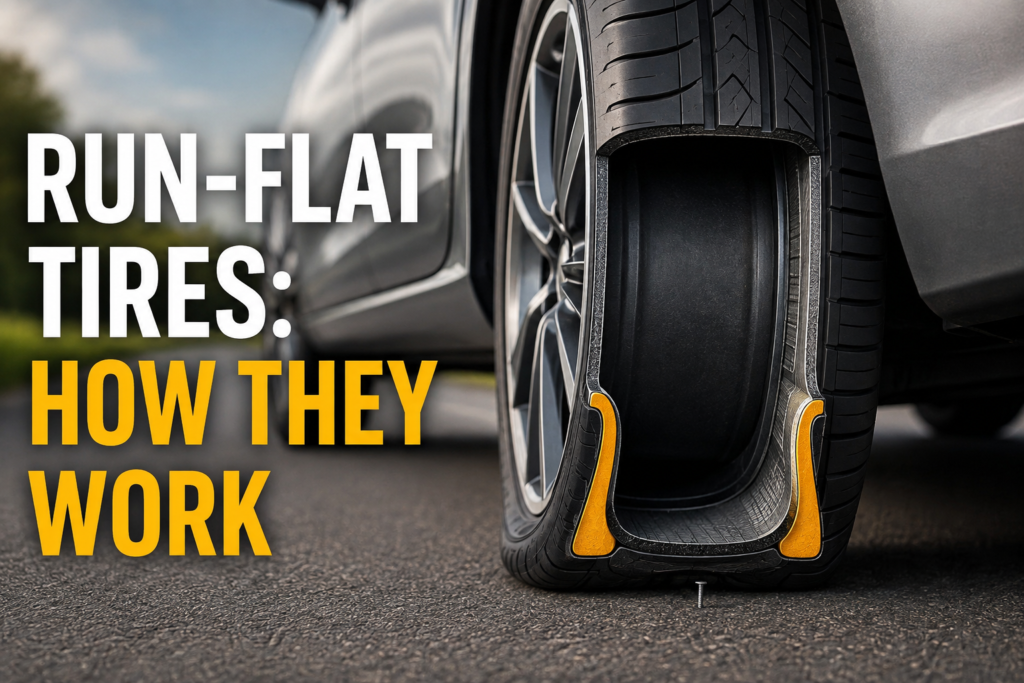
Run flat tires are specially designed tires that can support the weight of a vehicle even after losing most or all of their air pressure. They use stronger sidewalls and other internal construction features to prevent the tire from completely collapsing after a puncture.
A conventional tire depends heavily on air pressure to maintain its shape and support the vehicle. When the air escapes, the sidewall becomes soft and the tire can deform significantly. This can make steering difficult and may cause damage to the tire and wheel.
Run flat tires are built differently. Their reinforced sidewalls provide additional support when air pressure is lost. This allows the driver to continue traveling for a limited distance at a reduced speed.
Many vehicles equipped with run flat tires also have a tire pressure monitoring system. This system is especially important because a driver may not immediately notice that a run flat tire has lost pressure.
How Do Run Flat Tires Work?
The basic idea behind run flat tire technology is simple. The tire has reinforced components that help carry the vehicle’s weight when normal air pressure is no longer available.
The strongest part of many run flat tires is the sidewall. Manufacturers use specially engineered rubber compounds and stronger internal materials to make the sidewall much more resistant to bending and compression.
When a regular tire loses air, the sidewall can flex excessively. This can generate heat and eventually damage the tire. A run flat tire is designed to control this movement.
The reinforced sidewall helps keep the tire mounted on the wheel and maintains enough structure for the vehicle to move. The exact construction varies between manufacturers, so not every run flat tire works in exactly the same way.
Some run flat designs use reinforced sidewalls, while other systems use internal support structures. However, the goal remains the same: maintain enough tire support after air pressure is lost to allow the driver to reach a safe destination.
What Happens When a Run Flat Tire Gets a Puncture?
This is where run flat tires become particularly useful.
Imagine driving on a highway when a sharp object punctures one of your tires. With a conventional tire, you may quickly notice a change in steering, handling, or ride quality. The tire pressure drops, and you may need to stop as soon as it is safe.
With a run flat tire, the reinforced construction can continue supporting the vehicle even after pressure is lost. Your vehicle’s tire pressure monitoring system should alert you that there is a problem.
At this point, the most important thing is to slow down and avoid aggressive steering, hard acceleration, and sudden braking. The purpose of run flat technology is to help you reach a safe place, not to allow you to continue driving as usual.
The manufacturer normally specifies a maximum speed and distance for driving after pressure loss. These limits vary depending on the tire and vehicle, so I always recommend checking the vehicle owner’s manual and tire manufacturer’s instructions.
How Far Can You Drive on Run Flat Tires?
One of the most common questions about run flat tires is how far they can travel after losing air.
Many run flat systems are designed to provide approximately 50 miles of continued travel at speeds around 50 mph after a complete loss of pressure. However, these numbers are not universal.
Actual limits depend on the specific tire, vehicle, load, road conditions, temperature, and amount of damage. If you have a puncture, you should follow the exact recommendations provided for your tire and vehicle.
I would never treat the maximum distance as a target. If a safe tire shop is only a few miles away, there is little reason to keep driving for dozens of miles simply because the tire is capable of doing so.
The safest approach is to drive only as far as necessary to reach a safe location or professional assistance.
Why Tire Pressure Monitoring Is Important
A tire pressure monitoring system is especially important with run flat tires.
A conventional flat tire may be obvious because the vehicle can feel different. However, run flat tires are designed to maintain their shape and handling characteristics better after losing pressure. This means you may not immediately realize that something is wrong.
The tire pressure monitoring system can warn you that a tire has lost pressure. When the warning appears, you should not ignore it.
Check the tire as soon as possible and determine whether it has a puncture or another problem. Even though the tire can continue moving for a limited distance, driving farther than necessary can increase heat buildup and damage.
In my opinion, the combination of run flat tires and a reliable tire pressure monitoring system provides much more confidence than relying on the tire alone.
Advantages of Run Flat Tires
Run flat tires offer several useful benefits.
Better Safety After a Puncture
One of the biggest advantages is that you can potentially avoid stopping immediately on the roadside. This can be particularly valuable on busy highways, poorly lit roads, or isolated areas.
Being able to drive to a safer location can reduce your exposure to passing traffic and other roadside dangers.
No Immediate Need for a Spare Tire
Vehicles equipped with run flat tires may not require a traditional spare tire. This can free up space in the trunk and reduce the amount of equipment you need to carry.
For drivers who regularly use their trunk for luggage, shopping, or other items, the additional space can be useful.
More Convenient Tire Problems
Nobody wants to change a tire during rain, extreme heat, or at night. Run flat technology can reduce the need for an immediate roadside tire change.
Instead of getting out of the vehicle and installing a spare, you may be able to carefully drive to a tire service location.
Improved Stability After Air Loss
The reinforced structure can help the tire remain attached to the wheel and maintain a degree of stability after pressure loss. This is an important part of the technology because sudden tire deformation can affect vehicle handling.
Disadvantages of Run Flat Tires
Run flat tires are not perfect, and there are several disadvantages worth considering.
Higher Cost
Run flat tires are often more expensive than comparable conventional tires. Depending on the vehicle and tire brand, the price difference can be noticeable.
If you are replacing all four tires, the additional cost can become an important factor.
Firmer Ride
The reinforced sidewalls that make run flat tires useful can also make them feel firmer. Some drivers notice a harsher ride compared with conventional tires.
Modern suspension systems and tire designs have improved comfort considerably, but ride quality can still vary from one model to another.
Limited Availability
Depending on your location, finding the exact replacement run flat tire may sometimes be more difficult than finding a standard tire.
This can be an issue if you are traveling far from major cities or specialized tire shops.
Not Every Run Flat Tire Can Be Repaired
Whether a punctured run flat tire can be repaired depends on the tire manufacturer, the location and size of the damage, and how far the tire was driven after losing pressure.
If a run flat tire has been driven while underinflated, internal damage may not always be visible from the outside. A professional inspection is therefore important.
Run Flat Tires vs Regular Tires
The main difference between run flat tires and regular tires is how they respond to air loss.
A standard tire depends on inflation pressure to maintain its shape and carry the vehicle. Once the pressure drops significantly, the tire may become unsafe to drive on.
A run flat tire uses reinforced construction to provide additional support when air pressure is lost.
Regular tires are generally cheaper and may offer a softer ride. They are also widely available and can often be repaired when the damage meets proper repair guidelines.
Run flat tires provide the advantage of temporary mobility after a puncture, but they usually cost more and may produce a firmer ride.
For me, the choice comes down to priorities. If avoiding roadside tire changes is important, run flat tires can be a very practical option. If lower replacement costs and ride comfort are more important, conventional tires may make more sense.
Can You Replace Run Flat Tires With Regular Tires?
This is a question that should not be answered with a simple yes or no.
Some vehicles can use conventional tires, but others are specifically engineered around run flat tires. Suspension tuning, tire pressure monitoring systems, wheel design, and the vehicle manufacturer’s recommendations can all matter.
If your vehicle came from the factory with run flat tires, I recommend checking the owner’s manual before changing to conventional tires.
You should also consider whether the vehicle has a spare tire. If you replace run flat tires with regular tires without carrying a spare or another appropriate solution, a puncture could leave you stranded.
A qualified tire professional can help determine whether a different tire type is suitable for your particular vehicle.
How to Maintain Run Flat Tires
Run flat tires still require regular maintenance. Their special construction does not mean you can ignore tire pressure.
Check tire pressure according to the vehicle manufacturer’s recommended specifications. Inspect the tread for uneven wear, cuts, cracks, or objects that may have become embedded in the tire.
Wheel alignment is also important because incorrect alignment can cause uneven tread wear and reduce tire life.
If your tire pressure warning light comes on, take it seriously. Even though the tire may be capable of continued movement, driving with low pressure can create additional heat and potentially damage the tire.
Regular inspection is one of the easiest ways to get better performance and longer service from any tire, including run flat tires.
Are Run Flat Tires Worth It?
Whether run flat tires are worth the money depends on how and where you drive.
For someone who spends a lot of time on highways, travels long distances, or wants to avoid roadside tire changes, run flat tires can provide valuable peace of mind.
They can also be useful for drivers who do not want to carry a spare tire.
On the other hand, drivers who prioritize a softer ride and lower tire replacement costs may prefer conventional tires.
I think run flat tires are most valuable when you understand their purpose. They are not a permanent solution to a puncture. They are a temporary mobility solution designed to help you reach a safer destination.
Final Thoughts
Run flat tires are designed to provide an extra layer of convenience and safety when a tire loses air. Their reinforced construction allows them to support the vehicle for a limited distance and at a controlled speed without normal inflation pressure.
The technology can reduce the stress of getting a flat tire, especially when you are driving on a busy road or in an inconvenient location. However, run flat tires still need proper maintenance, correct tire pressure, and professional inspection after a puncture.
If you are considering run flat tires, my advice is to look beyond the purchase price. Think about your driving habits, road conditions, comfort preferences, replacement costs, and whether your vehicle was designed for this type of tire.
When used correctly, run flat tires can be a practical tire technology that gives drivers more time and control when an unexpected puncture happens.