Related Articles

Adaptive cruise control is one of the most useful driver assistance features available in many modern cars. I find it especially helpful on highways because it can make long drives more comfortable while helping the driver maintain a steady speed and distance from other vehicles. Unlike traditional cruise control, adaptive cruise control can automatically adjust the speed of the car when traffic conditions change.
In simple words, adaptive cruise control uses sensors and computer systems to understand what is happening in front of the vehicle. When a slower vehicle appears ahead, the system can reduce speed. When the road becomes clear, it can increase speed again until it reaches the selected setting. However, the driver still needs to remain alert and responsible for controlling the vehicle.
What Is Adaptive Cruise Control?
Adaptive cruise control, often called ACC, is an advanced version of traditional cruise control. Regular cruise control allows a driver to select a speed and lets the vehicle maintain that speed automatically. The problem is that traditional cruise control does not normally react to slower traffic.
Adaptive cruise control adds another layer of technology. It monitors the road ahead and detects vehicles traveling in the same direction. The system then compares the distance and speed of those vehicles with the settings selected by the driver.
For example, if I set my car to travel at 100 kilometers per hour and choose a comfortable following distance, the car can maintain that speed when the road is clear. If another vehicle enters my lane and is traveling at 80 kilometers per hour, the adaptive cruise control system can slow my car down to maintain the selected distance.
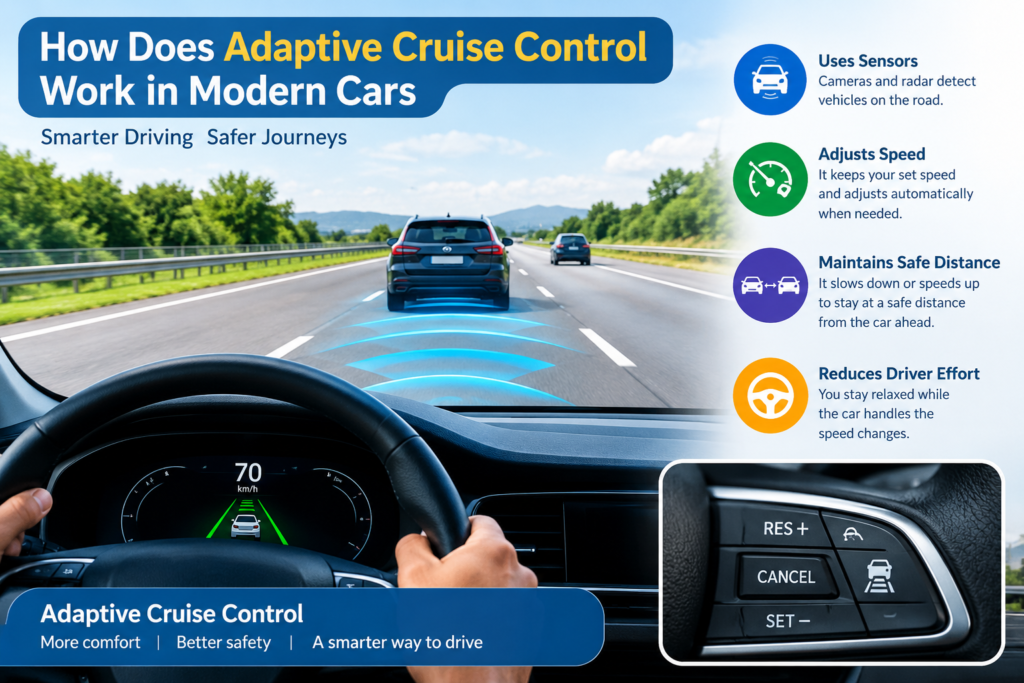
How Does Adaptive Cruise Control Work?
The basic working principle of adaptive cruise control is quite interesting. The system uses sensors to observe the road ahead. Depending on the vehicle, these sensors may include radar, cameras, or a combination of different technologies.
The sensors continuously collect information about vehicles and objects around the car. The vehicle computer processes this information and calculates important details such as distance, relative speed, and whether another vehicle is directly in the driving path.
If the road is clear, the system allows the car to continue toward the selected speed. If a slower vehicle is detected, the system reduces acceleration and may apply the brakes when necessary.
When the slower vehicle moves away or the road becomes clear, the system can gradually accelerate the car again. This entire process happens automatically and usually takes place very quickly.
The Role of Radar Sensors
Radar is an important technology used by many adaptive cruise control systems. Radar sensors send signals toward the road ahead and analyze the signals that return after interacting with vehicles and other objects.
This information helps the vehicle estimate how far away another vehicle is and how quickly it is moving. Because radar can work in different lighting conditions, it can be useful during nighttime driving as well.
Modern vehicles may use radar together with cameras to improve the system’s ability to understand the surrounding environment.
The Role of Cameras
Cameras provide another important source of information. A forward facing camera can recognize vehicles, road markings, traffic signs, and other visual information depending on the vehicle’s technology.
Camera based systems can help the car understand what is happening on the road. When combined with radar, cameras can provide a more complete picture of the driving environment.
In my view, combining different types of sensors is one of the most interesting developments in modern automotive technology because each sensor can provide different information.
How Does Adaptive Cruise Control Maintain Distance?
One of the main advantages of adaptive cruise control is its ability to maintain a selected following distance.
The driver can usually choose from several distance settings. These settings determine how much space the vehicle should try to maintain from the car ahead.
If traffic slows down, the system detects the change and reduces the vehicle’s speed. If traffic becomes faster, the system can increase speed while staying within the selected limit.
The exact behavior depends on the vehicle and its adaptive cruise control system. Some systems can operate in slow moving traffic, while others are designed mainly for highway speeds.
What Happens in Stop and Go Traffic?
Some modern adaptive cruise control systems are designed to work in stop and go traffic. This can be particularly useful during busy highway journeys.
If the vehicle ahead slows down and stops, a compatible system may automatically slow your car and bring it to a stop. Some systems can then resume driving automatically when traffic starts moving again. Other vehicles may require the driver to press a button or use the accelerator to resume the system.
This feature can reduce the effort required during repeated traffic movement, but I would never treat it as a replacement for paying attention.
Adaptive Cruise Control and Traditional Cruise Control
Traditional cruise control and adaptive cruise control have the same basic goal, which is to reduce the need for constant accelerator input. The major difference is how they respond to traffic.
Traditional cruise control generally maintains a selected speed. If another vehicle slows down in front of you, the driver needs to respond.
Adaptive cruise control can detect the slower vehicle and adjust the car’s speed. This makes it more useful for modern highway driving.
Another important difference is that adaptive cruise control is connected to more advanced sensors and vehicle computer systems. It is therefore more sophisticated than basic cruise control.
Does Adaptive Cruise Control Steer the Car?
Adaptive cruise control primarily controls speed and following distance. It does not automatically mean that the vehicle can steer itself.
Some modern vehicles combine adaptive cruise control with lane centering or steering assistance. When these technologies work together, the vehicle may provide assistance with both speed and steering.
However, these features do not mean that the driver can stop paying attention. The driver remains responsible for monitoring the road and responding when necessary.
Benefits of Adaptive Cruise Control
There are several reasons why adaptive cruise control has become popular in modern cars.
The first benefit is convenience. During long highway journeys, constantly adjusting the accelerator can become tiring. Adaptive cruise control can handle many routine speed adjustments.
Another benefit is smoother driving. Instead of repeatedly accelerating and braking manually, the system can make gradual changes based on traffic conditions.
It can also help maintain a consistent following distance. This can be useful when traffic speeds change frequently.
For me, one of the biggest advantages is reduced driver workload. A long journey can feel more comfortable when the vehicle assists with repetitive speed control.
Limitations of Adaptive Cruise Control
Despite its advantages, adaptive cruise control is not perfect. Drivers should understand its limitations before relying on it.
Sensors can sometimes have difficulty detecting objects because of weather, road conditions, dirt, or other factors. Heavy rain, fog, snow, or blocked sensors may affect performance.
The system may also behave differently in unusual traffic situations. Motorcycles, stopped vehicles, sharp curves, merging traffic, or objects in the roadway can create situations where the driver needs to take control.
Another important point is that adaptive cruise control does not understand every situation the way a human driver can. It is an assistance system, not an independent driver.
Is Adaptive Cruise Control Safe?
Adaptive cruise control can be a useful safety and comfort technology when used correctly. It can help maintain distance and reduce unnecessary acceleration and braking.
However, I believe the most important rule is simple: the driver should always remain focused on driving.
Adaptive cruise control should be considered a driver assistance feature. It should not be used as an excuse to look at a phone, become distracted, or stop monitoring traffic.
Drivers should also understand their vehicle’s specific system because features and limitations vary between manufacturers and models.
The Future of Adaptive Cruise Control
Adaptive cruise control is likely to become even more advanced as automotive technology continues to develop. Modern vehicles are increasingly using cameras, radar, computer vision, and other sensors to understand road conditions.
Future systems may provide smoother speed control and better responses to complicated traffic situations. Adaptive cruise control will also continue to work alongside other driver assistance technologies.
I think the most important development will not simply be making cars more automated. It will be creating systems that assist drivers in a predictable and understandable way.
Final Thoughts
Adaptive cruise control works by using sensors, vehicle computers, and braking and acceleration systems to monitor traffic and adjust the car’s speed. It can maintain a selected speed when the road is clear and slow the vehicle when a slower car is detected ahead.
From my point of view, it is one of the most practical driver assistance technologies in modern cars. It can make highway driving more comfortable, reduce repetitive work, and help maintain a consistent distance from other vehicles.
At the same time, drivers should remember that adaptive cruise control is not a replacement for human attention. Understanding how adaptive cruise control works and knowing its limitations is essential for using the technology responsibly.
As cars become smarter, features like adaptive cruise control will continue to change the driving experience. Used properly, this technology can make everyday journeys smoother while giving drivers useful assistance on busy roads and long highway trips.