Related Articles

When I think about the technology that has changed the way we drive modern cars, adaptive cruise control is one of the features that stands out to me. Traditional cruise control was already useful because it allowed drivers to maintain a selected speed without constantly pressing the accelerator. Adaptive cruise control takes this idea much further by allowing the vehicle to monitor traffic ahead and automatically adjust its speed.
In my view, adaptive cruise control is especially useful on highways and long road trips where traffic conditions can change frequently. Instead of maintaining one fixed speed all the time, the system can slow the vehicle when another car gets closer and accelerate again when the road becomes clear.
But how does adaptive cruise control actually work? Let us look at the technology behind this modern driving feature and understand why it has become common in many newer vehicles.
What Is Adaptive Cruise Control?
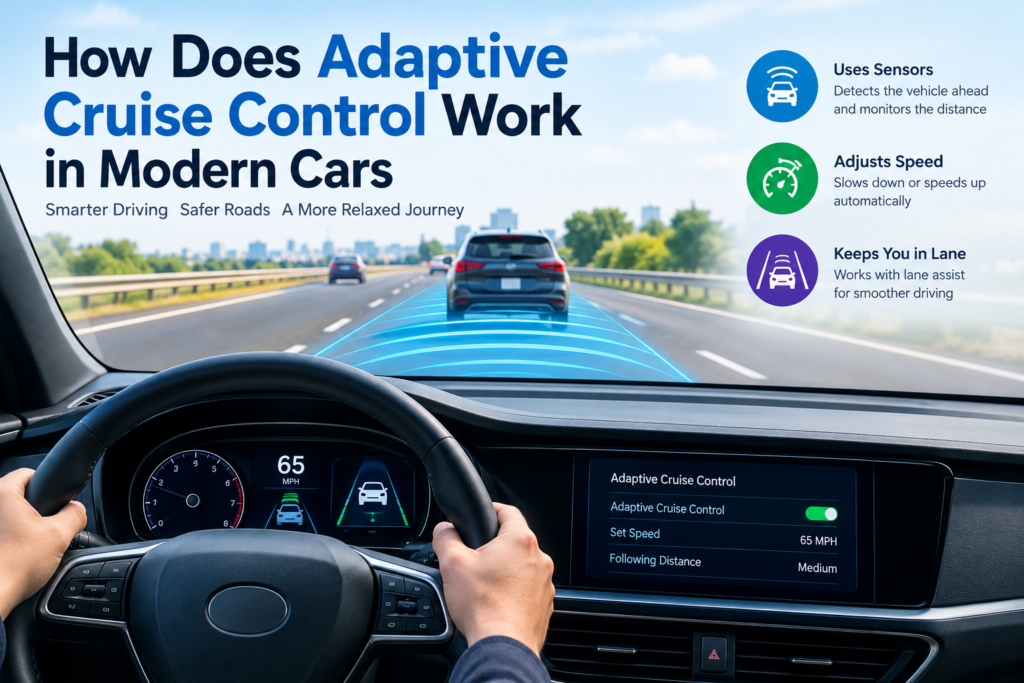
Adaptive cruise control, often called ACC, is an advanced version of traditional cruise control. It allows a driver to select a desired speed and following distance. The vehicle then uses sensors to monitor traffic ahead.
For example, imagine that I set my car to travel at 100 kilometers per hour. If there is no vehicle in front of me, the car can continue near the selected speed. If another vehicle enters my lane and is traveling more slowly, adaptive cruise control can detect it and reduce my vehicle’s speed.
When that vehicle moves away or the road becomes clear, the system can gradually increase the speed again toward the selected setting.
This makes adaptive cruise control different from standard cruise control. Traditional cruise control mainly maintains speed, while adaptive cruise control can respond to traffic conditions.
How Does Adaptive Cruise Control Work?
The basic operation of adaptive cruise control depends on sensors, computers, and the vehicle’s braking and acceleration systems.
Modern cars commonly use radar sensors, cameras, or a combination of different sensors. These sensors continuously collect information about the road and vehicles around the car.
The system looks for vehicles traveling ahead in the same lane. It estimates their distance and relative speed. The vehicle’s computer then processes this information and decides whether the car should maintain its speed, slow down, or accelerate.
I find this part of the technology particularly interesting because the system is constantly making small adjustments. The driver does not need to manually press the accelerator every time traffic changes.
Radar Sensors and Cameras
Radar is one of the most important technologies used in many adaptive cruise control systems. Radar sensors can detect objects ahead and estimate their distance and speed.
Some modern vehicles also use cameras to identify vehicles, lane markings, and other features of the road.
When radar and camera systems work together, the vehicle can collect more information about its surroundings. The exact technology varies from one manufacturer and vehicle model to another.
The sensors are normally positioned behind the front grille, near the front bumper, or behind the windshield. Because these sensors are important for the system, keeping their areas clean and unobstructed is important.
Maintaining a Safe Following Distance
One of the main purposes of adaptive cruise control is maintaining a selected following distance.
Most systems allow the driver to choose from several distance settings. Depending on the vehicle, these settings may be displayed using bars, vehicle icons, or labels such as short, medium, and long.
If traffic ahead slows down, the adaptive cruise control system can reduce the vehicle’s speed to maintain the selected distance.
For me, this is one of the most useful features during highway driving. Traffic does not always move at one constant speed. Cars can slow down unexpectedly, especially around busy areas or road construction.
What Happens When Traffic Speeds Up?
Adaptive cruise control is not only designed to slow the car down. It can also increase speed when traffic conditions allow it.
Suppose the vehicle ahead is traveling at 70 kilometers per hour and I have selected 100 kilometers per hour. The system may maintain a gap behind that vehicle rather than immediately reaching my selected speed.
If the vehicle ahead changes lanes or moves away, the road becomes clear. The system can then accelerate toward the selected speed.
The acceleration is normally controlled rather than sudden, although the exact behavior depends on the vehicle’s settings and manufacturer.
Can Adaptive Cruise Control Stop the Car?
Some adaptive cruise control systems can slow the vehicle to a complete stop in heavy traffic. This capability is sometimes associated with stop and go adaptive cruise control.
For example, if traffic becomes very slow, the system may continue reducing speed until the vehicle stops.
Some systems can also resume driving automatically after a short stop. Others may require the driver to press a button or use the accelerator to continue.
This is an area where drivers should understand their particular vehicle because adaptive cruise control features are not identical across all cars.
Adaptive Cruise Control and Highway Driving
I personally think adaptive cruise control makes the most sense during long highway journeys. When traffic is relatively predictable, the system can reduce the amount of constant accelerator and brake adjustment required from the driver.
Long drives can involve repeated changes in speed. A driver may accelerate, slow down, accelerate again, and repeat this process for hours.
Adaptive cruise control can handle many of these routine speed adjustments.
However, I would never treat adaptive cruise control as a replacement for paying attention. The driver still needs to monitor traffic, road conditions, signs, pedestrians, motorcycles, and unexpected hazards.
Does Adaptive Cruise Control Steer the Car?
This is an important point because adaptive cruise control and lane assistance are not necessarily the same thing.
Basic adaptive cruise control primarily controls vehicle speed and following distance. It does not automatically mean that the car can steer itself.
Some modern vehicles combine adaptive cruise control with lane keeping assistance or other driver assistance technologies. When these systems work together, the vehicle may provide steering support while adaptive cruise control manages speed.
Even then, drivers need to understand exactly what their vehicle is designed to do.
Adaptive Cruise Control Versus Traditional Cruise Control
Traditional cruise control allows a driver to select a speed and maintain it automatically.
For example, if I select 100 kilometers per hour, the vehicle attempts to maintain that speed regardless of whether another vehicle ahead is traveling more slowly.
Adaptive cruise control adds traffic monitoring. If the vehicle detects slower traffic ahead, it can reduce speed and maintain the selected following distance.
This makes adaptive cruise control more suitable for roads where traffic speed changes frequently.
Benefits of Adaptive Cruise Control
There are several reasons why adaptive cruise control has become popular in modern vehicles.
One major benefit is convenience. On long highway journeys, the system can reduce the need for constant accelerator adjustments.
Another benefit is smoother speed management. Instead of repeatedly pressing the accelerator and brake in moderate traffic, the system can make controlled adjustments.
Adaptive cruise control can also make driving feel less tiring during certain highway conditions.
However, I think the biggest benefit is that it supports the driver during repetitive driving situations. It should be viewed as a driver assistance feature rather than an automatic driving system.
Limitations of Adaptive Cruise Control
Despite its advantages, adaptive cruise control has limitations.
Sensors cannot understand every road situation perfectly. Heavy rain, snow, fog, dirt, blocked sensors, unusual road layouts, or unclear lane markings can affect how driver assistance systems operate.
The system may also respond differently to motorcycles, bicycles, stopped vehicles, vehicles entering the lane, or objects that are difficult for sensors to classify.
This is why I believe drivers should always remain prepared to take control.
Adaptive cruise control is an assistance system, not a substitute for a responsible driver.
How to Use Adaptive Cruise Control Safely
Before using adaptive cruise control, I recommend becoming familiar with the owner’s manual for the specific vehicle.
The driver should understand how to activate and deactivate the system, adjust the following distance, change the selected speed, and respond when the system requests driver intervention.
It is also important to keep the windshield and sensor areas clean. If the vehicle displays a warning that a sensor is blocked or unavailable, the driver should pay attention to that warning.
Hands should remain available to control the vehicle, and the driver should continuously watch the road.
Does Adaptive Cruise Control Save Fuel?
Adaptive cruise control may help maintain a more consistent speed, which can sometimes support efficient driving. However, fuel consumption depends on many factors including vehicle type, road conditions, traffic, speed, weather, tire pressure, and driving habits.
I would not consider adaptive cruise control a guaranteed fuel saving feature.
Its main purpose is to assist with maintaining speed and distance from traffic.
Why Adaptive Cruise Control Is Becoming More Common
Modern cars are becoming increasingly equipped with driver assistance technology. Adaptive cruise control is one part of this broader development.
As vehicles gain better sensors, cameras, processors, and software, manufacturers can offer more advanced assistance features.
What I find interesting is that technology once associated mainly with expensive vehicles is now available in many different types of cars.
The systems may differ significantly in capability, but the basic idea remains similar. The vehicle monitors traffic and helps manage speed according to the conditions ahead.
Final Thoughts
Adaptive cruise control works by combining sensors, vehicle computers, braking systems, and acceleration control to help maintain a selected speed and following distance. When traffic is clear, the vehicle can travel toward the driver’s selected speed. When a slower vehicle is detected ahead, the system can reduce speed and maintain an appropriate gap.
In my opinion, adaptive cruise control is one of the most practical driver assistance technologies available in modern cars. It can make highway driving more comfortable and reduce some of the repetitive work involved in maintaining speed.
At the same time, I believe it is important to remember that adaptive cruise control does not make a car fully autonomous. The driver remains responsible for observing the road and responding to situations that the system cannot handle.
Understanding how adaptive cruise control works is therefore just as important as knowing how to activate it. When used correctly and with proper attention, it can be a helpful part of the modern driving experience.