Related Articles


When I first started learning about cars, I used to think the engine was the only thing that really mattered. Over time, I realized that a vehicle can have a powerful engine, but if the suspension system is not working properly, the overall driving experience will never feel comfortable or safe. The suspension system is one of the most important parts of any vehicle because it keeps the tires connected to the road, absorbs shocks, and provides stability while driving.
Many drivers only pay attention to suspension parts after they notice unusual noises, rough rides, or poor handling. In my opinion, understanding how these components work can help every car owner make better maintenance decisions and avoid expensive repairs.
In this article, I will explain the major car suspension parts, how they work together, and why keeping them in good condition is essential for both comfort and safety.
What Is a Car Suspension System?
A car suspension system is a collection of components that connect the vehicle’s body to its wheels. Its main purpose is to absorb bumps, control body movement, and maintain tire contact with the road.
Without a suspension system, every small pothole or rough road would send strong vibrations directly into the cabin. Driving would become uncomfortable, and controlling the vehicle would be much more difficult.
Modern suspension systems are carefully designed to balance ride comfort, handling, and stability.
Why the Suspension System Is Important
I believe many people underestimate the importance of suspension parts until problems begin to appear. A healthy suspension system improves driving in many ways.
It keeps the tires firmly planted on the road, allowing better traction during acceleration and braking.
It reduces vibrations caused by uneven roads.
It improves steering response.
It increases passenger comfort.
It helps reduce tire wear.
It improves vehicle stability when turning or driving at high speeds.
Without a properly functioning suspension, even a well maintained vehicle can become difficult to control.
Main Parts of a Car Suspension System
The suspension system contains several components that work together to create a smooth and stable ride.
Shock Absorbers
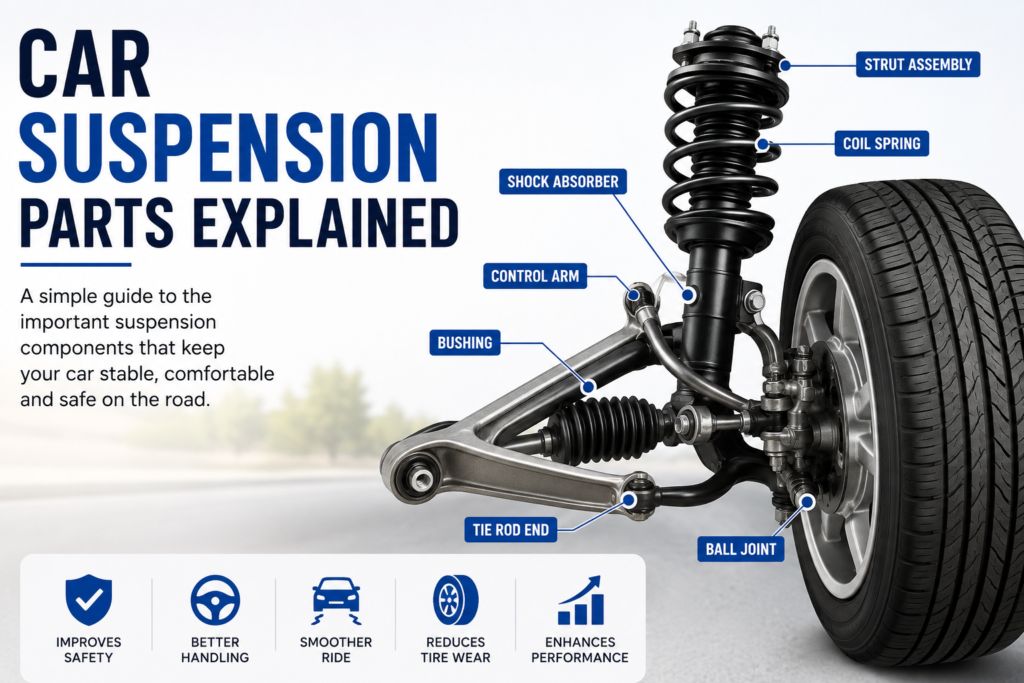
Shock absorbers are among the most important suspension components. Their job is to control the movement of the springs after the vehicle passes over bumps.
Without shock absorbers, the car would continue bouncing long after hitting a pothole.
Good shock absorbers improve ride comfort, steering control, and braking performance.
Common signs of worn shock absorbers include excessive bouncing, uneven tire wear, leaking fluid, and poor handling.
Struts
Many modern vehicles use struts instead of traditional shock absorbers.
A strut combines multiple suspension functions into one assembly. It supports the vehicle’s weight while also controlling suspension movement.
Because struts are structural components, replacing worn struts can dramatically improve driving comfort and steering accuracy.
Coil Springs
Coil springs support the weight of the vehicle and absorb road impacts.
Every time the car encounters a bump, the springs compress and expand to cushion the impact.
Strong and healthy springs help maintain proper ride height and improve vehicle balance.
Broken or sagging springs may cause the vehicle to lean or sit lower on one side.
Leaf Springs
Leaf springs are commonly found on pickup trucks, vans, and heavy duty vehicles.
Unlike coil springs, leaf springs consist of several layers of steel stacked together.
Their simple design allows them to carry heavy loads while providing reliable suspension support.
Although they are not as comfortable as coil springs, they are extremely durable.
Control Arms
Control arms connect the suspension to the vehicle frame.
They allow the wheels to move up and down while keeping them properly aligned.
Control arms contain bushings and ball joints that allow smooth suspension movement.
When control arms wear out, drivers may notice vibrations, clunking noises, or unstable steering.
Ball Joints
Ball joints act like flexible pivot points between the suspension and steering system.
They allow the wheels to move in multiple directions while maintaining proper alignment.
Worn ball joints may produce knocking sounds, loose steering, and uneven tire wear.
Replacing damaged ball joints early can prevent more serious suspension damage.
Bushings
Bushings are small rubber or polyurethane components placed between suspension parts.
Their job is to reduce vibration and minimize metal to metal contact.
As bushings age, they may crack, harden, or wear out.
Damaged bushings often cause squeaking sounds, vibrations, and reduced ride comfort.
Sway Bar
The sway bar, sometimes called the stabilizer bar, helps reduce body roll when the vehicle turns.
Without a sway bar, the car would lean excessively during cornering.
This component improves stability and gives drivers greater confidence while driving on curved roads.
Worn sway bar links can produce rattling noises over bumps.
Tie Rod Ends
Tie rod ends connect the steering system to the wheels.
Although they are technically part of the steering system, they work closely with suspension components.
Healthy tie rod ends provide precise steering control.
Loose or worn tie rods can cause poor alignment and unstable handling.
Wheel Bearings
Wheel bearings allow the wheels to rotate smoothly with minimal friction.
A damaged wheel bearing often creates a humming or grinding noise that becomes louder as speed increases.
Ignoring a faulty wheel bearing can eventually affect suspension performance and vehicle safety.
Suspension Bushings and Mounts
Many suspension components are attached using rubber mounts.
These mounts absorb vibrations while allowing controlled movement.
When they wear out, drivers may experience harsh impacts, unusual noises, or reduced ride quality.
Replacing worn mounts helps restore a smooth driving experience.
Common Suspension Problems
Suspension components naturally wear over time.
Some of the most common problems include leaking shock absorbers, worn struts, broken springs, damaged bushings, loose ball joints, worn tie rod ends, bent control arms, and failing wheel bearings.
Early diagnosis usually reduces repair costs and prevents additional damage.
Signs Your Suspension Needs Attention
Your vehicle often gives clear warning signs before suspension problems become serious.
Watch for excessive bouncing after bumps.
Uneven tire wear.
Vehicle pulling to one side.
Steering feels loose.
Clunking or knocking sounds.
Poor braking stability.
Rough or uncomfortable ride.
Visible fluid leaks from shock absorbers.
If you notice one or more of these symptoms, it is wise to have the suspension inspected by a qualified mechanic.
How to Extend Suspension Life
In my experience, proper driving habits make a significant difference in suspension longevity.
Drive carefully over potholes and speed bumps.
Maintain proper tire pressure.
Rotate tires regularly.
Avoid carrying excessive loads beyond your vehicle’s capacity.
Get wheel alignment checked periodically.
Replace worn suspension parts before they damage surrounding components.
Regular inspections can help identify small problems before they become expensive repairs.
Can Suspension Upgrades Improve Performance?
Many car enthusiasts choose to upgrade their suspension systems.
Performance shocks, adjustable coilovers, upgraded sway bars, and polyurethane bushings can improve handling and cornering stability.
However, not every upgrade is suitable for daily driving.
I believe it is always better to choose suspension components that match your driving style rather than simply selecting the stiffest setup available.
A balanced suspension provides both comfort and control.
Suspension Maintenance Tips
Routine maintenance plays a major role in keeping the suspension system healthy.
Inspect tires regularly for uneven wear.
Listen for unusual noises while driving.
Check ride height if the vehicle appears lower than normal.
Have suspension components inspected during routine servicing.
Replace damaged parts using high quality replacements.
These simple steps can help maintain vehicle safety and improve driving comfort for years.
Final Thoughts
In my opinion, the suspension system deserves far more attention than it usually receives. Every suspension part has a specific purpose, and all of them work together to create a smooth, stable, and safe driving experience. Components such as shock absorbers, struts, springs, control arms, ball joints, bushings, sway bars, and tie rod ends all play an important role in maintaining vehicle performance.
Understanding how these parts function makes it easier to recognize early warning signs and perform maintenance before problems become costly. Whether you drive a family sedan, an SUV, or a pickup truck, keeping your suspension system in excellent condition will improve comfort, steering precision, tire life, and overall road safety. Investing in quality suspension parts and regular inspections is one of the smartest decisions any vehicle owner can make for long term reliability and driving confidence.