
Related Articles



When I first started learning about modern car engines, I often heard mechanics talking about fuel injectors. At that time, I thought they were just small parts responsible for delivering fuel to the engine. After spending more time understanding how engines work, I realized that fuel injectors play one of the biggest roles in engine performance, fuel economy, and emissions. Without properly working fuel injectors, even the best engine cannot perform at its full potential.
Modern vehicles rely on precise fuel delivery instead of older carburetor systems. Fuel injectors make this possible by spraying the exact amount of fuel needed for efficient combustion. In my opinion, they are one of the smartest innovations in automotive engineering because they help engines produce more power while using less fuel.
In this article, I will explain how fuel injectors work, their different types, common problems, and why keeping them clean is important for your vehicle.
What Are Fuel Injectors?
Fuel injectors are electronically controlled valves that spray fuel into the engine in a fine mist. Their job is to deliver the right amount of fuel at the right time for proper combustion.
Instead of simply pouring fuel into the engine, fuel injectors atomize the fuel into tiny droplets. This fine spray mixes much better with air, allowing the engine to burn fuel more efficiently.
Almost every modern gasoline and diesel vehicle uses fuel injection technology because it provides better performance than older fuel delivery systems.
Why Fuel Injectors Are Important
Many drivers never think about fuel injectors until something goes wrong. From my experience, these small components have a huge impact on how smoothly a vehicle runs.
Properly functioning fuel injectors help improve engine power, increase fuel efficiency, reduce harmful emissions, provide smoother acceleration, support easier engine starting, and improve overall engine reliability.
Without accurate fuel delivery, the engine cannot maintain the correct air and fuel mixture required for efficient combustion.
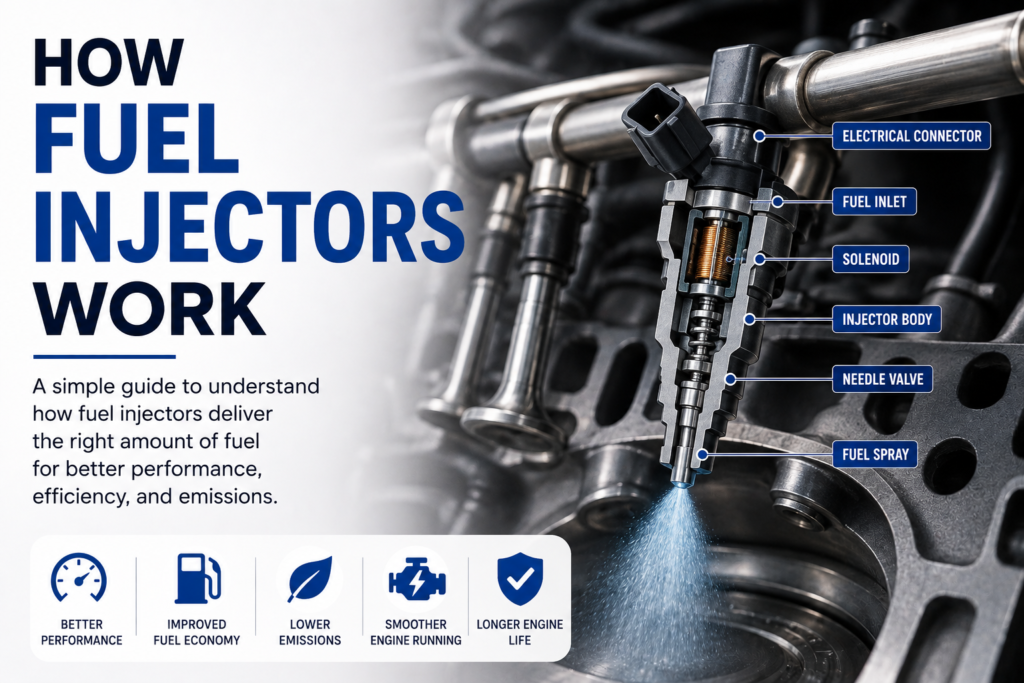
How Fuel Injectors Work
The operation of fuel injectors is surprisingly precise.
Fuel is pumped from the fuel tank through the fuel lines to the fuel rail under high pressure.
The engine control unit constantly monitors information from various sensors, including engine speed, throttle position, air temperature, oxygen sensors, and airflow sensors.
Using this information, the engine control unit calculates exactly how much fuel each cylinder requires.
When the correct moment arrives, the control unit sends an electrical signal to the fuel injector.
The injector opens for only a fraction of a second and sprays a carefully measured amount of fuel into the intake manifold or directly into the combustion chamber, depending on the engine design.
This process repeats thousands of times every minute while the engine is running.
Main Parts of a Fuel Injector
Fuel injectors may look simple from the outside, but they contain several important internal components.
The injector body houses all internal parts.
An electrical solenoid receives signals from the engine control unit.
A needle valve opens and closes to control fuel flow.
The nozzle sprays fuel into a fine mist.
Rubber seals prevent fuel leaks.
Every part must work perfectly to ensure accurate fuel delivery.
Types of Fuel Injection Systems
Automotive technology has evolved significantly over the years, leading to several different fuel injection systems.
Single Point Fuel Injection
Single point injection uses one injector positioned near the throttle body.
This design replaced carburetors in many older vehicles and offered better fuel control.
Although effective, it is less precise than modern multi point systems.
Multi Point Fuel Injection
Multi point fuel injection gives each cylinder its own injector.
This allows more accurate fuel delivery and improves engine efficiency.
Most modern gasoline vehicles use this system because it provides smoother operation and better fuel economy.
Direct Fuel Injection
Direct fuel injection sprays fuel directly into the combustion chamber instead of the intake manifold.
This technology improves fuel efficiency, increases engine power, and allows better combustion control.
Many new vehicles use direct injection because it helps manufacturers meet modern fuel economy and emission standards.
Sequential Fuel Injection
Sequential fuel injection operates each injector individually according to the engine firing order.
Fuel is delivered exactly when each cylinder requires it.
This system provides excellent fuel efficiency and smoother engine performance.
Benefits of Fuel Injectors
Modern fuel injectors offer several important advantages.
One of the biggest benefits is improved fuel economy because only the required amount of fuel is delivered.
Engine performance also improves because fuel mixes more effectively with air.
Cold starts become easier since the engine receives the proper fuel mixture immediately.
Emissions decrease because combustion becomes cleaner and more complete.
Throttle response becomes faster, making acceleration feel smoother and more responsive.
Common Fuel Injector Problems
Like every engine component, fuel injectors eventually wear out or become dirty.
One common problem is clogged injectors caused by fuel deposits.
Leaking injectors may allow excess fuel into the engine.
Electrical failures can prevent injectors from opening.
Worn injector seals may cause fuel leaks.
Damaged nozzles may spray fuel unevenly instead of producing a fine mist.
These issues reduce engine performance and increase fuel consumption.
Symptoms of Bad Fuel Injectors
Fortunately, faulty fuel injectors usually produce warning signs before complete failure.
Some of the most common symptoms include rough idling, engine misfires, reduced fuel economy, hesitation during acceleration, poor engine performance, difficult starting, increased exhaust smoke, fuel smell around the engine, and the check engine light turning on.
If these symptoms appear, inspecting the fuel injectors should be part of the diagnostic process.
What Causes Fuel Injectors to Fail?
Several factors contribute to injector problems.
Poor quality fuel often leaves deposits inside the injector.
Driving with a nearly empty fuel tank may allow dirt from the bottom of the tank to enter the fuel system.
Old fuel filters can restrict fuel flow.
High mileage naturally causes wear over time.
Lack of regular maintenance also increases the risk of injector failure.
Fortunately, many injector problems can be prevented with proper care.
Fuel Injector Cleaning
I believe regular injector cleaning is one of the simplest ways to maintain engine performance.
Fuel system cleaning additives can help remove light deposits.
Professional injector cleaning uses specialized equipment to remove stubborn carbon buildup.
In severe cases, injectors may need ultrasonic cleaning or replacement.
Keeping injectors clean helps restore fuel economy and improve engine response.
Can Fuel Injectors Increase Horsepower?
Many people ask whether upgrading fuel injectors automatically increases engine power.
For a standard vehicle, installing larger injectors alone usually does not create extra horsepower.
However, high performance engines with turbochargers or engine tuning often require larger injectors to deliver additional fuel safely.
The engine control unit must also be properly calibrated after installing performance injectors.
For daily drivers, maintaining clean factory injectors usually provides the best results.
How Long Do Fuel Injectors Last?
Fuel injectors are designed to last a very long time.
Many injectors continue working reliably for well over 100,000 miles when properly maintained.
Their lifespan depends on fuel quality, maintenance habits, driving conditions, and overall engine health.
Regular servicing helps maximize injector life.
Tips to Keep Fuel Injectors Healthy
Keeping fuel injectors in good condition is not difficult.
Use high quality fuel whenever possible.
Replace the fuel filter according to the manufacturer’s maintenance schedule.
Avoid driving with an almost empty fuel tank regularly.
Use fuel injector cleaner occasionally if recommended for your vehicle.
Fix engine problems quickly before they affect the fuel system.
Follow routine maintenance intervals.
These simple habits help fuel injectors perform efficiently for many years.
Fuel Injectors and Fuel Economy
One of the biggest advantages of modern fuel injectors is improved fuel efficiency.
Accurate fuel delivery allows the engine to burn fuel more completely.
When injectors become clogged, the engine may use extra fuel to compensate for poor combustion.
Cleaning or replacing faulty injectors often restores normal fuel consumption.
Drivers who notice sudden drops in mileage should consider having the fuel system inspected.
Final Thoughts
In my opinion, fuel injectors are among the most important components in any modern engine. Although they are small, they have a direct influence on power, fuel economy, emissions, engine smoothness, and overall reliability. Their ability to deliver the exact amount of fuel at precisely the right moment allows modern engines to perform far better than older carbureted systems.
Understanding how fuel injectors work helps every vehicle owner appreciate the importance of proper maintenance. Regular servicing, clean fuel, timely fuel filter replacement, and occasional injector cleaning can prevent expensive repairs while keeping the engine running at its best. Taking care of your fuel injectors is a simple investment that pays off through better performance, improved efficiency, and a longer lasting engine.