Related Articles
When I think about the parts that make a car move smoothly, CV joints are one of those components that often get overlooked. Most drivers know about the engine, transmission, brakes, and tires, but not everyone knows how power actually reaches the wheels while the suspension is moving and the steering is turning. This is where CV joints become extremely important.
CV stands for Constant Velocity. A CV joint is designed to transfer power from the transmission or differential to the wheels while allowing the axle to move at different angles. Without this ability, front wheel drive cars would have a difficult time turning smoothly while still sending engine power to the wheels.
In my view, CV joints are among the most practical examples of smart automotive engineering. They have to handle engine torque, suspension movement, steering angles, road impacts, and changing driving conditions at the same time. In this article, I will explain what CV joints do, how they work, the main types, common symptoms of failure, and why proper maintenance matters.
What Is a CV Joint?
A CV joint is a mechanical joint found on a vehicle’s drive axle. Its main job is to transfer rotational power from the transmission or differential to the driven wheel without creating major changes in rotational speed.
The word constant in Constant Velocity is important. When the joint operates at an angle, it still allows the axle to rotate smoothly at a consistent speed. This is especially important on front wheel drive vehicles because the front wheels need to turn left and right while also moving up and down with the suspension.
A typical drive axle can have more than one CV joint. The outer CV joint is located closer to the wheel, while the inner CV joint is closer to the transmission or differential. Each joint performs a slightly different job, but both are important for smooth power delivery.
What Does a CV Joint Do?
The primary function of a CV joint is to transfer engine power to the wheels while allowing movement and flexibility in the drivetrain.
When you accelerate, the engine produces power. That power passes through the transmission and differential before reaching the drive axles. The CV joints allow the axle to transfer that power even when the wheels are not perfectly aligned with the transmission.
For example, when you turn the steering wheel on a front wheel drive car, the front wheels change direction. The outer CV joint allows the axle to continue delivering power while operating at this sharper angle.
At the same time, the suspension moves whenever you drive over bumps or uneven roads. The inner CV joint helps accommodate changes in axle length and angle caused by suspension movement.
This combination of flexibility and power transfer is what makes CV joints so important.
How Do CV Joints Work?
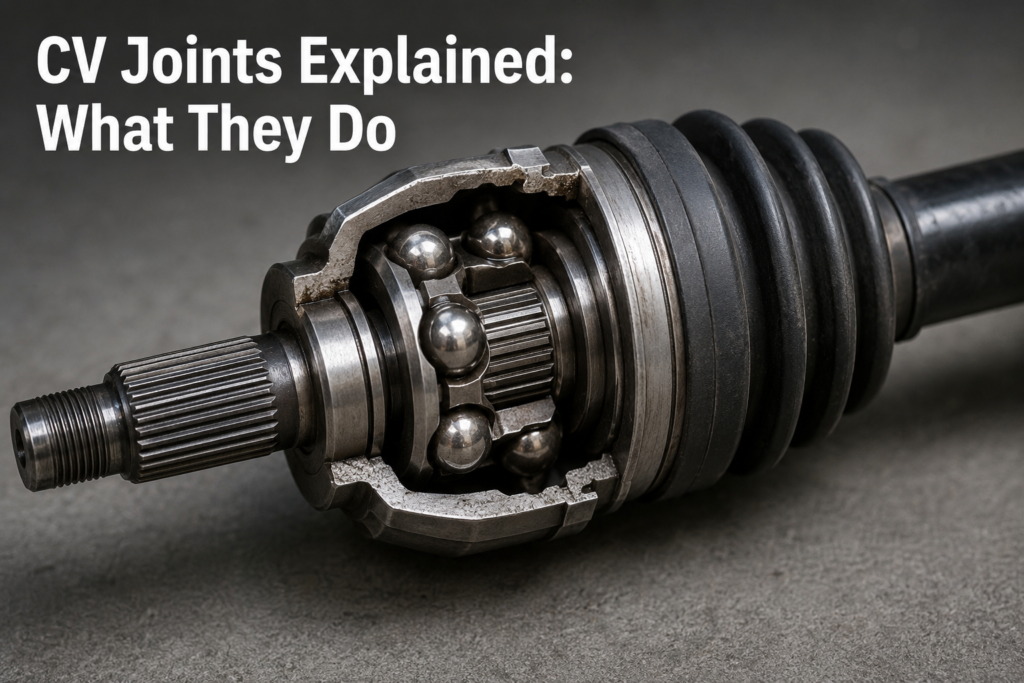
CV joints use carefully designed internal components to maintain smooth rotation. One common design uses steel balls, a cage, an inner race, and an outer housing.
The steel balls move inside specially shaped tracks. These tracks allow the joint to bend while maintaining smooth power transfer. The design also helps keep the rotational speed consistent between the input and output sides of the joint.
The joint is packed with special grease to reduce friction and protect the internal metal surfaces. A flexible rubber or synthetic boot surrounds the joint and keeps the grease inside while preventing dirt, water, and road debris from entering.
This protective boot may look like a simple rubber cover, but I consider it one of the most important parts of the CV axle assembly. If the boot becomes damaged, the joint can quickly become contaminated and lose its lubrication.
Types of CV Joints
There are several types of CV joints used in modern vehicles. The most common designs include the Rzeppa joint and tripod joint.
Rzeppa CV Joint
The Rzeppa joint is commonly used as an outer CV joint. It is designed to handle large operating angles, which makes it suitable for wheels that need to turn during steering.
Inside the joint are several steel balls held in place by a cage. These balls move along grooves inside the joint as the axle operates at different angles.
A worn outer CV joint is often associated with a clicking or popping sound when making tight turns. This is one of the most recognizable CV joint symptoms.
Tripod CV Joint
The tripod CV joint is commonly used on the inner side of a drive axle. It is designed to accommodate changes in axle length as the suspension moves.
The inner joint generally does not need to handle the same steering angle as the outer joint. Instead, it needs to allow movement as the wheel travels up and down.
Different vehicles use different designs, so the exact type of CV joint depends on the vehicle’s drivetrain and axle design.
Common Signs of a Bad CV Joint
A damaged CV joint can produce several noticeable symptoms. Paying attention to these signs can help prevent a small problem from becoming a more expensive repair.
Clicking Noise When Turning
One of the most common signs of a worn outer CV joint is a clicking or popping noise during sharp turns.
You may notice the sound more clearly when turning at low speed while accelerating. If the clicking becomes louder or more frequent, the joint should be inspected.
Vibrations While Driving
A damaged inner CV joint can sometimes cause vibrations during acceleration. The vibration may become stronger as the vehicle gains speed or when more power is applied.
However, vibrations can have many causes, including tire problems, wheel imbalance, worn suspension components, or drivetrain issues. For this reason, a proper inspection is important before replacing a CV joint.
Grease Around the Wheel Area
If you notice thick grease splattered around the inside of a wheel or nearby suspension components, a damaged CV boot could be the reason.
A torn boot allows grease to escape while allowing dirt and moisture to enter. If the problem is discovered early, replacing the boot and cleaning the joint may sometimes prevent the need for a complete CV axle replacement. If the joint has already been damaged, replacing the axle or joint may be necessary.
Clunking or Knocking Sounds
A worn CV joint can sometimes produce a clunking sound when accelerating, decelerating, or changing direction. This can also be caused by other drivetrain or suspension components, so it should not automatically be blamed on the CV joint.
Difficulty With Smooth Power Delivery
In more advanced cases, a badly worn CV joint can affect the smoothness of power transfer. The vehicle may feel less refined during acceleration, particularly if the inner joint has significant wear.
Why CV Boots Are So Important
In my opinion, checking the CV boot is one of the easiest ways to prevent major CV joint problems.
The boot protects the joint from the outside environment and keeps the special grease inside. Over time, rubber can become hard, cracked, or torn because of age, heat, road conditions, and normal movement.
Once the boot is damaged, the joint is exposed to dust, mud, water, and other contaminants. These materials can mix with the grease and create abrasive conditions inside the joint.
That is why I would never ignore a torn CV boot. A small boot problem can eventually turn into a complete CV joint or axle replacement.
Can You Drive With a Bad CV Joint?
It depends on the condition of the joint and the symptoms. A vehicle with an early CV joint problem may continue to drive for some time, but that does not mean the issue should be ignored.
As wear increases, the joint can become less reliable. In severe cases, a damaged CV joint or axle can affect the vehicle’s ability to transfer power to the wheel.
If you hear repeated clicking, feel strong vibrations, or see a badly damaged CV boot, I recommend having the vehicle inspected as soon as practical. Continuing to drive with a severely damaged drivetrain component can lead to a much more expensive repair.
How to Maintain CV Joints
CV joints generally do not require frequent maintenance when their boots remain in good condition. However, regular visual inspections can make a big difference.
During routine servicing, it is worth checking the CV boots for cracks, splits, loose clamps, or grease leakage. Pay particular attention to the areas where the boot bends during steering and suspension movement.
If a boot is damaged, addressing it early may save the joint from unnecessary wear.
It is also important to use the correct grease when servicing a CV joint. Ordinary grease is not necessarily suitable for this application because CV joints operate under high loads and require specialized lubrication.
CV Joint Replacement
When a CV joint is badly worn, replacement is usually the most practical solution. Depending on the vehicle and the design of the axle, a technician may replace only the joint or replace the complete CV axle assembly.
Many modern vehicles are serviced with complete axle replacement because it can be more straightforward and reliable than rebuilding an individual joint.
The correct approach depends on the vehicle, the condition of the components, and the repair options available. A professional inspection can determine whether the boot, joint, or complete axle needs attention.
Final Thoughts
CV joints may not receive much attention from everyday drivers, but they perform a critical job. They allow engine power to reach the wheels while handling steering movement, suspension travel, and different operating angles.
The most important thing I would remember about CV joints is that the protective boot matters just as much as the joint itself. A healthy boot keeps the grease inside and contaminants outside. Once that protection is lost, wear can develop quickly.
If your vehicle develops clicking sounds while turning, unusual vibration during acceleration, or grease around the inside of a wheel, do not ignore these signs. Getting the problem checked early can help prevent more serious drivetrain damage and potentially reduce repair costs.
Understanding how CV joints work also makes it easier to recognize problems before they become major issues. With regular inspections and proper repairs, CV joints can provide reliable power transfer and smooth driving for many miles.