Related Articles
Driving at night can be challenging, especially on roads where there is little street lighting. I have found that one of the biggest problems during night driving is managing the headlights properly. High beams provide much better visibility, but using them around other drivers can create glare and make driving uncomfortable or even dangerous for others. This is where Automatic High Beam Assist becomes useful.
Automatic High Beam Assist is a driver assistance feature that can automatically switch between high beam and low beam headlights depending on the traffic and road conditions. The main purpose of this system is to give the driver better visibility at night while reducing the chances of dazzling other road users.
In modern vehicles, this feature works with cameras, sensors, electronic control systems, and intelligent software. Although the technology may sound complicated, the basic idea is quite simple. The vehicle looks at the road ahead, detects other vehicles and light sources, and decides when high beams should be used.
What Is Automatic High Beam Assist?
Automatic High Beam Assist is a vehicle lighting technology designed to control the headlights automatically during nighttime driving. Instead of requiring the driver to manually switch between high beam and low beam, the system can make this adjustment based on the surrounding conditions.
When the road ahead is dark and there are no vehicles nearby, the system can activate the high beams. When it detects an approaching vehicle or a vehicle traveling in the same direction, it can switch back to low beams.
This makes the system particularly useful on highways, rural roads, mountain roads, and other areas where street lighting may be limited.
From my point of view, the biggest advantage is convenience. Drivers do not have to constantly think about whether their high beams are appropriate. The system monitors the road continuously and helps manage the headlights while the driver remains focused on steering and traffic.
How Automatic High Beam Assist Detects Vehicles
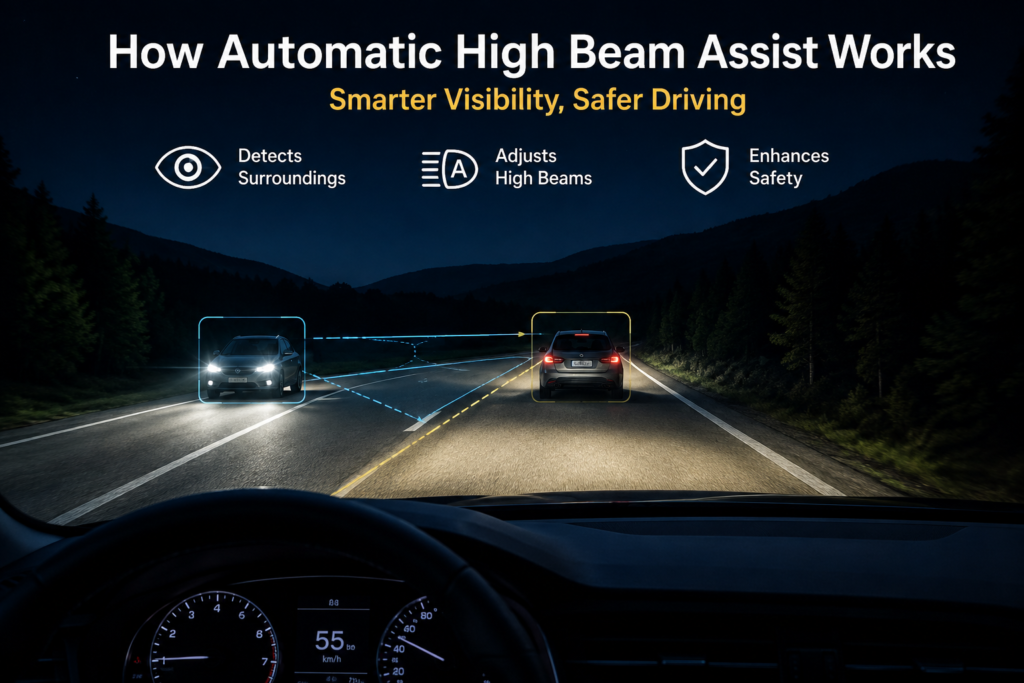
The most important part of Automatic High Beam Assist is its ability to understand what is happening in front of the vehicle. Modern systems commonly use a forward facing camera installed near the windshield, usually around the rearview mirror area.
The camera captures images of the road ahead. The vehicle’s software then analyzes these images to identify important objects and light sources.
For example, the system may detect:
• Headlights from an approaching vehicle
• Taillights from a vehicle traveling ahead
• Streetlights
• Illuminated buildings
• Reflective road signs
• Other sources of bright light
The system processes this information quickly and determines whether using high beams is appropriate.
The camera does not simply look for brightness. Advanced systems can analyze the position, movement, and characteristics of light sources. This helps the vehicle distinguish between another car and something such as a streetlight.
When Does the System Turn On High Beams?
Automatic High Beam Assist normally activates high beams when several conditions are suitable.
First, the vehicle generally needs to be traveling in a dark environment. If there is enough surrounding lighting, the system may decide that high beams are unnecessary.
Second, the road ahead needs to be relatively clear of other vehicles. If there are no approaching vehicles and no vehicles immediately ahead, high beams can improve the driver’s visibility.
Third, the system considers the vehicle’s speed and other operating conditions. Exact behavior varies between manufacturers and vehicle models.
When these conditions are satisfied, the system can activate the high beams automatically.
I think this is particularly useful on dark roads outside cities. On a completely unlit road, high beams can help the driver see road markings, curves, pedestrians, animals, and obstacles much earlier than low beams alone.
When Does Automatic High Beam Assist Turn the High Beams Off?
The system’s other important job is switching the high beams off when they could disturb another road user.
Suppose you are driving on a dark road with your high beams activated. A vehicle approaches from the opposite direction. Its headlights become visible to the camera.
The system recognizes the approaching vehicle and switches to low beams.
Similarly, if you are following another vehicle, the system can detect its taillights and reduce the headlight intensity by switching to low beam.
Once the other vehicle has passed or moved far enough away, the system may activate the high beams again if the road remains dark.
This automatic process can happen repeatedly during a journey without requiring the driver to manually operate the headlight control every time.
The Role of the Forward Facing Camera
The forward facing camera is one of the most important components of an automatic high beam system.
It continuously observes the road and sends information to the vehicle’s electronic control system. The camera is designed to recognize patterns associated with headlights and taillights.
In some vehicles, the camera is part of a larger driver assistance camera system that supports several features. The same camera technology may also help with traffic sign recognition, lane departure warning, and other safety functions.
The camera needs a clear view to work effectively. Dirt, snow, ice, heavy rain, fog, or damage around the windshield area can affect its ability to detect objects and lights.
This is why I believe keeping the windshield and camera area clean is more important than many drivers realize.
How the Vehicle Makes the Decision
After the camera detects the road environment, the vehicle’s electronic control unit processes the information.
The software evaluates factors such as the brightness of the surroundings, detected vehicles, their distance, and their position on the road.
The system then determines whether high beams should remain active or whether low beams are more appropriate.
The process happens very quickly. Drivers may barely notice the transition because modern headlight systems are designed to respond smoothly.
In some advanced vehicles, the system can do more than simply switch between two settings. Certain lighting technologies can control different sections of the headlights independently, allowing the vehicle to provide illumination while reducing light directed toward other vehicles.
However, the exact technology depends on the vehicle.
Automatic High Beam Assist vs Manual High Beams
With traditional headlights, the driver has complete responsibility for switching between low and high beams.
This is simple but can become inconvenient. On a busy road, the driver may need to change the setting frequently. If the driver forgets to switch off the high beams, an approaching driver may experience glare.
Automatic High Beam Assist is designed to reduce this problem.
Instead of manually controlling the lights all the time, the driver can allow the system to handle the switching when conditions are suitable.
However, I would not consider Automatic High Beam Assist a replacement for driver attention. The driver still needs to observe the road and understand the lighting conditions.
Benefits of Automatic High Beam Assist
One of the biggest benefits is improved nighttime visibility.
High beams illuminate a greater distance in front of the vehicle, which can help drivers identify hazards earlier. This can be especially helpful on roads without street lighting.
Another benefit is convenience. The driver does not need to repeatedly operate the headlight switch when traffic conditions change.
The system can also help reduce glare for other drivers. By switching to low beams when another vehicle is detected, it can make nighttime driving more comfortable for everyone.
Automatic High Beam Assist can also support safer driving habits by making it easier to use high beams appropriately.
Limitations of Automatic High Beam Assist
Like any driver assistance technology, Automatic High Beam Assist is not perfect.
The camera may have difficulty detecting vehicles in certain conditions. Heavy rain, fog, snow, dirt, glare, sharp curves, hills, or unusual lighting can affect system performance.
For example, a vehicle approaching around a sharp bend may not be detected immediately because it is temporarily outside the camera’s direct view.
A motorcycle or bicycle may also be more difficult for some systems to recognize depending on its lighting and position.
Streetlights and reflective objects can also influence the system’s decisions.
Because of these limitations, drivers should always remain responsible for controlling the vehicle and headlights when necessary.
Does Automatic High Beam Assist Work in Bad Weather?
Weather conditions can affect the performance of the system.
Rain can create reflections and reduce visibility. Fog can scatter light and make it harder for cameras to identify distant objects. Snow or ice on the windshield can partially block the camera’s view.
If the camera cannot clearly understand the environment, the system may reduce its functionality or request driver intervention.
This is one reason I would always recommend checking the road conditions yourself rather than relying completely on automatic features.
How to Use Automatic High Beam Assist Properly
Using the system is generally straightforward. The driver normally activates the automatic high beam function through the headlight controls or vehicle settings.
Once activated, the system monitors the road while the vehicle is operating under suitable conditions.
However, drivers should understand their vehicle’s owner’s manual because the operation can vary between manufacturers.
If the system does not respond as expected, the driver should manually control the headlights.
It is also important to keep the windshield clean around the camera area and make sure the vehicle’s headlights are properly maintained.
Is Automatic High Beam Assist Worth Having?
In my opinion, Automatic High Beam Assist is one of those vehicle features that becomes more useful the more you drive at night.
It does not completely change how a car works, but it solves a common problem in a practical way. Instead of forcing the driver to constantly switch between high and low beams, it uses cameras and software to make the process easier.
For people who regularly drive on dark highways or rural roads, the feature can be especially valuable.
At the same time, it should be viewed as a driver assistance system rather than an autonomous feature. The driver remains responsible for paying attention and controlling the vehicle.
Final Thoughts
Automatic High Beam Assist is a good example of how modern automotive technology can make everyday driving more convenient and potentially safer. The system uses a forward facing camera and electronic software to monitor the road, identify vehicles and light sources, and automatically adjust the headlights.
Its main goal is simple: provide better visibility when the road is dark while reducing unnecessary glare for other drivers.
From my perspective, the real value of Automatic High Beam Assist is that it combines convenience with better lighting management. It allows drivers to benefit from high beam visibility without having to manually change the headlights every few moments.
Still, no technology can replace an attentive driver. Weather, road layout, camera visibility, and unusual traffic situations can affect how the system performs. For that reason, drivers should understand how their particular system works and remain prepared to take control whenever necessary.
As vehicle technology continues to improve, automatic lighting systems are likely to become even smarter. Future headlights may provide more precise illumination while responding more effectively to traffic, road conditions, and the driver’s surroundings. For now, Automatic High Beam Assist remains a useful feature for anyone who wants better nighttime visibility with less manual effort.