Related Articles
Keyless entry systems have changed the way I interact with modern cars. Instead of taking a traditional metal key out of my pocket and putting it into a lock, I can simply approach the vehicle, touch the door handle, and get inside. Some advanced systems can even recognize the key automatically and unlock the car without requiring me to press a button.
In my view, keyless entry is one of those car technologies that seems simple when we use it, but there is actually a lot happening behind the scenes. The system uses wireless communication, sensors, antennas, and electronic control units to identify an authorized key and allow access to the vehicle.
Understanding how keyless entry systems work can also help car owners use this technology more safely and understand its benefits and limitations.
What Is a Keyless Entry System?
A keyless entry system is an electronic system that allows a driver to lock or unlock a vehicle without using a traditional physical key. Depending on the vehicle, the system may work through a remote key fob, smart key, or smartphone.
Basic remote keyless entry systems usually require the driver to press a button on the key fob. When the button is pressed, the key fob sends a wireless signal to the vehicle. If the vehicle recognizes the signal as valid, it unlocks or locks the doors.
Modern cars can also use passive keyless entry. With this type of system, I do not always need to press a button. The vehicle can detect the smart key when I am close to the car and unlock the door when I touch the handle.
This makes the experience much more convenient, especially when my hands are full or I am carrying shopping bags.
How Keyless Entry Systems Work
The basic operation of a keyless entry system involves communication between the vehicle and the key. The smart key contains electronic components that allow it to communicate with the vehicle wirelessly.
When I approach a car with a passive keyless entry system, the vehicle uses antennas to detect whether an authorized key is nearby. These antennas create a short range communication area around the vehicle.
The smart key responds to the vehicle’s signal. The vehicle then checks the information received from the key. If the system confirms that the key is authorized, the car can unlock the doors.
Once I enter the vehicle, another security check may take place before the engine is allowed to start. This is why simply having a similar looking key is normally not enough to start a modern car.
The process happens very quickly, so from my point of view, the door seems to unlock almost instantly.
The Role of the Key Fob
The key fob is one of the most important parts of a keyless entry system. It looks like a small remote control, but it contains electronic circuits, a battery, and security information.
Traditional remote key fobs normally have buttons for locking and unlocking the vehicle. Some may also include buttons for opening the trunk, activating a panic alarm, or starting the engine remotely.
Modern smart keys can perform additional functions. They can communicate with the vehicle automatically and may not require a button press for normal entry.
The key fob usually contains a unique electronic identity that the vehicle recognizes. This helps prevent an ordinary radio signal from unlocking the vehicle.
Passive Keyless Entry
Passive keyless entry is one of the most convenient forms of keyless entry technology. It allows the vehicle to recognize the smart key when it is close to the car.
For example, when I walk toward my vehicle with the smart key in my pocket, the car can detect its presence. When I touch the door handle, the system checks the key and unlocks the doors if the key is authorized.
The same technology can work when leaving the car. Depending on the vehicle, touching a specific area of the handle or pressing a small button can lock the doors.
Some vehicles automatically lock themselves after the key moves away from the vehicle.
This technology reduces the need to repeatedly take the key out of my pocket, which makes everyday driving more comfortable.
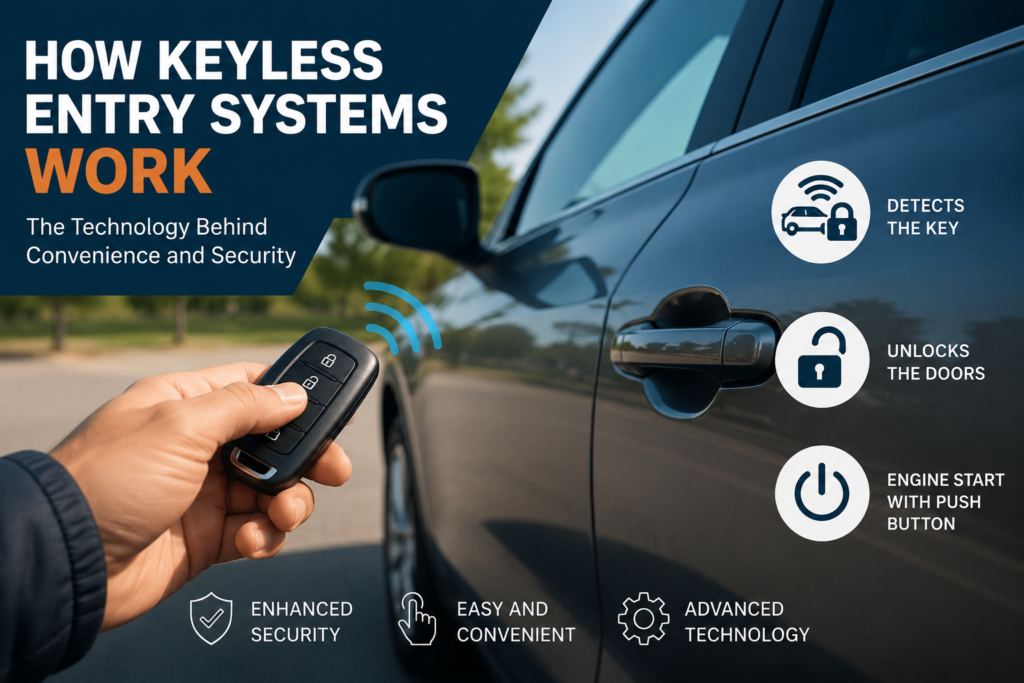
How Push Button Start Works
Keyless entry is often combined with push button start. In this setup, I can start the vehicle without inserting a physical key into the ignition.
When I sit inside the vehicle and press the brake pedal, the car checks whether the authorized smart key is present inside the cabin. The vehicle communicates with the key through its electronic system.
If the key is detected and authentication is successful, the engine start system becomes available. I can then press the start button to start the engine.
In vehicles with hybrid or electric powertrains, the same basic idea can be used even though there may not be a conventional engine starting process.
Security Technology Behind Keyless Entry
Security is an important part of modern keyless entry systems. The vehicle does not simply accept any wireless signal. It uses electronic identification and security protocols to determine whether the key is authorized.
Many systems use changing or encrypted communication to make unauthorized access more difficult. The exact technology depends on the manufacturer and vehicle model.
Modern vehicles may also use immobilizer technology. The immobilizer prevents the vehicle from being started unless the correct electronic authorization is detected.
From my perspective, this is an important advantage because the keyless system is not only about convenience. It is also designed to protect the vehicle from unauthorized use.
However, no electronic security system should be considered completely impossible to attack. Vehicle owners should still follow basic security practices.
What Is a Keyless Entry Antenna?
Antennas are another important part of the system. A modern vehicle can have several antennas positioned around the cabin and body.
These antennas help the vehicle determine whether the smart key is outside or inside the car. This distinction is important because the vehicle needs to know where the key is before allowing certain functions.
For example, if the smart key is outside the car, the system may allow the doors to unlock. If the key is inside the cabin, the system can authorize the push button start.
Multiple antennas can help improve detection and positioning. This is one reason keyless entry systems can perform their tasks so quickly.
Keyless Entry and Relay Attacks
Although keyless entry provides excellent convenience, there are security concerns that vehicle owners should understand. One example is a relay attack.
In a relay attack, criminals may use specialized equipment to extend the communication distance between a vehicle and its smart key. The goal is to make the vehicle believe that the authorized key is nearby when it is actually farther away.
This type of attack is one reason I believe it is important for owners of keyless vehicles to understand how their particular system works.
Some manufacturers have introduced additional security features to reduce these risks. Some smart keys can also enter a sleep mode or have other methods of reducing unnecessary wireless communication.
Owners should check the vehicle manufacturer’s recommendations for protecting their particular keyless system.
Advantages of Keyless Entry Systems
There are several reasons why keyless entry systems have become common in modern vehicles.
The biggest advantage is convenience. I do not need to search through my pockets for a traditional key every time I want to unlock the car.
Another advantage is speed. The system can unlock the vehicle very quickly when the authorized key is detected.
Keyless entry can also be useful when my hands are occupied. For example, if I am carrying groceries, I can approach the car and unlock it without having to put everything down.
Push button start provides another level of convenience because there is no need to insert a key into an ignition switch.
Modern keyless systems can also be integrated with other vehicle features, including remote starting, trunk access, alarm systems, and smartphone applications.
Disadvantages of Keyless Entry
Despite its advantages, keyless entry also has some limitations.
The biggest issue is that the system depends on electronic components and a battery. If the key fob battery becomes weak or completely runs out, normal operation may be affected.
Fortunately, many vehicles have backup methods for unlocking the car and starting the vehicle when the key fob battery is low. The exact procedure depends on the manufacturer.
Another concern is electronic security. Because the system communicates wirelessly, it requires strong security technology to prevent unauthorized access.
Keyless entry systems can also be more expensive to repair than traditional mechanical locks. If an electronic key, antenna, or control module fails, diagnosis and replacement may require specialized equipment.
What Happens When the Key Fob Battery Dies?
This is a common question among keyless car owners. In most modern vehicles, a dead key fob battery does not necessarily mean that the car becomes unusable.
Many smart keys contain a hidden mechanical key that can be used to unlock the driver’s door manually. The vehicle may also have a specific location where the key fob can be placed so the car can detect it even when the fob battery is weak.
The exact procedure varies from one vehicle to another. For this reason, I recommend checking the owner’s manual and learning the emergency starting procedure before it is actually needed.
How to Protect a Keyless Car
There are several simple steps that can improve the security of a keyless vehicle.
I would start by keeping the smart key in a secure location when it is not being used. Some owners use signal blocking pouches designed to reduce wireless communication when the key is stored.
It is also a good idea to check whether the vehicle manufacturer provides security updates or specific recommendations for the keyless system.
Using additional security measures such as a steering wheel lock can provide another layer of protection, particularly if the vehicle is parked in a high risk area.
The important thing is to understand that convenience should not completely replace basic security awareness.
Keyless Entry vs Traditional Keys
Traditional keys are simple and mechanical. They usually require the driver to insert the key into a lock or ignition.
Keyless entry systems replace much of this physical interaction with electronic communication. This makes them faster and more convenient, but also introduces electronic components that can fail or require maintenance.
Personally, I see keyless entry as a natural development in automotive technology. Cars have become increasingly electronic, and access systems have evolved along with them.
Traditional keys still have an advantage in simplicity, while keyless systems provide a much more convenient daily experience.
The Future of Keyless Entry Technology
Keyless entry technology continues to develop. Modern vehicles are increasingly using smartphones and digital keys alongside traditional smart key systems.
A digital car key can allow a compatible smartphone to communicate with the vehicle. Depending on the system, the owner may be able to unlock the car, lock it, or start it using a supported mobile device.
Biometric security and advanced digital authentication may also become more common in future vehicles.
As vehicles become more connected, I expect keyless entry systems to become more integrated with mobile apps, cloud services, and other vehicle technologies.
Final Thoughts
Keyless entry systems have made vehicle access faster, easier, and more convenient. The technology may appear simple from the outside, but it depends on several components working together, including the smart key, antennas, sensors, electronic control units, and security software.
The basic idea is straightforward. The vehicle communicates with an authorized key, verifies its identity, and then allows specific functions such as unlocking the doors or starting the vehicle.
In my opinion, keyless entry is one of the most useful examples of how technology has improved everyday driving. At the same time, car owners should understand the security considerations and learn what to do if the key fob battery becomes weak.
As automotive technology continues to improve, keyless entry systems will likely become even smarter and more closely connected with smartphones and digital vehicle platforms. For drivers, that means greater convenience, better integration, and a more modern way of interacting with their cars.
I can also create an AdSense friendly featured image for this keyless entry article.