
Related Articles

When I think about how much cars have changed in the last few years, one of the biggest changes I notice is the infotainment system. A modern car is no longer just a machine that takes us from one place to another. The dashboard has become a small technology center where we can control music, navigation, phone calls, vehicle settings, and sometimes even climate functions.
Modern car infotainment systems combine hardware and software to give drivers a more connected and convenient driving experience. From my point of view, the most interesting thing is that these systems are becoming more like smartphones, but they are specially designed to work inside a vehicle.
What Is a Car Infotainment System?
A car infotainment system is the technology system built into a vehicle that provides information and entertainment to the driver and passengers. The word infotainment comes from combining information and entertainment.
In older cars, the dashboard usually had a basic radio, a few physical buttons, and perhaps a small display. Today, many vehicles have large touchscreens, digital instrument displays, voice assistants, navigation systems, Bluetooth connectivity, smartphone integration, and internet based services.
The main purpose is to make important information easier to access while also providing entertainment. Depending on the vehicle, the system may allow drivers to control audio, navigation, phone calls, vehicle settings, cameras, and other features from one central interface.
How Does a Modern Infotainment System Work?
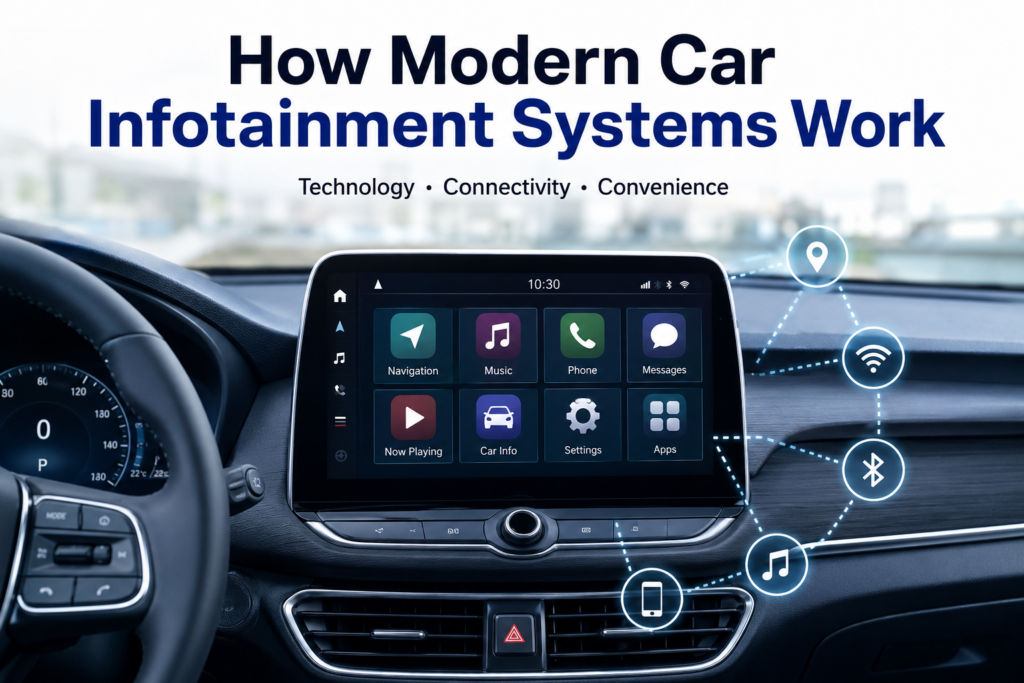
At a basic level, a modern car infotainment system works like a specialized computer. It has a processor, memory, storage, operating software, a display, speakers, microphones, and communication hardware.
When I use the touchscreen to select a song or enter a destination, the system receives that command through its interface. The processor then processes the request and communicates with the appropriate part of the vehicle or connected device.
For example, if I select navigation, the infotainment system may use GPS information to determine the vehicle’s location. It can then display a map and calculate a suitable route. If I connect my phone through Bluetooth or a compatible smartphone platform, the system communicates with the phone to access supported features.
This combination of hardware, software, sensors, and communication technologies is what makes modern infotainment systems useful.
The Touchscreen Is the Main Interface
The touchscreen is probably the most noticeable part of a modern car infotainment system. Instead of having separate buttons for every function, manufacturers can place many controls inside one digital interface.
A touchscreen can display navigation maps, music controls, phone contacts, vehicle information, cameras, and settings. The layout can also change depending on what the driver is doing.
However, I believe a good infotainment system should not depend entirely on touch controls. Physical buttons and steering wheel controls can still be useful because drivers can operate them without taking their eyes away from the road for too long.
This is one reason modern car manufacturers try to balance digital displays with simple physical controls.
Navigation and GPS
Navigation is another important part of modern car infotainment systems. GPS technology allows the vehicle system to determine its location by receiving signals from satellites.
Once the system knows where the vehicle is, navigation software can display maps and provide directions. Depending on the system, navigation may also provide traffic information, estimated arrival times, road warnings, and alternative routes.
Some infotainment systems use online services to provide updated traffic and map information. This can be particularly helpful because road conditions can change quickly.
In my opinion, built in navigation is most useful when it can combine accurate maps with real time information. A map alone is helpful, but knowing about traffic or road closures makes navigation much more practical.
Smartphone Connectivity
One of the biggest developments in car infotainment is smartphone integration. Most people already carry a powerful computer in their pocket, so it makes sense for the car to connect with it.
Bluetooth is commonly used for wireless phone calls and audio streaming. Some vehicles also support smartphone platforms that allow compatible apps and services to appear on the car’s display.
With smartphone connectivity, drivers may be able to access navigation, music, podcasts, messages, and phone calls through a vehicle friendly interface.
The advantage is that drivers do not necessarily need to learn a completely different system. They can use familiar services through the car’s screen while keeping the phone itself out of their hands.
Voice Control
Voice control has also become an important feature in modern infotainment systems. Instead of pressing buttons or typing on a touchscreen, drivers can use spoken commands.
For example, a driver might ask the system to call a contact, change the music, find a nearby location, or enter a destination.
Voice control is especially useful while driving because it can reduce the amount of physical interaction with the screen. However, the quality of voice recognition can depend on the vehicle, software, microphone quality, background noise, and internet connection.
I think voice commands are becoming more useful, but they still work best when they are simple and clear.
Audio and Entertainment
Entertainment remains one of the main reasons infotainment systems exist. Modern systems can support traditional radio, Bluetooth audio, USB devices, music streaming, podcasts, and other digital media.
The audio system itself can also be quite advanced. Some vehicles have multiple speakers positioned around the cabin, digital sound processing, and different audio settings.
The infotainment system acts as the central controller for all of these functions. Instead of switching between separate devices, everything can be managed from one interface.
For passengers, this can make long journeys more comfortable. For drivers, having familiar music and audio services available can make everyday driving more enjoyable.
Vehicle Controls and Information
Modern infotainment systems are not limited to entertainment. Many vehicles use the central screen to display important vehicle information and control different functions.
Depending on the model, drivers may be able to adjust climate settings, select driving modes, monitor energy consumption, check tire information, view cameras, or change certain vehicle preferences.
Electric vehicles often take this even further. Their infotainment systems can display battery percentage, charging information, estimated range, energy usage, and nearby charging stations.
This shows how the infotainment system is becoming more closely connected to the actual vehicle rather than remaining a separate entertainment device.
Cameras and Parking Assistance
Another feature commonly connected to infotainment systems is the vehicle camera system. When the driver selects reverse, the display can show a rear camera view.
More advanced vehicles may have multiple cameras that create a wider view around the car. Some systems can provide a virtual top view that helps drivers understand the vehicle’s position while parking.
Parking sensors can also work together with the display to show nearby objects using visual warnings.
From my perspective, this is one of the most practical uses of a large infotainment screen because it provides information that would otherwise be difficult for the driver to see.
Software and Updates
Modern infotainment systems depend heavily on software. This means manufacturers can sometimes improve the system after the vehicle has already been purchased.
Some vehicles can receive software updates through the internet. These updates may improve performance, fix bugs, add features, or update maps and connected services.
This is similar to how smartphones receive software updates. However, cars have much longer lifespans than most smartphones, so keeping infotainment software reliable and compatible can be a bigger challenge.
A system that feels modern when a car is new can eventually become outdated if its software and hardware are not properly maintained.
Internet Connectivity
Many newer vehicles can connect to the internet through built in cellular connections or connected smartphones. Internet access can provide services such as live traffic information, weather updates, online searches, remote vehicle features, and updated maps.
Some connected cars can communicate with manufacturer services in the background. This can allow the vehicle to receive information about software, maintenance, charging, or other services.
The exact features depend on the vehicle and the services offered by its manufacturer.
Safety and Driver Attention
Although modern infotainment systems provide many benefits, I believe safety should always come first. A large touchscreen can be useful, but too much interaction while driving can become distracting.
For this reason, many systems include steering wheel controls, voice commands, simplified menus, and driver friendly interfaces.
The best infotainment system is not necessarily the one with the most features. In my opinion, it is the one that gives useful information without making the driver spend too much time looking at the screen.
Navigation, music, calls, and vehicle information should be easy to access and understand.
The Future of Car Infotainment
I think car infotainment systems will continue becoming more intelligent and connected. Artificial intelligence, better voice recognition, improved navigation, larger displays, and more personalized software could change how drivers interact with their vehicles.
Future systems may understand natural conversations instead of requiring specific commands. They could potentially learn a driver’s preferences and automatically adjust navigation, music, climate settings, and other functions.
At the same time, manufacturers will need to make sure these technologies remain reliable and safe.
Final Thoughts
Modern car infotainment systems have transformed the way we interact with vehicles. What started as a simple radio and display has developed into a sophisticated computer system that connects the driver, smartphone, internet, navigation, entertainment, and vehicle controls.
From my point of view, the biggest advantage is convenience. I can access navigation, music, calls, vehicle information, and other useful features from one place.
However, technology should always support the driver rather than become a distraction. A well designed infotainment system should be simple, responsive, easy to understand, and safe to use.
As cars become more connected and software driven, infotainment systems will likely become an even bigger part of the driving experience. The technology may become more advanced, but the basic goal should remain the same: making driving more convenient, informed, connected, and enjoyable.