
Related Articles


When people talk about a car suspension system, two terms that often come up are shock absorbers and struts. Many drivers use these words as if they mean the same thing, but they are actually different suspension components. Both play an important role in keeping the vehicle stable, comfortable, and safe, but they do their jobs in different ways.
In my experience, understanding the difference between shock absorbers and struts can help car owners make better decisions when a suspension problem appears. It can also prevent unnecessary repairs because you will have a better idea of which part your vehicle actually uses.
In this article, I will explain shock absorbers vs struts in simple language, including their functions, differences, warning signs, replacement needs, and how to know which one may be causing a problem.
What Is a Shock Absorber?
A shock absorber is a suspension component designed mainly to control the movement of the vehicle. When your car travels over a pothole, speed bump, rough road, or uneven surface, the suspension springs compress and expand. Without something controlling this movement, the vehicle would continue bouncing for a while.
This is where the shock absorber becomes important.
A shock absorber uses hydraulic fluid and internal valves to control the movement of the suspension. It does not normally support the full weight of the vehicle. Instead, it works with the springs and other suspension components to reduce excessive bouncing and movement.
A good shock absorber helps the tires maintain better contact with the road. This can improve handling, braking, ride comfort, and overall vehicle stability.
What Is a Strut?
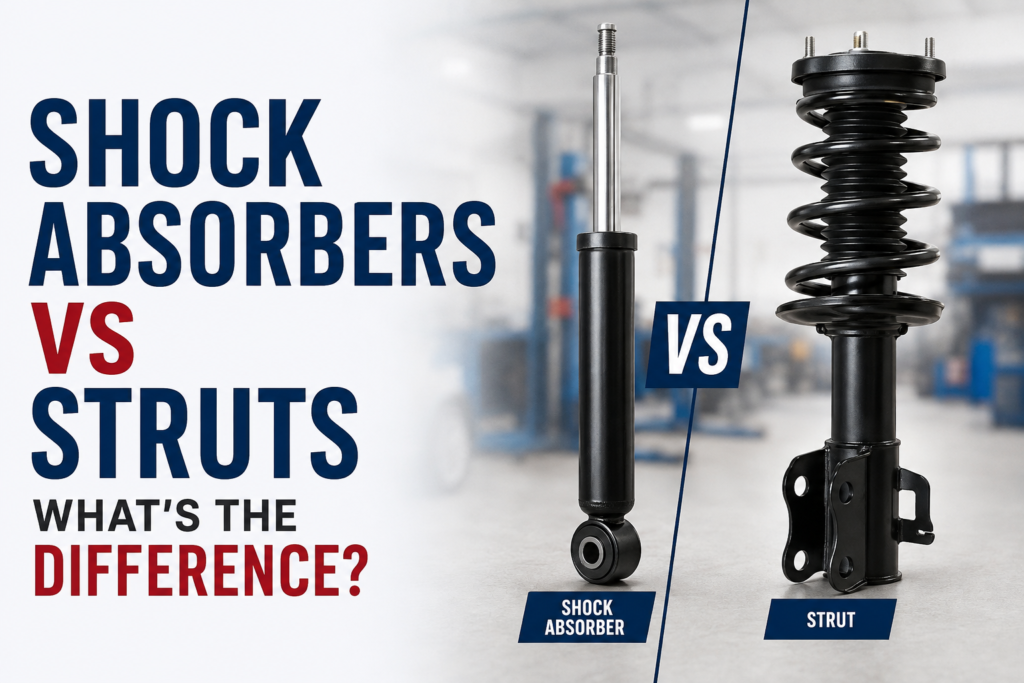
A strut performs some of the same basic suspension control functions as a shock absorber, but it is also a structural part of the suspension system.
A common type is the MacPherson strut, which is widely used in modern cars. The strut assembly can include the shock absorber, coil spring, upper mount, bearing, and other related components.
One of the biggest differences is that a strut can help support the vehicle and provide structural positioning for the wheel assembly. It can also affect steering geometry on vehicles where the front suspension uses struts.
This means replacing a strut can sometimes be a more involved repair than replacing a simple shock absorber.
Shock Absorbers vs Struts: The Main Difference
The easiest way to understand the difference is to look at their role in the suspension.
A shock absorber mainly controls suspension movement. A strut can control suspension movement while also acting as a structural part of the suspension system.
A shock absorber is usually one component within a larger suspension system. A strut can be considered part of the suspension structure itself.
This difference is important because shocks and struts are not always interchangeable. If your vehicle was designed with struts, you cannot simply replace them with ordinary shock absorbers.
How Shock Absorbers Work
The basic operation of a shock absorber is quite interesting. Inside the shock absorber is a piston that moves through hydraulic fluid. When the suspension moves, the piston also moves.
The internal valves restrict the movement of the fluid. This resistance slows down the movement of the suspension.
For example, imagine driving over a large bump. The spring compresses as the wheel moves upward. After the bump, the spring wants to return to its normal position. Without a shock absorber, the spring could cause repeated bouncing.
The shock absorber controls this movement so the car settles more quickly.
This is why a vehicle with worn shock absorbers may feel loose or bouncy, especially on rough roads.
How Struts Work
A strut also uses damping technology to control suspension movement, but its role is broader.
In a typical strut suspension, the strut assembly works with the coil spring and other mounting components. The strut helps position the wheel and can contribute to the overall structural support of the suspension.
On the front of many vehicles, the strut is also connected to the steering system. As the driver turns the steering wheel, the strut assembly can move with the wheel.
Because of this, worn strut components can sometimes affect both ride quality and steering behavior.
Ride Comfort and Handling
Both shock absorbers and struts have a major influence on ride comfort and handling.
When these components are working properly, the vehicle feels controlled when driving over uneven surfaces. The body does not bounce excessively, and the tires remain more firmly connected to the road.
When they become worn, you may notice more body movement. The car may feel less stable during turns, and the ride may become uncomfortable.
In my view, one of the biggest mistakes drivers make is ignoring these changes because the vehicle still moves. Suspension wear can happen gradually, so many people simply get used to the way their car feels.
Signs of Bad Shock Absorbers
Worn shock absorbers can produce several noticeable symptoms.
One common sign is excessive bouncing after driving over a bump. If the vehicle continues moving up and down instead of settling quickly, the shocks may be worn.
You may also notice increased body movement when braking or accelerating. The vehicle can feel less controlled during turns, especially at higher speeds.
Uneven tire wear can also occur because worn suspension components may prevent the tires from maintaining consistent contact with the road.
Fluid leaking from the shock absorber is another warning sign. If you see oil around the shock body, it is worth having the suspension inspected by a qualified mechanic.
Signs of Bad Struts
Bad struts can create symptoms that are similar to worn shocks because both components control suspension movement.
Common warning signs include excessive bouncing, unusual noises, poor handling, uneven tire wear, and increased body movement.
If a front strut assembly is worn, you may also notice problems while steering. A knocking or clunking noise when turning or driving over rough roads can indicate an issue with the strut assembly or one of its related components.
However, these symptoms can also be caused by other suspension parts. That is why a proper inspection is important before replacing anything.
Are Struts Better Than Shock Absorbers?
It is not really a question of which one is better.
Shock absorbers and struts are designed for different suspension layouts. A vehicle designed around shock absorbers needs shocks, while a vehicle designed around struts needs struts.
The choice is usually made by the vehicle manufacturer during the suspension design process.
For car owners, the important thing is to understand what your particular vehicle uses and replace worn components with the correct parts.
Do Shocks and Struts Need to Be Replaced Together?
They do not necessarily need to be replaced together, but replacement is often recommended in pairs on the same axle.
For example, if one front shock absorber is worn, replacing both front shock absorbers can help maintain more balanced suspension performance.
The same idea applies to struts. If one front strut has reached the end of its service life, replacing the pair can provide more consistent handling.
Some vehicles may also require related components such as mounts, bearings, dust boots, or bump stops to be inspected during the repair.
How Long Do Shock Absorbers and Struts Last?
There is no single mileage figure that applies to every vehicle.
Service life depends on road conditions, driving style, vehicle weight, climate, road debris, and the quality of the suspension components.
A car that spends most of its time on smooth roads may experience less suspension stress than one regularly driven on damaged or uneven roads.
Instead of relying only on mileage, I recommend paying attention to changes in the way the vehicle drives. If the ride suddenly feels less controlled, it is worth getting the suspension checked.
Why Suspension Inspection Matters
Suspension components affect much more than comfort.
The suspension helps keep the tires connected to the road. This matters during braking, cornering, acceleration, and emergency maneuvers.
A worn shock absorber or strut may not cause an immediate breakdown, but ignoring suspension problems can affect vehicle control and tire performance.
Regular inspections are especially useful if you frequently drive on rough roads or notice new noises, bouncing, steering changes, or uneven tire wear.
Final Thoughts
The main difference between shock absorbers and struts is their role within the suspension system. A shock absorber primarily controls suspension movement, while a strut can control suspension movement and also serve as an important structural component.
Both are essential for good ride quality, handling, and vehicle stability. They are not simply two names for exactly the same part.
If your vehicle feels unusually bouncy, unstable, noisy, or difficult to control, the suspension deserves attention. Rather than replacing parts based only on symptoms, I believe the best approach is to have the complete suspension system inspected and identify the actual cause.
Understanding shock absorbers vs struts makes it easier to communicate with a mechanic, recognize potential problems, and take better care of your vehicle. A small suspension issue may seem unimportant at first, but keeping these components in good condition can make a noticeable difference in how safely and comfortably your car drives.