Related Articles
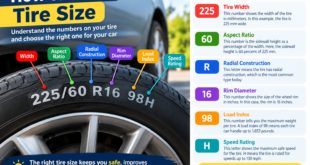
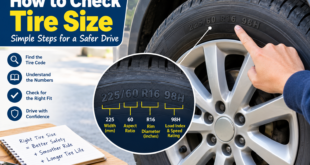
When I first started paying closer attention to tire markings, I noticed that there are many numbers and letters printed on the sidewall. Most drivers understand the tire size, but the tire load index is often overlooked. In my opinion, this is one of the most important numbers on a tire because it tells us how much weight the tire is designed to carry safely.
Understanding the tire load index can help you choose the right tires, avoid unnecessary wear, and maintain better handling and safety. It is especially important when replacing tires or buying a different tire size.
In this guide, I will explain what tire load index means, how to read it, how it relates to load capacity, and why you should always consider it when choosing tires for your vehicle.
What Is Tire Load Index?
The tire load index is a numerical code printed on the sidewall of a tire. It represents the maximum weight that one tire can carry when operated under the conditions specified by the tire manufacturer.
The number itself is not the actual weight in kilograms or pounds. Instead, it corresponds to a specific load capacity listed in a standardized load index chart.
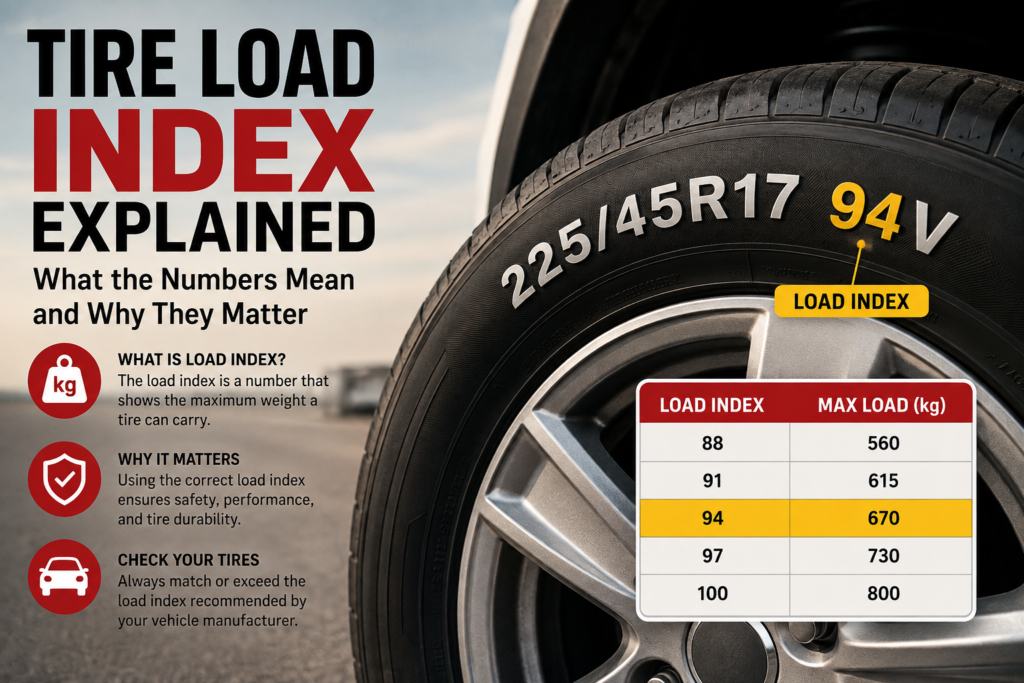
For example, a tire with a load index of 94 can carry up to approximately 670 kilograms under its specified conditions. A tire with a load index of 91 has a maximum capacity of approximately 615 kilograms.
This means that a higher load index generally indicates that the tire can support more weight.
Where Can You Find the Tire Load Index?
Finding the load index is quite simple once you know what to look for. You can find it printed on the sidewall of your tire as part of the tire size marking.
For example, you might see:
225/45R17 94V
In this example, the number 94 is the tire load index, while the letter V represents the tire speed rating.
The other numbers and letters describe different characteristics of the tire.
225 represents the tire width in millimeters.
45 represents the aspect ratio.
R means the tire has radial construction.
17 represents the wheel diameter in inches.
94 represents the load index.
V represents the speed rating.
So when reading a tire sidewall, I always recommend looking at the complete marking rather than focusing only on the tire size.
How Does the Tire Load Index Chart Work?
The tire load index uses numbers that correspond to specific weight capacities. These numbers normally range from lower capacities suitable for smaller vehicles to much higher capacities used on larger vehicles and commercial applications.
Here are some common examples:
| Load Index | Maximum Load Per Tire |
|---|---|
| 88 | 560 kg |
| 91 | 615 kg |
| 94 | 670 kg |
| 97 | 730 kg |
| 100 | 800 kg |
| 103 | 875 kg |
| 106 | 950 kg |
| 109 | 1,030 kg |
| 112 | 1,120 kg |
| 116 | 1,250 kg |
These figures are useful for understanding the relationship between the index number and carrying capacity.
However, I would not recommend choosing a tire simply because it has a higher number. The vehicle manufacturer specifies the appropriate tire specifications for a reason.
Why Is Tire Load Index Important?
The tire load index is important because tires carry the entire weight of your vehicle. This includes the vehicle itself, passengers, luggage, fuel, and anything else being transported.
If the tires are not capable of supporting the required weight, several problems can occur.
The tires may experience excessive heat buildup, increased wear, reduced handling performance, or structural stress. In severe circumstances, using tires that are not suitable for the vehicle’s required load can create a serious safety risk.
This is why I believe the load index should receive the same attention as tire size when buying replacement tires.
A tire that fits the wheel perfectly is not necessarily the correct tire for the vehicle.
How Much Weight Can Four Tires Carry?
A simple way to understand tire load capacity is to multiply the maximum load of one tire by four.
For example, if each tire has a load index of 94 and can carry approximately 670 kilograms, four tires theoretically provide a combined capacity of about 2,680 kilograms.
However, this does not mean that your vehicle can automatically carry 2,680 kilograms.
The actual vehicle weight limit is determined by the vehicle manufacturer and other components, including the suspension, wheels, axles, brakes, and chassis.
The weakest component determines the practical limit.
That is why the tire load index should never be used by itself to determine how much cargo or how many passengers a vehicle can safely carry.
Tire Load Index and Vehicle Weight
Every vehicle has a recommended weight capacity. You can usually find this information on the vehicle information label, owner’s manual, or manufacturer’s documentation.
The recommended tire load index is selected according to the vehicle’s design and expected operating conditions.
For example, a small hatchback may use tires with a relatively low load index because it weighs less. A large SUV may require tires with a higher load index because it is heavier and may carry more passengers and cargo.
Pickup trucks and commercial vehicles can require even greater load carrying capacity.
This is one reason why replacing tires with a completely different specification without checking the manufacturer’s recommendation is not something I would advise.
Can I Use a Higher Load Index?
In many situations, a tire with a higher load index can be used if its other specifications are appropriate for the vehicle.
For example, if your vehicle requires a tire with a load index of 91, a suitable tire with a higher load index may provide additional load capacity.
However, there are other factors to consider.
The replacement tire should have the correct size, construction, speed rating, wheel compatibility, and overall specifications. A higher load index alone does not make a tire suitable.
There can also be differences in ride comfort and handling depending on the tire construction.
For this reason, I prefer to follow the vehicle manufacturer’s recommended specifications whenever possible.
Can I Use a Lower Load Index?
Using a lower load index than recommended is generally not a good idea.
A lower load index means the tire is designed to carry less weight. If your vehicle requires a certain load capacity, installing tires below that requirement can reduce the safety margin of the tire.
This becomes even more important when the vehicle is heavily loaded.
For example, family road trips with several passengers and luggage can place significantly more weight on the tires. If the tires are already below the required load specification, the situation can become more concerning.
My advice is simple: do not choose a lower load index just because the tires are cheaper or easier to find.
Tire Load Index and Tire Pressure
Tire load index and tire pressure are closely related, but they are not the same thing.
The load index tells you the tire’s rated carrying capacity under specified conditions. Tire pressure affects how the tire supports the vehicle and manages heat while driving.
Every vehicle has a recommended tire pressure, usually displayed on a label inside the driver’s door area or in the owner’s manual.
I always recommend using the manufacturer’s recommended tire pressure rather than relying on the maximum pressure printed on the tire sidewall.
Correct inflation helps the tire perform as intended and can contribute to better handling, even wear, and fuel efficiency.
Does a Higher Load Index Make a Tire Better?
Not necessarily.
A higher load index means greater rated load carrying capacity, but that does not automatically make the tire better for every vehicle.
A tire should be selected according to the vehicle’s requirements and the driver’s needs.
For example, a passenger car does not necessarily need an extremely high load index if the manufacturer specifies a lower one.
Choosing a tire with the correct specifications is more important than simply choosing the highest possible number.
I look at the entire tire specification, including size, load index, speed rating, construction, tread design, and manufacturer recommendations.
Tire Load Index for SUVs and Trucks
Tire load index becomes especially important with SUVs, pickups, vans, and other heavier vehicles.
These vehicles can carry more passengers and cargo, which increases the load placed on the tires.
Some truck tires also use different load ranges and construction types designed for demanding applications. If you own a pickup or commercial vehicle, it is particularly important to check the manufacturer’s recommended tire specifications before changing tires.
For vehicles that frequently tow trailers or carry heavy loads, you should also follow the vehicle manufacturer’s towing and payload limits.
The tire load index is only one part of the complete weight rating system.
How to Check Your Tire Load Index
Checking your tire load index takes only a few seconds.
First, look at the sidewall of the tire.
Find the complete tire size marking.
Look for the number immediately before the speed rating letter.
For example:
205/55R16 91V
In this example, 91 is the tire load index and V is the speed rating.
You can then compare the number with a standard tire load index chart to find the approximate maximum load capacity per tire.
You should also compare the number with the specification recommended by your vehicle manufacturer.
Common Mistakes Drivers Make
One mistake I often see is choosing tires based only on appearance.
A tire may look perfect on a vehicle, but its specifications may not be appropriate.
Another common mistake is assuming that a larger tire automatically has a higher load capacity. This is not always true. Load capacity depends on the tire’s construction, size, pressure rating, and specific design.
Some drivers also confuse the load index with the speed rating. These are two separate specifications.
The load index tells you about carrying capacity, while the speed rating indicates the maximum speed capability of the tire under specified conditions.
Understanding both is important.
Final Thoughts on Tire Load Index
In my view, the tire load index is one of those small details that can make a big difference when choosing tires. It may look like just another number on the sidewall, but it provides important information about how much weight a tire is designed to carry.
Before buying replacement tires, I recommend checking your vehicle’s original tire specifications and comparing them with the new tires. Make sure the load index, speed rating, size, and other important specifications are appropriate for your vehicle.
Remember that a tire is not simply a round piece of rubber. It is an important safety component that supports the vehicle, passengers, and cargo every time you drive.
Taking a few minutes to understand the tire load index can help you make a smarter tire buying decision and keep your vehicle performing as intended.
The best approach is always to follow your vehicle manufacturer’s recommendations and choose quality tires that meet the required specifications.