Related Articles
When I look at a tire, I do not only check its size, tread pattern, or brand. One of the details I think every driver should understand is the tire speed rating. It is usually shown as a letter near the end of the tire size information, and although it looks like a small detail, it can tell you a lot about how a tire is designed to perform.
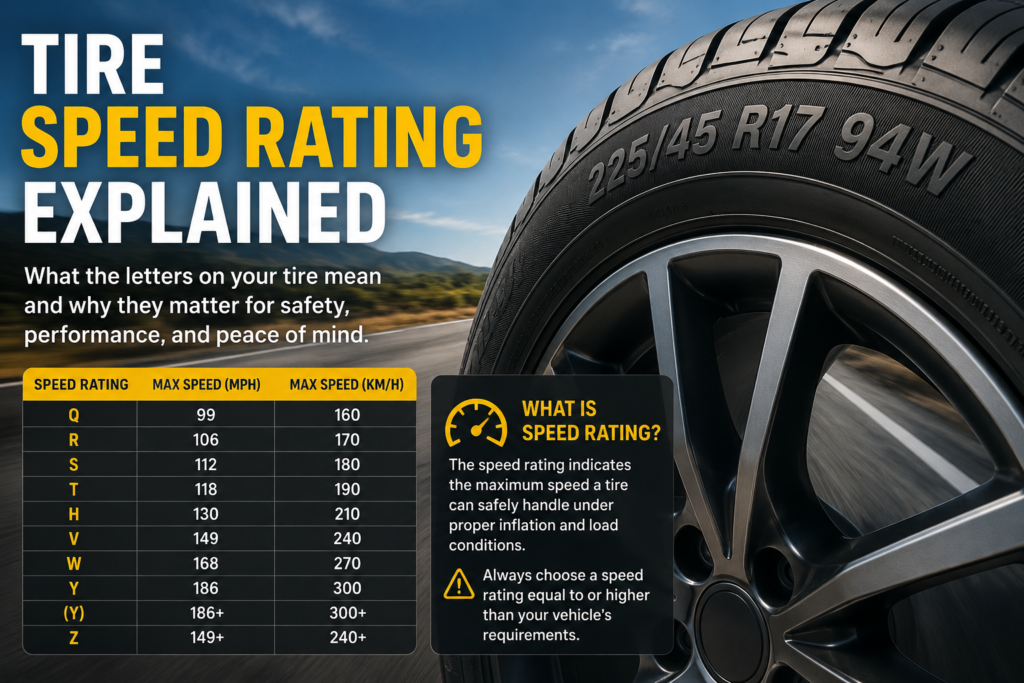
Many drivers see letters such as T, H, V, W, or Y on a tire and simply ignore them. I used to think these letters were just part of the tire code, but they actually have an important purpose. The tire speed rating indicates the maximum speed a tire is designed to handle under specific test conditions when it is properly inflated and carrying the appropriate load.
Understanding tire speed ratings can help you choose the right tires, maintain your vehicle properly, and avoid buying tires that are not suitable for your car. In this guide, I will explain tire speed ratings in simple terms and share the information I believe every driver should know.
What Is a Tire Speed Rating?
A tire speed rating is a letter that represents the maximum speed a tire can safely sustain under specified conditions. The rating is determined through standardized testing and is closely related to the tire’s construction, materials, heat resistance, and ability to remain stable at higher speeds.
For example, a tire with an H speed rating is designed for speeds up to approximately 130 mph, or 210 km/h, under the specified test conditions. A V rated tire is designed for speeds up to approximately 149 mph, or 240 km/h.
It is important to understand that a speed rating does not mean you should drive at that speed. It simply tells you the tire’s tested capability. Normal driving conditions, road quality, weather, tire pressure, vehicle load, and tire condition all affect real world performance.
In my opinion, the easiest way to think about a speed rating is as a performance limit built into the tire.
Where Can You Find the Speed Rating?
You can usually find the tire speed rating on the sidewall. It appears near the end of the tire size and load information.
For example, suppose your tire says:
225/45 R17 94W
Here is what the information means.
225 represents the tire width in millimeters.
45 represents the aspect ratio.
R represents radial construction.
17 represents the wheel diameter in inches.
94 represents the load index.
W represents the tire speed rating.
The final letter is the part we are interested in when discussing tire speed ratings.
If you are buying replacement tires, I recommend checking the information printed on your existing tires and comparing it with the specifications listed in your vehicle owner’s manual.
Common Tire Speed Ratings
Different speed rating letters represent different maximum tested speeds. Some of the most common ratings found on passenger cars include:
| Speed Rating | Maximum Speed |
|---|---|
| Q | 99 mph or 160 km/h |
| R | 106 mph or 170 km/h |
| S | 112 mph or 180 km/h |
| T | 118 mph or 190 km/h |
| H | 130 mph or 210 km/h |
| V | 149 mph or 240 km/h |
| W | 168 mph or 270 km/h |
| Y | 186 mph or 300 km/h |
There are also specialized ratings and variations, especially for high performance tires.
The numbers above are useful for understanding the rating system, but I would not recommend selecting a tire based only on the highest number. Your vehicle manufacturer specifies the tire characteristics that are appropriate for your vehicle.
What Does an H Speed Rating Mean?
The H speed rating is one of the ratings many drivers encounter. An H rated tire has a maximum tested speed of approximately 130 mph or 210 km/h under specified conditions.
H rated tires are commonly found on many passenger cars, family sedans, and some crossover vehicles. They are generally designed to provide a balance between everyday comfort, handling, and highway performance.
If your vehicle requires H rated tires, choosing a tire with the correct H rating can be a sensible approach. However, always check your vehicle manufacturer’s recommendation before making a final decision.
What Does a V Speed Rating Mean?
A V speed rating indicates a maximum tested speed of approximately 149 mph or 240 km/h.
V rated tires are often associated with vehicles that have stronger performance capabilities. They may be designed with construction and tread characteristics that support greater stability at higher speeds.
One thing I always keep in mind is that higher speed capability can sometimes come with tradeoffs. Depending on the tire design, a performance oriented tire may provide sharper handling but may not offer exactly the same ride comfort or tread life as a tire designed primarily for comfort.
This is why the highest rating is not automatically the best choice for every driver.
What Do W and Y Speed Ratings Mean?
W and Y ratings are generally associated with high performance tires.
A W rated tire has a maximum tested speed of approximately 168 mph or 270 km/h.
A Y rated tire has a maximum tested speed of approximately 186 mph or 300 km/h.
These ratings are often found on performance cars, sports cars, and vehicles designed for higher speed operation.
There are also special designations involving the letter Z, which can appear on certain high performance tires. Modern tire markings can be more detailed than the simple letter system, so I recommend checking the complete tire specification rather than focusing on one letter alone.
Does a Higher Speed Rating Mean a Better Tire?
This is one of the most common questions about tire speed ratings.
The simple answer is no.
A higher speed rating means the tire is designed and tested for a higher maximum speed under specified conditions. It does not automatically mean the tire is better for every vehicle or every driver.
For example, if your vehicle is designed around an H rated tire, buying a much higher rated tire may not provide a noticeable benefit during normal city driving. You could instead be paying for performance characteristics that you rarely use.
The right tire is the one that matches your vehicle, driving conditions, climate, load requirements, and personal priorities.
Why Does Tire Speed Rating Matter?
Tire speed rating matters because tires experience more heat and mechanical stress as speed increases.
At higher speeds, the tire rotates extremely quickly. The tread, sidewalls, belts, and internal materials must work together while dealing with heat and centrifugal forces.
A tire designed for a higher speed rating may use construction and materials intended to manage these conditions.
This is why I would never treat the speed rating as an unimportant number or letter. Tires are the only part of the vehicle that directly contacts the road, so choosing the correct specification is important for overall safety and handling.
Tire Speed Rating and Handling
Speed rating can also influence the way a vehicle feels on the road.
Higher performance tires can sometimes provide more responsive steering and improved stability during fast cornering. They may also feel firmer compared with tires designed mainly for comfort.
However, tire design involves many factors. The tread compound, tread pattern, sidewall construction, tire size, inflation pressure, and vehicle suspension all affect handling.
So if you notice a difference after changing tires, the speed rating may be one factor, but it is not necessarily the only reason.
Can You Use a Lower Speed Rating?
This is where I recommend being careful.
If your vehicle manufacturer specifies a particular speed rating, installing a lower rated tire can reduce the tire’s performance capability compared with the vehicle’s requirements.
For that reason, I would avoid choosing a lower speed rating simply because the tire is cheaper.
Always check the owner’s manual, tire information placard, and manufacturer recommendations before changing the specification.
In some situations, winter tires may have different speed ratings, and vehicle manufacturers may provide specific guidance for them. If you are considering a lower rated tire for seasonal use, follow the manufacturer’s recommendations and adjust your driving accordingly.
Can You Use a Higher Speed Rating?
In many cases, a higher speed rated tire can be used when it is compatible with the vehicle and meets all other required specifications.
However, I would still check the complete tire size, load index, construction, and vehicle requirements before making the switch.
A higher speed rating does not compensate for an incorrect tire size or insufficient load capacity.
This is an important point because some drivers focus heavily on the speed letter and forget about the other numbers printed on the tire.
Speed Rating and Tire Pressure
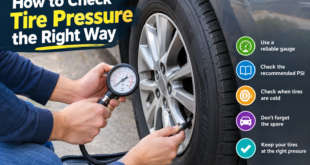
Tire pressure is extremely important when discussing tire performance.
A tire’s rated capability assumes proper inflation and specific testing conditions. Driving with significantly incorrect tire pressure can affect handling, braking, fuel economy, tread wear, and heat buildup.
I personally believe checking tire pressure regularly is one of the simplest maintenance tasks a driver can do.
Do not use the maximum pressure printed on the tire sidewall as your normal target unless it happens to match the vehicle manufacturer’s recommendation. Instead, check the recommended cold tire pressure listed on the vehicle’s tire information placard or owner’s manual.
Speed Rating and Vehicle Load
The load index printed near the speed rating is another important specification.
For example, in 225/45 R17 94W, the number 94 represents the tire’s load index while W represents the speed rating.
These two specifications work together. A tire needs to be capable of carrying the appropriate load while operating within its rated conditions.
If you regularly carry passengers, luggage, tools, or other heavy items, make sure your tires are properly rated for the vehicle’s requirements.
Does Speed Rating Affect Fuel Economy?
It can, but there is no simple rule that says a higher speed rating will always increase or decrease fuel consumption.
Fuel economy depends on many factors, including tire design, rolling resistance, tire pressure, vehicle weight, alignment, driving style, road conditions, and weather.
Some performance tires may use compounds and construction focused more on grip and handling than low rolling resistance. Other high rated tires may be engineered with efficiency in mind.
If fuel economy is important to you, look at the complete tire specifications rather than judging the tire only by its speed rating.
How I Check a Tire Before Buying
When buying tires, I would not look at the price alone. I recommend checking several things.
First, confirm the tire size.
Second, check the required load index.
Third, check the required speed rating.
Fourth, consider the climate and road conditions where you normally drive.
Fifth, look at tread design and expected performance.
Finally, consider the tire’s age, warranty, reputation, and overall value.
A cheap tire is not necessarily a good deal if it does not match your vehicle’s requirements or does not perform well in the conditions where you drive.
Common Mistakes Drivers Make
One common mistake is assuming that every tire with the same size is identical. Two tires can have the same size but different load indexes, speed ratings, tread designs, and performance characteristics.
Another mistake is choosing the lowest priced tire without checking its specifications.
Some drivers also believe that a higher speed rating means they can safely drive faster than the legal speed limit. That is not what the rating means. Road laws, traffic conditions, weather, and safe driving practices still determine how fast you should drive.
Ignoring tire pressure is another major mistake. Even an excellent tire cannot perform properly if it is badly underinflated or overinflated.
Final Thoughts on Tire Speed Ratings
Understanding tire speed ratings is much easier once you know what the letter actually represents. The rating tells you the maximum speed capability established through standardized testing under specified conditions.
Letters such as T, H, V, W, and Y represent different speed capabilities, but the highest rating is not automatically the best option for every car.
In my view, the smartest approach is to follow the vehicle manufacturer’s tire specifications and then choose a quality tire that fits your driving style and road conditions.
When you understand the tire size, load index, speed rating, pressure requirements, and other sidewall markings, buying tires becomes much less confusing.
Your tires play a major role in braking, steering, stability, comfort, and overall road safety. Spending a few minutes understanding the information printed on their sidewalls can help you make better decisions and get more confidence from every drive.