Related Articles
When I first started paying closer attention to car tires, I realized that the markings on the sidewall can look confusing. You may see letters, numbers, symbols, and other information printed around the tire, and at first it can seem like a code that only mechanics understand. In reality, tire markings are quite easy to understand once you know what each part means.
The letters on a tire provide important information about the tire type, construction, speed capability, and intended use. The numbers tell you things such as tire width, aspect ratio, wheel diameter, and load capacity. Understanding these markings can help you choose the right tires for your vehicle and avoid buying a tire that does not match your car.
In this guide, I will explain the most common tire letters and markings in simple language so you can understand exactly what is written on your tire sidewall.
A Simple Example of Tire Markings
Let us take a common tire marking as an example:
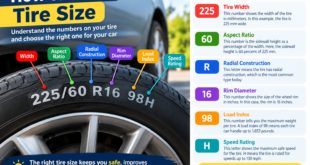
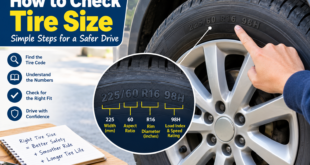
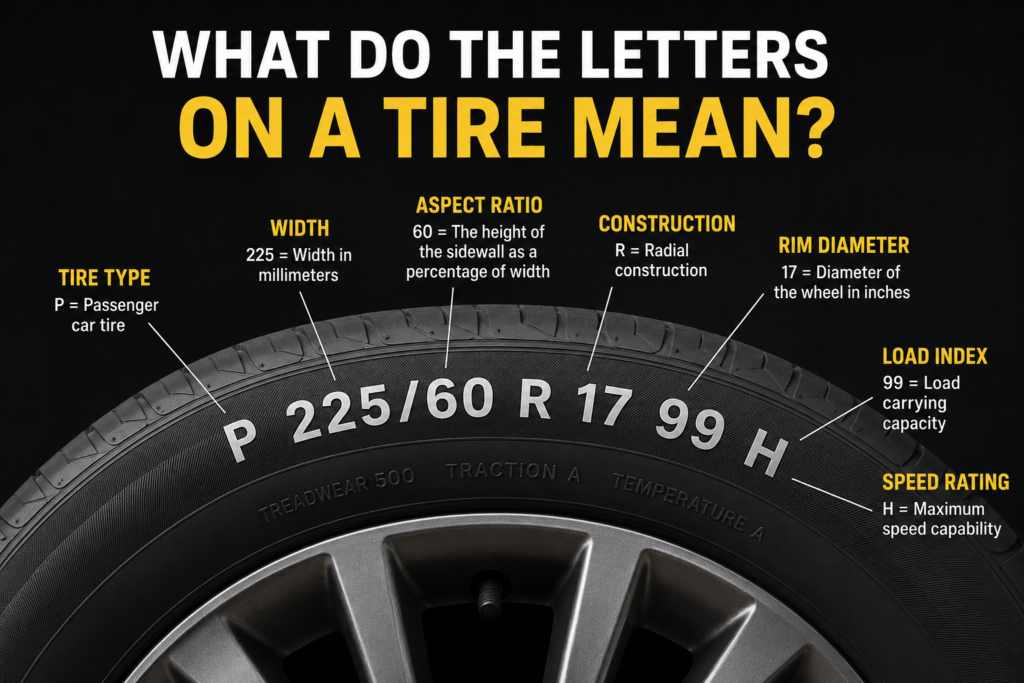
P225/60R17 99H
At first glance, this combination may look complicated. However, every part has a specific meaning.
The P identifies the tire type.
The 225 represents the tire width.
The 60 is the aspect ratio.
The R tells us about the tire construction.
The 17 represents the wheel diameter.
The 99 is the load index.
The H is the speed rating.
Once you understand these individual parts, reading tire size becomes much easier.
What Does the Letter P Mean on a Tire?
The letter P usually stands for Passenger. A tire marked with P is designed for passenger vehicles such as cars, sedans, crossovers, and some small SUVs.
For example, in P225/60R17, the P tells us that the tire belongs to the passenger tire category.
You may also see tires without a P at the beginning. This does not automatically mean that the tire is wrong. Tire size systems can vary depending on the vehicle and market.
Another common marking is LT, which means Light Truck. LT tires are designed for certain trucks, vans, and vehicles that may carry heavier loads or perform demanding work.
This is one reason I always recommend checking the tire size and specifications recommended by the vehicle manufacturer instead of choosing a tire simply because it looks similar.
What Does R Mean on a Tire?
One of the most common letters you will see on modern tires is R.
The R means Radial construction.
Radial tires are made with internal layers that run across the tire from one side to the other, with additional reinforcing layers around the tread area. This construction has become standard on most modern passenger vehicles.
For example, in 225/60R17, the R tells you that the tire uses radial construction.
Sometimes people think the R means rim, but that is not what it means. The number after R tells you the wheel diameter, while R itself identifies the tire construction.
What Does Z Mean on a Tire?
The letter Z can appear in tire markings associated with higher speed capability. You may see markings such as ZR on performance tires.
ZR generally indicates a tire designed for high speed applications, but the exact speed capability should still be checked using the complete tire specification, including its speed rating.
For example, a tire might have a marking such as 225/40ZR18 92Y. In this case, the ZR indicates the tire’s construction and high speed category, while the Y provides the specific speed rating.
I would not recommend choosing a tire simply because it has a Z or ZR marking. The tire should always match the requirements of your vehicle.
What Does T Mean on a Tire?
The letter T can have different meanings depending on where it appears.
If you see a tire marked T125/70R16, the T may identify a temporary spare tire size. Temporary spare tires are designed for limited use and are not intended to replace a normal tire for everyday driving.
If you see T in another location on the tire, its meaning may be different. This is why the complete marking is important rather than focusing on a single letter.
Temporary spare tires often have specific speed and distance limitations, so I always recommend following the instructions provided with the vehicle.
What Does H Mean on a Tire?
The letter H is commonly found at the end of a tire size and represents the tire’s speed rating.
For example:
225/60R17 99H
Here, H is the speed rating.
A speed rating indicates the maximum speed capability of a properly maintained tire under specified testing conditions. It does not mean that you should drive at that speed on public roads.
Different speed ratings use different letters. Some common examples include:
T for up to 190 km/h
H for up to 210 km/h
V for up to 240 km/h
W for up to 270 km/h
Y for up to 300 km/h
These values are commonly used references, although specific tire specifications can vary.
The important thing for everyday driving is to use the speed rating recommended for your vehicle.
What Does V Mean on a Tire?
The letter V is another speed rating.
A V rated tire is designed for speeds up to approximately 240 km/h under the applicable testing conditions.
You may find this rating on many performance oriented passenger vehicles.
For normal driving, having a higher speed rating does not automatically mean the tire is better. A tire should be selected based on the vehicle manufacturer’s specifications, driving conditions, weather, load, and other requirements.
What Does W Mean on a Tire?
The letter W represents a higher speed rating than V.
A W rated tire is generally designed for speeds up to approximately 270 km/h under specified conditions.
These tires are often found on performance cars and vehicles designed for higher speed applications.
Again, I think it is important not to assume that a higher speed rating automatically makes a tire the best choice. Tires are designed with different combinations of handling, comfort, durability, wet grip, and performance.
What Does Y Mean on a Tire?
The letter Y represents a very high speed rating and is generally associated with tires capable of approximately 300 km/h under specified testing conditions.
You are more likely to see Y rated tires on high performance vehicles.
Some tire markings may include Y in parentheses, which can indicate a rating associated with speeds above 300 km/h. These specifications are mainly relevant to high performance applications rather than ordinary daily driving.
What Does XL Mean on a Tire?
You may also notice XL printed on the sidewall.
XL means Extra Load.
An XL tire is designed to carry more load than a standard tire of the same basic size when inflated to the appropriate pressure.
This does not mean every vehicle needs an XL tire. If your vehicle manufacturer specifies an XL tire, then it is important to use the appropriate specification.
You should also remember that tire pressure plays a major role in load carrying capacity. The correct pressure should come from the vehicle manufacturer’s recommendations rather than the maximum pressure printed on the tire sidewall.
What Does SL Mean on a Tire?
SL generally means Standard Load.
This marking is used to distinguish a standard load tire from tires designed for extra load applications.
For many passenger vehicles, standard load tires are perfectly suitable when they meet the manufacturer’s specifications.
The key is to compare the complete tire specification rather than choosing between SL and XL based only on the label.
Understanding the Numbers Between the Letters
Although this article focuses on tire letters, the numbers work together with those letters to provide the complete picture.
Consider P225/60R17 99H again.
The number 225 means the tire is approximately 225 millimeters wide from sidewall to sidewall when measured according to the applicable standards.
The number 60 represents the aspect ratio. It means the sidewall height is approximately 60 percent of the tire’s section width.
The number 17 indicates that the tire fits a 17 inch wheel.
The number 99 is the load index. It corresponds to a specific maximum load capacity according to the tire load index table.
Finally, the letter H is the speed rating.
Together, these markings provide a detailed description of the tire.
Why Tire Letters Matter
Understanding tire letters is not just useful information. It can help you make better decisions when replacing your tires.
For example, imagine that your vehicle requires a specific tire size with a particular load index and speed rating. If you buy a tire based only on width and wheel diameter, you could end up with a tire that does not meet the vehicle’s requirements.
This is why I believe every driver should learn the basic tire markings.
You do not need to become a tire expert. You simply need to know how to read the important information.
Where Can I Find My Correct Tire Size?
The easiest place to find the recommended tire size is usually the vehicle information label.
Depending on the vehicle, this label may be located on the driver’s side door jamb, inside the driver’s door, or in another manufacturer specified location.
The owner’s manual can also provide the recommended tire size and pressure.
When replacing tires, I recommend checking these sources instead of relying only on the tire currently installed on the vehicle. If someone previously installed an incorrect tire size, copying that size could simply repeat the mistake.
Do All Tires Use the Same Letters?
No. Tire markings can vary depending on the tire manufacturer, vehicle type, country, and tire category.
You may see markings such as P, LT, T, R, ZR, XL, SL, and various speed rating letters.
Some tires also contain additional markings for winter use, mud and snow classification, original equipment applications, or manufacturer specific requirements.
That is why the entire sidewall should be considered when identifying a tire.
Common Mistakes When Reading Tire Markings
One common mistake is thinking that R means rim. It actually identifies radial construction.
Another mistake is confusing the speed rating with the tire size. The final letter such as H, V, W, or Y provides speed rating information.
Some drivers also believe that a higher speed rating is always better. That is not necessarily true. A tire should match the vehicle and driving conditions.
Another mistake is ignoring the load index. The load index is important because tires must be capable of supporting the vehicle and its occupants and cargo.
Finally, some people choose a tire simply because it fits the wheel physically. Physical fit alone is not enough. The complete specification matters.
Final Thoughts
In my opinion, reading tire markings is one of those basic car skills that every driver should have. The letters may look complicated when you first see them, but they actually provide useful information about how the tire is designed and what it is capable of doing.
A marking such as P225/60R17 99H can tell you the tire category, width, aspect ratio, construction, wheel diameter, load index, and speed rating.
Once you understand what P, R, H, V, W, Y, LT, XL, and other common markings mean, choosing and checking tires becomes much easier.
Before buying new tires, always compare the complete sidewall markings with the specifications recommended for your vehicle. Also consider your normal driving conditions, road quality, weather, load, and the type of driving you do.
A tire is one of the most important parts of your vehicle because it is the only part of the car that directly contacts the road. Understanding the information printed on it is therefore a simple but valuable step toward making smarter tire decisions and maintaining your vehicle properly.