Related Articles
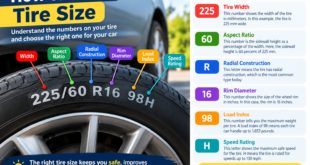
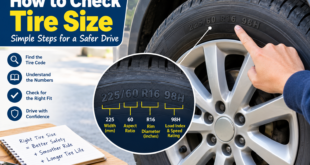
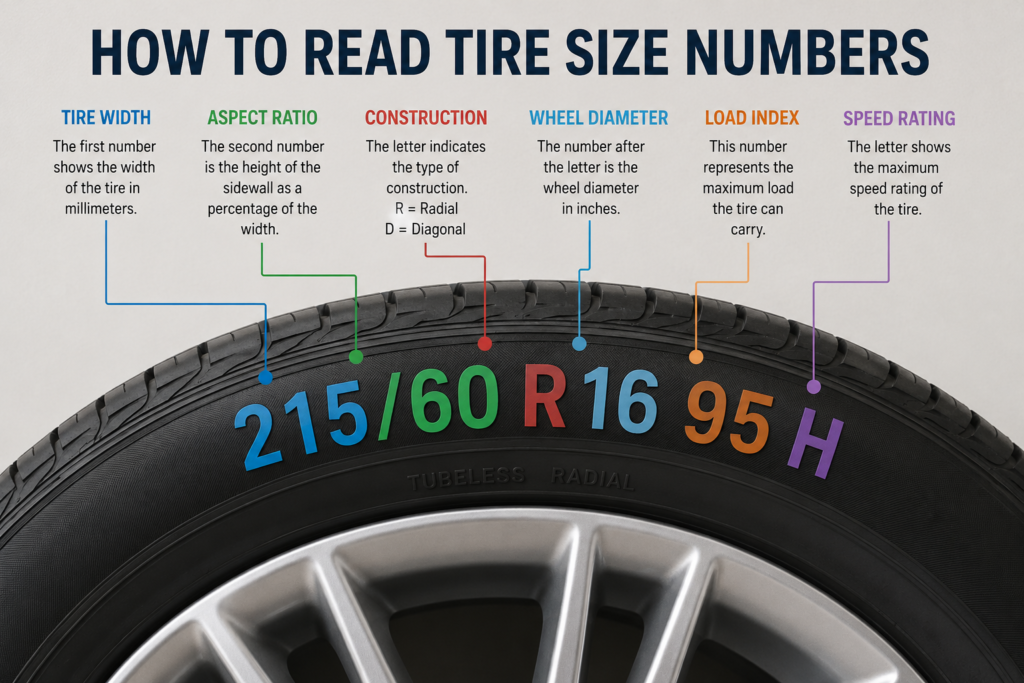
When I first started paying more attention to car tires, I realized that the numbers written on the sidewall can look confusing. A tire may have something like 215/60 R16 95H printed on it, and at first glance, it may seem like a random combination of numbers and letters. In reality, every part of that code tells us something important about the tire.
Knowing how to read tire size numbers is useful for every driver. It can help when buying new tires, checking the correct tire size for your car, comparing different tire options, or simply understanding what is already fitted to your vehicle.
In my view, learning to read tire size numbers is one of those simple car maintenance skills that can save you from making an expensive mistake. You do not need to be a mechanic to understand the information on a tire sidewall. Once you know what each number and letter means, the entire code becomes much easier to understand.
What Do Tire Size Numbers Mean?
A common tire size looks like this:
215/60 R16 95H
Each section has a specific meaning.
The first number represents the tire width in millimeters. The second number represents the aspect ratio. The letter shows the tire construction. The next number tells you the wheel diameter. The load index shows how much weight the tire can carry, while the speed rating indicates the tire’s maximum rated speed under specified conditions.
Let us break down each part so you can understand exactly what you are looking at.
1. The First Number Is Tire Width
In the example 215/60 R16 95H, the number 215 represents the tire width.
This measurement is given in millimeters. It refers to the approximate width of the tire from one sidewall to the other when properly mounted and inflated.
So, a 215 tire is approximately 215 millimeters wide.
You may also see sizes such as 185, 195, 205, 225, 235, or 245. Generally, a larger first number means a wider tire.
Tire width can affect several aspects of driving. Wider tires can provide a larger contact area with the road, which may improve dry road grip and handling. However, tire performance is not determined by width alone. Tire design, rubber compound, tread pattern, vehicle weight, road conditions, and inflation pressure also matter.
From my point of view, this is one reason why I would never choose a wider tire simply because it looks better. The tire size needs to match the vehicle manufacturer’s specifications.
2. The Second Number Is the Aspect Ratio
The number after the slash is called the aspect ratio.
In 215/60 R16, the number 60 means the sidewall height is approximately 60 percent of the tire’s width.
The calculation is:
215 × 60% = 129 millimeters
That means the approximate sidewall height is 129 millimeters.
A lower aspect ratio generally means a shorter sidewall. For example, a 215/45 tire has a shorter sidewall than a 215/60 tire.
This difference can affect the driving experience. Tires with lower aspect ratios are often associated with sharper steering response and a sportier appearance. Tires with taller sidewalls can provide more cushioning over rough roads.
I think this is particularly important for people who drive on roads with potholes or uneven surfaces. A tire with a taller sidewall may offer more protection against certain road impacts, although the correct choice always depends on the vehicle and manufacturer recommendations.
3. What Does the Letter R Mean?
After the aspect ratio, you may see the letter R.
In 215/60 R16, the R stands for radial construction.
Radial tires are the standard type used on most modern passenger cars. Their internal construction uses reinforcing cords arranged in a radial direction from the center of the tire.
You may occasionally come across older or specialized tires using different construction markings, but radial tires are by far the most common choice for modern vehicles.
When reading tire size numbers, it is important not to confuse the R with a measurement. It describes how the tire is constructed.
4. The Number After R Is Wheel Diameter
The number immediately after the construction letter tells you the diameter of the wheel that the tire fits.
In 215/60 R16, the number 16 means the tire is designed to fit a 16 inch wheel.
This measurement is expressed in inches, even though the tire width is measured in millimeters.
This is one of the easiest parts of tire size numbers to understand. If your tire says R15, it fits a 15 inch wheel. If it says R17, it fits a 17 inch wheel.
The tire and wheel must be compatible. You cannot simply install a tire designed for a 17 inch wheel onto a 16 inch wheel.
5. What Is the Load Index?
After the wheel diameter, you may see another number.
In our example, that number is 95.
This is called the load index. It represents the maximum load the tire is rated to carry under the conditions specified by the tire manufacturer.
The load index is not the actual weight in kilograms. Instead, it corresponds to a specific load value shown in a standardized load index table.
For example, a load index of 95 corresponds to a maximum load of approximately 690 kilograms per tire under the applicable rating conditions.
This information is important because every vehicle has a recommended load capacity. Installing tires with an inappropriate load rating can affect safety and handling.
Personally, I consider the load index something drivers should never ignore. A tire may physically fit your vehicle but still not be the correct choice if its load capacity does not meet the vehicle requirements.
6. What Does the Speed Rating Letter Mean?
The final letter in our example is H.
This is the tire’s speed rating.
Speed ratings use letters to indicate the maximum speed at which a tire is designed to carry its rated load under specified conditions.
For example, an H rated tire has a maximum rated speed of approximately 210 km/h.
Other common ratings include T, H, V, W, and Y.
It is important to understand that the speed rating does not mean you should drive at that speed. It simply identifies the tire’s tested performance category under the applicable conditions.
Your vehicle manufacturer recommends a specific tire specification based on the vehicle’s design. When replacing tires, I would always check the recommended speed rating rather than choosing one based only on price or appearance.
A Complete Example of Tire Size Numbers
Let us put everything together.
Suppose your tire says:
215/60 R16 95H
Here is what it means:
215 means the tire is approximately 215 millimeters wide.
60 means the sidewall height is approximately 60 percent of the tire width.
R means radial construction.
16 means the tire fits a 16 inch wheel.
95 is the load index.
H is the speed rating.
Once you understand this pattern, reading most passenger car tire sizes becomes much easier.
What About Tire Sizes That Look Different?
Not every tire uses exactly the same format.
For example, you may see a tire marked P215/60 R16.
The letter P generally indicates a passenger car tire in the applicable tire classification system.
You may also see markings such as LT, which can indicate a tire designed for light trucks, depending on the tire specification system.
Some tires also have additional markings for special applications, original equipment specifications, winter use, or reinforced construction.
This is why I recommend looking at the complete tire sidewall instead of focusing only on the first few numbers.
Why Correct Tire Size Matters
Using the correct tire size is important for safety, handling, comfort, and vehicle performance.
The wrong tire size can affect the relationship between the tire and the road. It may also change the overall diameter of the tire, which can influence the speedometer reading, gearing characteristics, braking behavior, and electronic systems on some vehicles.
A tire that is too wide or too tall may also create clearance problems with suspension components, bodywork, or wheel wells.
Another important point is that changing tire size can affect the vehicle’s overall driving characteristics. Even if a different size physically fits, that does not automatically mean it is suitable.
I always think of the manufacturer recommended tire size as the starting point. If someone wants to change tire size, the change should be researched carefully and ideally discussed with a qualified tire professional.
Where Can You Find Your Tire Size?
The easiest place to find tire size numbers is the sidewall of the tire.
You can also find the recommended tire size in several other places depending on the vehicle. The information may be listed on the driver’s door jamb sticker, inside the fuel door, in the owner’s manual, or on vehicle documentation.
The door jamb label is particularly useful because it may also show recommended tire pressure and other important tire information.
Remember that the pressure written on the tire sidewall is not necessarily the recommended pressure for your vehicle. The vehicle manufacturer’s recommended pressure should normally be checked on the vehicle information label or owner’s manual.
Tire Size and Tire Pressure Are Different
This is a common point of confusion.
Tire size tells you the physical specifications and ratings of the tire.
Tire pressure tells you how much air pressure should be maintained in the tire.
For example, 215/60 R16 95H is a tire size and rating description. A number such as 35 PSI is a pressure measurement.
Both pieces of information are important, but they describe completely different things.
Proper inflation is essential for handling, braking, tire life, and fuel economy. I make it a habit to check tire pressure regularly instead of waiting until a tire looks low.
How to Choose the Right Replacement Tire
When buying replacement tires, I recommend starting with the vehicle manufacturer’s recommended size and specifications.
Check the tire width, aspect ratio, construction, wheel diameter, load index, and speed rating.
It is also worth considering the type of driving you normally do. Someone who mostly drives around town may have different priorities from someone who regularly travels long distances or drives on rough roads.
Weather conditions matter as well. Tire compounds and tread patterns are designed for different conditions, so choosing the correct tire type is just as important as choosing the correct size.
Price should not be the only deciding factor. A tire is one of the most important contact points between your vehicle and the road.
Common Mistakes When Reading Tire Sizes
One common mistake is thinking that the first number represents the wheel diameter. It does not. The first number represents tire width in millimeters.
Another mistake is assuming the second number is a measurement in millimeters. The second number is an aspect ratio expressed as a percentage.
Some people also confuse the R with a wheel size. The R indicates radial construction, while the number after it represents wheel diameter.
Another mistake is ignoring the load index and speed rating. These markings are part of the tire specification and should be considered when selecting replacement tires.
Final Thoughts
Learning how to read tire size numbers is much easier than it initially appears. A marking such as 215/60 R16 95H contains useful information about tire width, sidewall height, construction, wheel diameter, load capacity, and speed rating.
In my opinion, every driver should understand these basic markings. You do not need advanced mechanical knowledge. Once you understand the pattern, you can look at a tire sidewall and quickly identify the most important information.
The next time you check your tires, take a moment to read the numbers. Understanding what they mean can help you make better decisions when replacing tires and can also give you a better understanding of how your vehicle is designed to perform.
Most importantly, always compare replacement tires with your vehicle manufacturer’s recommended specifications. The correct tire is not simply one that fits the wheel. It should also have the appropriate size, load capacity, speed rating, and overall specifications for your vehicle.