Related Articles
When I think about regular car maintenance, I usually think about engine oil, brakes, tire pressure, and battery checks. However, one important service that many drivers do not think about until there is a problem is wheel alignment. Proper wheel alignment may not sound like a major part of car maintenance, but it can make a noticeable difference in how your vehicle drives, how your tires wear, and how safely you control the car.
I have found that many people confuse wheel alignment with wheel balancing. They are not the same thing. Wheel alignment is about adjusting the angles of the wheels so they match the specifications recommended for the vehicle. When those angles are correct, the tires can maintain better contact with the road and the car can move in a more stable and predictable way.
In this article, I will explain what wheel alignment is, why your car needs it, what causes alignment problems, and how you can recognize the warning signs.
What Is Wheel Alignment?
Wheel alignment is the process of checking and adjusting the angles of your vehicle’s wheels. These angles affect the direction in which the tires point and how they sit against the road.
A properly aligned vehicle should travel straight when the steering wheel is centered. The tires should also make proper contact with the road surface without putting unnecessary pressure on particular areas of the tread.
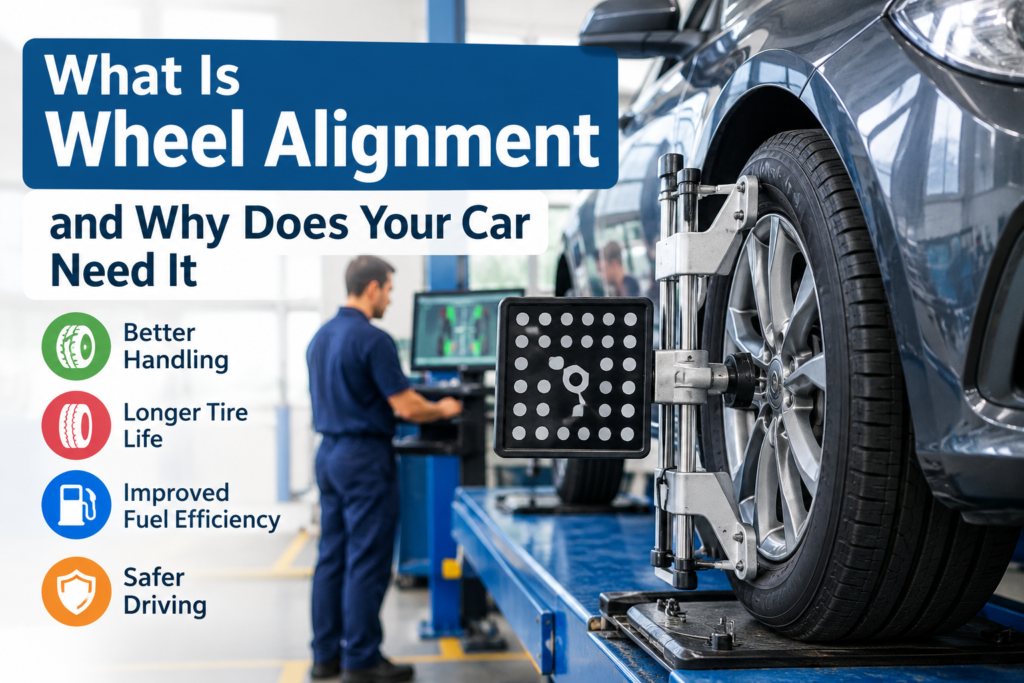
Modern vehicles are designed with specific alignment measurements. These measurements can vary depending on the make and model of the car. During an alignment service, a technician uses specialized equipment to measure the wheel angles and compare them with the manufacturer’s recommended specifications.
If the measurements are outside the correct range, adjustments may be necessary.
The Three Main Wheel Alignment Angles
When discussing wheel alignment, three terms are especially important: camber, caster, and toe.
Camber
Camber describes the inward or outward angle of a wheel when viewed from the front of the vehicle.
If the top of the tire leans too far inward or outward, it can cause uneven tire wear. The correct camber helps the tire maintain better contact with the road.
Caster
Caster refers to the angle of the steering axis when viewed from the side of the vehicle. It plays an important role in steering stability and helps the steering wheel return toward the center after a turn.
If caster is not within the recommended range, you may notice changes in steering feel or vehicle stability.
Toe
Toe describes the direction in which the tires point when viewed from above.
If the front edges of the tires point slightly toward each other, this is called toe in. If they point away from each other, it is called toe out.
Incorrect toe settings can cause rapid and uneven tire wear and may make the vehicle feel less stable.
Why Does Your Car Need Wheel Alignment?
The main reason your car needs proper wheel alignment is to make sure the tires and steering system work together correctly.
When the wheels are properly aligned, your vehicle can generally handle more predictably. The tires can wear more evenly, and you may experience a smoother driving experience.
Here are some of the biggest reasons I believe wheel alignment should not be ignored.
It Helps Prevent Uneven Tire Wear
Tires are one of the most important safety components on a vehicle, and replacing them can be expensive.
Poor wheel alignment can cause certain parts of the tire tread to wear faster than others. Instead of wearing evenly across the tread, one edge may become noticeably thinner.
This can reduce the useful life of the tire and force you to replace it earlier than expected.
From a practical point of view, maintaining proper wheel alignment can be a simple way to protect the money you have already spent on your tires.
It Improves Steering and Handling
A car with correct wheel alignment should feel predictable when you steer.
If the alignment is incorrect, the vehicle may pull toward one side of the road. You may also need to make constant steering corrections to keep the car moving in a straight line.
For me, this is one of the most noticeable reasons to have the alignment checked. A vehicle that does not track properly can become tiring to drive, especially during longer journeys.
It Can Improve Driving Safety
Proper tire contact with the road is important for safe driving. Alignment problems can affect handling, particularly when braking, turning, or driving at higher speeds.
Wheel alignment does not replace other safety checks, but keeping the wheels within the correct specifications can help your vehicle behave as intended by the manufacturer.
If your car suddenly begins pulling to one side or the steering feels unusual, I would not ignore the problem.
It Can Help Protect Fuel Economy
Incorrect alignment can create additional rolling resistance because the tires may not move in the direction the vehicle is traveling.
The effect on fuel consumption can vary depending on how severe the problem is and what other factors are involved. Still, maintaining the correct alignment is part of keeping the vehicle mechanically efficient.
I would not get a wheel alignment only to save fuel, but it is certainly a useful benefit when combined with better tire wear and handling.
What Causes Wheel Alignment Problems?
Wheel alignment does not usually change without a reason. Several everyday situations can affect the alignment of a vehicle.
Hitting Potholes
Potholes are one of the most common causes of alignment problems. A hard impact can affect suspension or steering components and change the position of a wheel.
This is particularly important if you regularly drive on roads with potholes or rough surfaces.
Hitting Curbs
Accidentally hitting a curb with a tire can also affect wheel alignment. Even if there is no obvious damage, a strong impact may change suspension or steering geometry.
Road Accidents
A collision, even a relatively minor one, can sometimes affect suspension components and wheel alignment.
After an accident, it is sensible to have the vehicle inspected rather than assuming everything is fine because the tires still look normal.
Worn Suspension Components
Wheel alignment depends on several steering and suspension components. If parts such as bushings, ball joints, or tie rod ends become worn, maintaining the correct alignment may become difficult.
This is why a proper inspection is important when alignment problems keep returning.
Signs Your Car May Need Wheel Alignment
Your vehicle can give you several clues when something is wrong.
One common warning sign is the car pulling to one side. If you have to keep turning the steering wheel slightly to maintain a straight path on a reasonably flat road, alignment could be one possible cause.
Another sign is an off center steering wheel. If the car is traveling straight but the steering wheel sits noticeably to one side, the alignment may need to be checked.
You should also inspect your tires for uneven tread wear. If one side of a tire is wearing much faster than the other, there may be an alignment or suspension issue.
Some drivers also notice unusual steering behavior after hitting a large pothole or curb. In that situation, getting the vehicle checked can help identify a problem before it becomes more expensive.
Wheel Alignment and Wheel Balancing Are Different
This is a common source of confusion.
Wheel alignment focuses on the angles and positioning of the wheels in relation to the vehicle and road.
Wheel balancing focuses on distributing the weight of the tire and wheel assembly correctly. An unbalanced wheel can cause vibrations, particularly at certain speeds.
Both services are useful, but they solve different problems.
If your steering wheel vibrates at highway speeds, balancing could be involved. If your vehicle pulls to one side or the tires are wearing unevenly, alignment may be worth checking.
Sometimes a vehicle can need both services, especially after tire or suspension work.
When Should You Get a Wheel Alignment?
There is no single interval that works perfectly for every vehicle because driving conditions and manufacturer recommendations are different.
I think the most important time to check alignment is when you notice warning signs or after a significant impact.
It can also be useful to check alignment when installing new tires, after certain suspension repairs, or when replacing steering components.
Your vehicle owner’s manual may also provide maintenance recommendations.
If your car has recently driven over a major pothole, hit a curb, or experienced an accident, an inspection can be a sensible decision.
How Is Wheel Alignment Performed?
A professional wheel alignment usually starts with an inspection of the tires, steering, and suspension components.
The vehicle is then positioned on an alignment machine. Specialized sensors or cameras are used to measure the wheel angles.
The technician compares the measurements with the manufacturer’s specifications. If adjustments are possible and necessary, the appropriate components are adjusted to bring the alignment closer to the recommended settings.
A good alignment service should not simply adjust the wheels without checking for worn or damaged components. If something is damaged, the underlying problem may need to be repaired first.
Can You Do Wheel Alignment at Home?
I would not recommend trying to perform a modern wheel alignment at home without the correct equipment and technical knowledge.
Checking tire pressure and visually inspecting your tires are simple maintenance tasks that most drivers can learn. Wheel alignment is different because accurate measurements are required.
Professional alignment equipment is designed to measure small changes in wheel angles that may not be obvious by looking at the vehicle.
For an accurate result, I prefer having the alignment checked by a qualified technician.
How Wheel Alignment Can Save Money
At first, wheel alignment may seem like another maintenance expense. However, ignoring an alignment problem can sometimes lead to greater costs.
Uneven tire wear can shorten tire life. Continued driving with a steering or suspension issue can potentially make the underlying problem more complicated.
Regular maintenance is usually about preventing small problems from becoming larger ones. Wheel alignment fits into that idea.
When I consider the cost of replacing a set of tires, spending money on proper maintenance makes more sense than allowing avoidable tire wear to continue.
Final Thoughts
Wheel alignment is an important part of vehicle maintenance that should not be overlooked. It helps keep the wheels positioned correctly, supports predictable steering, promotes more even tire wear, and can contribute to a better driving experience.
The most important thing is to pay attention to changes in the way your vehicle drives. If your car pulls to one side, the steering wheel is no longer centered, or your tires show unusual wear, it is worth having the vehicle inspected.
I believe good car maintenance is not only about fixing problems after they appear. It is also about noticing small changes early and taking care of them before they become expensive or affect your safety. Keeping your wheels properly aligned is a simple maintenance step that can help protect your tires, your vehicle, and your driving experience.