
Related Articles


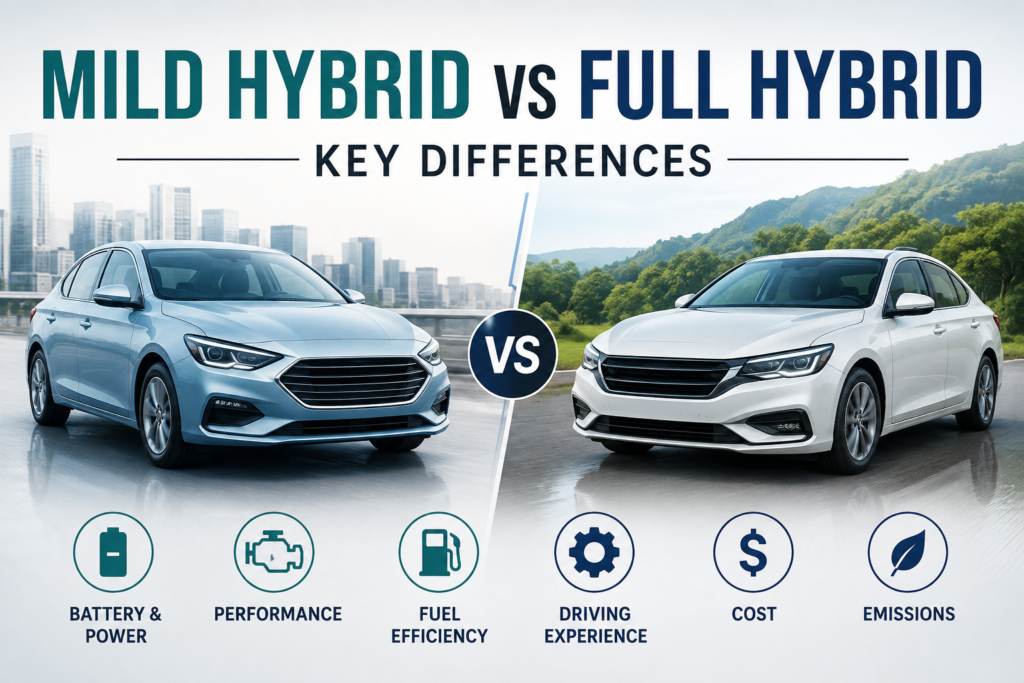
When people start looking at hybrid cars, one of the first things they notice is that not every hybrid vehicle works in the same way. Some cars use a mild hybrid system, while others use a full hybrid system. Both technologies are designed to improve fuel efficiency and reduce the workload on the engine, but the way they achieve these goals is quite different.
In my view, understanding the difference between a mild hybrid and a full hybrid is important before choosing a car. The name may sound similar, but the driving experience, electric power, fuel savings, battery size, and overall technology can be noticeably different.
In this article, I will explain mild hybrid vs full hybrid in simple terms and discuss the key differences that matter when buying or driving a hybrid vehicle.
What Is a Mild Hybrid?
A mild hybrid is a vehicle that uses a small electric motor and battery to support the gasoline or diesel engine. The electric motor usually cannot drive the car by itself. Instead, it assists the engine during situations where extra power is needed, such as starting from a stop, accelerating, or climbing a hill.
The mild hybrid system can also help the engine restart smoothly when the vehicle stops in traffic. It works closely with the start stop system, making engine restarts quicker and smoother.
One of the main advantages of a mild hybrid is its relatively simple design compared with a full hybrid. The battery is generally smaller, which means the system does not need as much space or weight.
From my point of view, a mild hybrid is best understood as an upgraded version of a conventional gasoline or diesel vehicle. The engine remains the main source of power, while the electric system provides assistance when needed.
What Is a Full Hybrid?
A full hybrid is more advanced because it can use the gasoline engine, electric motor, or both to move the vehicle. Depending on the driving conditions, the car may operate using electric power alone for short periods.
This is one of the biggest differences between mild hybrid and full hybrid technology.
A full hybrid normally has a larger battery and a more powerful electric motor than a mild hybrid. The system constantly decides how to use the available power. At low speeds, the electric motor may move the car without the engine running. During stronger acceleration, the engine and electric motor can work together.
A full hybrid can also recover energy when the vehicle slows down. This process is called regenerative braking. Instead of allowing some of the vehicle’s kinetic energy to disappear as heat through the brakes, the system converts part of that energy into electrical energy and stores it in the battery.
Mild Hybrid vs Full Hybrid: The Main Difference
The easiest way to understand the difference is to look at how much work the electric motor can do.
In a mild hybrid, the electric motor mainly assists the engine. It is not normally designed to power the vehicle independently.
In a full hybrid, the electric motor can provide enough power to move the vehicle under certain conditions without assistance from the gasoline engine.
This difference affects almost everything else, including fuel economy, battery capacity, driving experience, and system cost.
Battery Size and Electric Power
Battery size is another important difference between mild hybrid and full hybrid vehicles.
Mild hybrids normally use a smaller battery because the electric motor is mainly providing assistance. The battery stores energy recovered during braking and supplies it to the electric motor when needed.
Full hybrids use a larger battery because the electric motor has a much bigger role. The battery needs enough energy to support electric driving and assist the engine during acceleration.
However, a full hybrid battery is still generally much smaller than the large battery found in a fully electric vehicle. A full hybrid does not normally need to be plugged into a charger because its battery is recharged through regenerative braking and engine operation.
Fuel Economy
Fuel economy is one of the main reasons people consider hybrid vehicles.
A mild hybrid can improve fuel economy compared with a similar conventional vehicle. The electric assistance can reduce the amount of work required from the engine, especially during acceleration and stop and go driving.
However, full hybrids usually have greater potential for fuel savings because they can switch between electric power and engine power. This is particularly useful in city traffic, where frequent braking and low speed driving provide many opportunities for regenerative braking and electric operation.
In my opinion, this is where the full hybrid system has a clear advantage. If most of your driving takes place in busy urban areas, a full hybrid can make better use of its electric motor.
Driving Experience
The driving experience can also be different.
A mild hybrid generally feels similar to a conventional car. The engine remains active for most of the journey, and the electric motor works quietly in the background.
Some drivers may barely notice when the mild hybrid system is helping the engine. The main benefits are smoother engine operation and improved efficiency rather than a completely different driving experience.
A full hybrid can feel more different. At low speeds, the vehicle may move using electric power, creating a quiet and smooth experience. The gasoline engine may start when more power is required.
Some full hybrid vehicles also use sophisticated transmission systems that manage the engine and electric motor together. This can make city driving particularly smooth.
Performance
It is easy to assume that full hybrids are always faster than mild hybrids, but that is not necessarily true.
Performance depends on the specific vehicle, engine, electric motor, weight, transmission, and software.
A mild hybrid can provide useful electric assistance during acceleration. This can make the engine feel more responsive.
A full hybrid can combine electric motor torque with engine power, which can provide strong acceleration in certain situations. Electric motors are capable of producing torque quickly, so the assistance can be noticeable when moving away from a stop.
Still, the primary goal of most hybrid systems is efficiency rather than maximum performance.
Regenerative Braking
Regenerative braking is an important part of hybrid technology.
When a normal vehicle slows down, much of its kinetic energy is converted into heat through the brake system. A hybrid vehicle can recover some of that energy.
A mild hybrid system can recover energy during deceleration and braking, then store it in the battery. This energy can later be used to support the engine.
A full hybrid generally takes regenerative braking further because its larger battery and electric motor can play a bigger role in energy recovery.
This makes regenerative braking particularly useful in city driving, where the vehicle repeatedly accelerates and slows down.
Cost and Complexity
Mild hybrid vehicles are usually simpler than full hybrids. Because the battery and electric motor are smaller, the hybrid system can often be integrated into a conventional vehicle design with fewer changes.
This can help keep the purchase price more reasonable.
Full hybrid systems are more complex. They require a larger battery, a more powerful electric motor, sophisticated control software, and a drivetrain designed to manage different power sources.
As a result, a full hybrid can cost more than a comparable mild hybrid.
However, the higher initial cost may be balanced by better fuel economy over time, depending on how much the vehicle is driven and local fuel prices.
Maintenance Differences
Both mild hybrid and full hybrid vehicles contain more technology than a traditional gasoline car, but that does not automatically mean they require constant maintenance.
Mild hybrid systems are generally closer to conventional vehicle designs, so many components and service procedures can be familiar to mechanics.
Full hybrids have additional electrical and drivetrain components. However, modern hybrid systems are designed to operate reliably for many years when properly maintained.
Regular maintenance such as engine oil changes, brake inspections, tire care, cooling system checks, and scheduled servicing remains important.
One interesting advantage of hybrid vehicles is that regenerative braking can reduce the amount of work done by the conventional friction brakes. Depending on driving conditions, this can help reduce brake wear.
Which Hybrid Is Better for City Driving?
If I were choosing between a mild hybrid and a full hybrid mainly for city driving, I would generally give the advantage to the full hybrid.
City traffic involves frequent stops, slow speeds, acceleration, and braking. These conditions allow a full hybrid to use its electric motor more frequently and recover more energy through regenerative braking.
A mild hybrid can still provide useful benefits in urban traffic, but it usually cannot drive using electric power alone.
For drivers who spend most of their time on highways, the difference may be less dramatic. Highway driving often involves steady speeds, where the gasoline engine can operate efficiently.
Which Hybrid Is Better for Long Distance Driving?
For long distance driving, the answer depends on the vehicle and the driver’s priorities.
A full hybrid can still deliver good efficiency, especially when the journey includes towns and traffic. However, the advantage of electric driving is usually more noticeable at lower speeds.
A mild hybrid can be a practical choice for drivers who regularly travel long distances and want some improvement in fuel economy without paying for a more complicated full hybrid system.
This is why I would not say that one technology is automatically better for everyone. Driving habits matter a lot.
Mild Hybrid vs Full Hybrid Comparison
The basic differences can be summarized quite simply.
A mild hybrid uses a small electric motor to assist the engine, while a full hybrid can use electric power to move the vehicle under certain conditions.
A mild hybrid normally has a smaller battery, while a full hybrid uses a larger battery.
A mild hybrid generally offers modest fuel economy improvements, while a full hybrid can provide greater fuel savings, especially in city driving.
Mild hybrids usually feel similar to conventional vehicles, while full hybrids can provide a noticeably quieter electric driving experience.
Mild hybrids are generally less complex, while full hybrids use more advanced power management technology.
Environmental Benefits
Both types of hybrid vehicles can help reduce fuel consumption and emissions compared with similar conventional vehicles.
The amount of improvement depends on the vehicle, driving conditions, traffic, maintenance, and driving style.
Full hybrids can have an advantage in urban conditions because they can operate electrically for short periods and reduce engine operation.
Mild hybrids also provide benefits by improving engine efficiency and recovering energy that would otherwise be wasted.
It is important to remember that neither type of hybrid completely eliminates fuel consumption. Both still rely on an internal combustion engine.
Mild Hybrid or Full Hybrid: Which Should You Choose?
The right choice depends on what you expect from your vehicle.
If you want a car that feels similar to a conventional vehicle but offers improved efficiency and smoother engine assistance, a mild hybrid can be a sensible option.
If fuel economy is a major priority and you regularly drive in cities, a full hybrid may be more attractive. The ability to use electric power for short periods can make a significant difference in stop and go traffic.
I would also consider the purchase price, expected fuel savings, driving distance, available servicing, vehicle size, and long term ownership costs before making a decision.
Final Thoughts
The difference between mild hybrid and full hybrid technology mainly comes down to the role of the electric motor.
A mild hybrid uses electric power to support the engine, while a full hybrid can use electric power to drive the vehicle under certain conditions. This makes full hybrid systems more capable, but it also makes them more complex and potentially more expensive.
In my opinion, there is no universal winner. A mild hybrid can be a practical choice for someone who wants better efficiency without moving too far away from conventional vehicle technology. A full hybrid can be a better choice for someone who wants stronger fuel saving potential and a more electric style of driving.
Before buying either type, I recommend looking beyond the word hybrid. Check how the specific vehicle works, how much fuel it actually uses in your type of driving, what maintenance it requires, and how much it costs compared with other options.
Once you understand these differences, choosing between a mild hybrid and a full hybrid becomes much easier.