
Related Articles

Hybrid cars have become one of the most interesting developments in modern automotive technology. When I look at how a hybrid vehicle works, I find it different from a traditional petrol car because it does not depend on only one source of power. Instead, it combines a petrol engine with an electric motor and a battery system to provide better efficiency and smoother driving.
The basic idea behind hybrid car technology is simple. The vehicle uses electricity when it can, petrol power when it needs more energy, and sometimes both systems together. The car continuously manages these power sources according to driving conditions. This helps reduce fuel consumption while still giving the driver the convenience and range of a conventional car.
What Is a Hybrid Car?
A hybrid car is a vehicle that uses two different power sources. In most modern hybrid vehicles, these are an internal combustion engine and one or more electric motors.
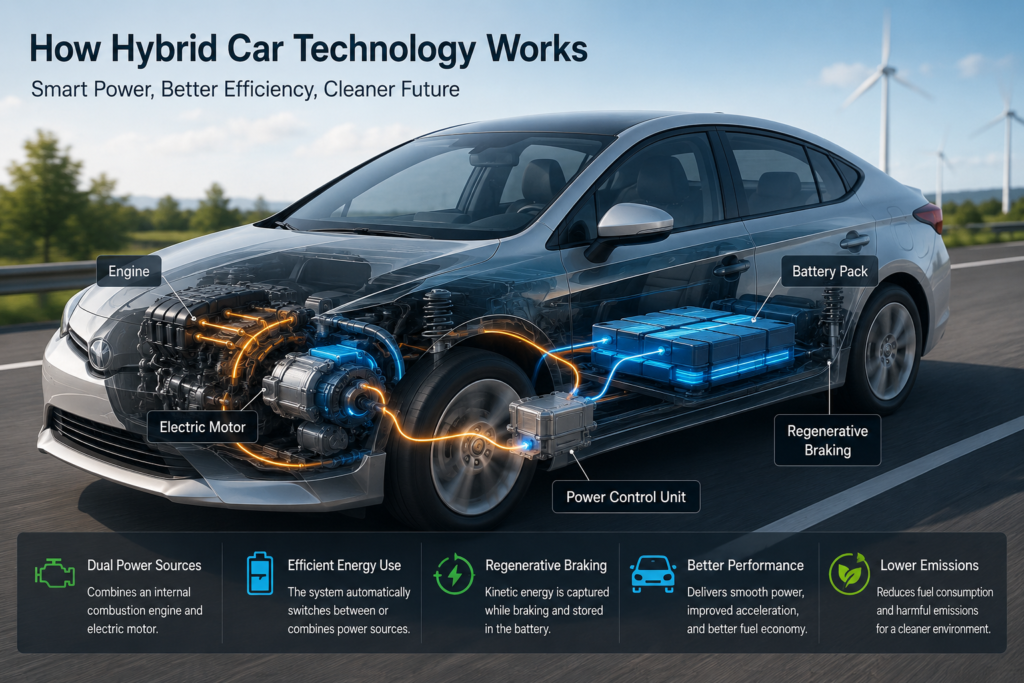
The petrol engine works in a familiar way by burning fuel to create mechanical power. The electric motor gets its energy from a rechargeable battery pack. A computer controlled system decides when the engine, electric motor, or both should provide power.
This is what makes hybrid car technology different from a normal petrol vehicle. Instead of allowing the engine to handle every driving situation, the hybrid system tries to use the most efficient power source for each moment.
For example, an electric motor can be very useful when a car starts moving from a stop. During highway driving, the petrol engine can provide efficient continuous power. When the vehicle slows down, the system can recover some of the energy that would normally be lost through braking.
Main Components of Hybrid Car Technology
To understand how hybrid cars work, it helps to know their main components.
The first major component is the petrol engine. It provides power when the vehicle needs it and can also help recharge the battery in certain hybrid designs.
The second component is the electric motor. It can move the vehicle using electricity from the battery. Electric motors provide strong torque at low speeds, which is useful during acceleration.
The third important component is the high voltage battery pack. This battery stores electrical energy for the electric motor. Unlike a small 12 volt car battery, the hybrid battery is designed to store and deliver much more energy.
Another important component is the power control system. It manages the flow of electricity between the battery, electric motor, generator, and other components.
There is also regenerative braking. This system allows the vehicle to recover some energy when it slows down and send that energy back into the battery.
How a Hybrid Car Starts
One of the most interesting things about a hybrid car is how quietly it can start.
In many hybrid vehicles, the electric motor can move the car from a stationary position without immediately starting the petrol engine. This is particularly useful in parking areas, residential streets, and slow traffic.
When the battery has enough charge and the driving conditions are suitable, the vehicle may use electric power alone for a short period. If more power is required, the petrol engine starts automatically.
From my point of view, this is one of the biggest advantages of hybrid technology. The driver does not normally have to decide which power source to use. The vehicle’s electronic control system makes that decision automatically.
How the Petrol Engine and Electric Motor Work Together
The petrol engine and electric motor can operate separately or together depending on the situation.
When driving slowly, the electric motor may provide most or all of the power. This can reduce fuel consumption because the petrol engine is not running continuously.
When the driver presses the accelerator harder, the electric motor can assist the petrol engine. This combination can provide strong acceleration without requiring the petrol engine to do everything by itself.
During steady driving, the petrol engine may become the primary source of power. At the same time, the system can monitor the battery level and driving conditions.
This intelligent power management is a major part of hybrid car technology. The vehicle constantly evaluates speed, acceleration, battery charge, engine load, and other factors.
How Regenerative Braking Works
Regenerative braking is one of the most important technologies used in hybrid cars.
In a traditional car, some of the vehicle’s kinetic energy is converted into heat when the brakes are applied. That energy is basically lost.
A hybrid vehicle can recover some of this energy. When the driver slows down, the electric motor can work as a generator. The movement of the wheels turns the motor, producing electricity. That electricity is then sent back to the battery.
The process is not able to recover every bit of energy, but it can improve overall efficiency.
This is why hybrid cars are particularly useful in city driving. Urban driving involves frequent stopping and starting, giving the regenerative braking system more opportunities to recover energy.
How the Hybrid Battery Gets Charged
A conventional hybrid car usually does not need to be plugged into a charging station. Instead, its battery is charged while the vehicle is operating.
Regenerative braking is one method. Another method is energy produced by the petrol engine. Depending on the hybrid design, the engine can drive a generator that sends electrical energy to the battery.
The vehicle’s computer controls the charging process carefully. It does not simply keep charging the battery whenever the engine is running. The system considers the battery’s current state and the vehicle’s operating conditions.
This makes a conventional hybrid different from a plug in hybrid. A plug in hybrid has a larger battery and can normally be connected to an external power source for charging.
What Happens During Acceleration?
Acceleration is an area where hybrid technology can provide a noticeable benefit.
When a driver accelerates, the electric motor can provide immediate torque. The petrol engine can then provide additional power if required.
This combination can make acceleration feel smooth and responsive. The electric motor does not need to build up power in exactly the same way as a traditional engine, so it can respond very quickly.
In some hybrid systems, both power sources work together during stronger acceleration. The exact operation depends on the vehicle’s design and control system.
Hybrid Cars in City Traffic
I believe city driving is where the advantages of hybrid technology become especially clear.
Traffic usually involves frequent acceleration, braking, idling, and low speed movement. These conditions can cause traditional petrol cars to consume more fuel.
A hybrid can often use its electric motor during low speed driving and can switch the petrol engine off when it is not needed. Regenerative braking can also recover energy every time the vehicle slows down.
This combination can make hybrid cars very efficient in urban environments.
On longer highway journeys, the benefits can still exist, although the difference between hybrid and conventional vehicles can depend heavily on vehicle design, driving style, road conditions, and speed.
Does a Hybrid Car Need Special Maintenance?
Hybrid cars contain additional electrical components, but that does not mean every part of the vehicle requires complicated maintenance.
The petrol engine still needs normal maintenance such as oil changes, filters, coolant checks, and other recommended servicing.
The hybrid battery and electric drive system are designed to operate for a long time, but they are specialized components. If a problem occurs, diagnosis may require equipment and technicians familiar with hybrid systems.
Another advantage is that regenerative braking can reduce the amount of work done by the conventional friction brakes in certain driving conditions. This can potentially reduce brake wear.
However, maintenance requirements vary between manufacturers and models, so following the manufacturer’s service schedule is always important.
Advantages of Hybrid Car Technology
There are several reasons why people choose hybrid vehicles.
The first is improved fuel efficiency. Using electric power during suitable conditions can reduce the amount of petrol required.
The second is reduced emissions. Burning less fuel can mean fewer exhaust emissions from the vehicle.
The third advantage is smooth driving. Electric motors can provide quick and quiet power, especially at low speeds.
Another benefit is regenerative braking. Instead of losing all braking energy as heat, the system can recover some of it and store it in the battery.
Hybrid technology can also provide a useful balance between electric driving and petrol engine range. Drivers do not necessarily need to depend on public charging infrastructure in the same way as they might with a fully electric vehicle.
Limitations of Hybrid Vehicles
Hybrid cars are not perfect, and it is important to understand their limitations.
The biggest difference is that hybrid systems are more complex than conventional petrol systems. They contain an engine, electric motor, battery, control electronics, and additional components.
The initial purchase price can also be higher for some hybrid models.
Battery replacement can be expensive if the battery eventually reaches the end of its useful life, although modern hybrid batteries are designed for long service.
Hybrid cars can also be heavier because they carry both a conventional engine system and an electric drive system.
For these reasons, buying a hybrid should be based on driving habits, budget, expected ownership period, and the specific vehicle model.
Hybrid Cars Compared With Electric Cars
Hybrid cars and electric cars are often compared, but they are not the same.
A fully electric car normally uses electricity as its primary source of propulsion and does not have a conventional petrol engine.
A hybrid car combines electric power with a petrol engine. This can make it convenient for drivers who want better fuel efficiency without completely changing the way they refuel their vehicle.
Plug in hybrid vehicles sit somewhere between the two. They usually have larger batteries and can travel farther using electricity before the petrol engine becomes necessary.
Each technology has its own advantages, and the best choice depends on how and where the vehicle is used.
The Future of Hybrid Car Technology
Hybrid technology continues to develop as manufacturers look for ways to improve vehicle efficiency and reduce emissions.
Modern hybrid systems are becoming more intelligent. Software can make better decisions about when to use electric power, when to start the engine, and when to recover energy.
Battery technology is also improving. More efficient batteries can help manufacturers increase electric driving capability without making the system unnecessarily large.
I think hybrid technology will remain important because it provides a practical connection between traditional vehicles and newer electric transportation. It allows drivers to benefit from electric motors while still having a petrol engine available for longer journeys.
Final Thoughts
Understanding how hybrid car technology works makes it easier to appreciate what is happening underneath the vehicle. A hybrid car is not simply a petrol car with a battery added to it. It is an integrated system where the petrol engine, electric motor, battery, regenerative braking system, and electronic controls work together.
The vehicle constantly manages energy to reduce unnecessary fuel use and make driving more efficient. Electric power can help during low speed driving and acceleration, while the petrol engine can provide additional power and longer range. Regenerative braking then gives the system an opportunity to recover some energy during deceleration.
In my view, the biggest strength of hybrid technology is its balance. It offers many benefits of electric propulsion while maintaining the convenience of a traditional fuel powered vehicle. As automotive technology continues to improve, hybrid cars will likely remain an important part of the transition toward more efficient transportation.
For anyone considering a hybrid car, the most important thing is to look beyond the word hybrid. Different hybrid systems work in different ways, so fuel economy, battery design, maintenance requirements, driving conditions, and ownership costs should all be considered before making a decision.