Related Articles

Modern vehicles are becoming smarter every year, and one feature that has completely changed the driving experience is Adaptive Cruise Control. I remember when traditional cruise control simply maintained a constant speed. It worked well on empty highways, but the moment another vehicle slowed down, I had to brake manually and reset the system again. Adaptive Cruise Control has solved that problem by automatically adjusting the vehicle’s speed based on traffic conditions.
For anyone who spends a lot of time driving on highways, this technology can make long trips more comfortable and less tiring. It helps maintain a safe following distance while reducing the need for constant acceleration and braking. Although it does not replace an attentive driver, it adds an extra layer of convenience and safety during everyday driving.
In this guide, I will explain how Adaptive Cruise Control works, its benefits, limitations, and how to use it safely.
What Is Adaptive Cruise Control
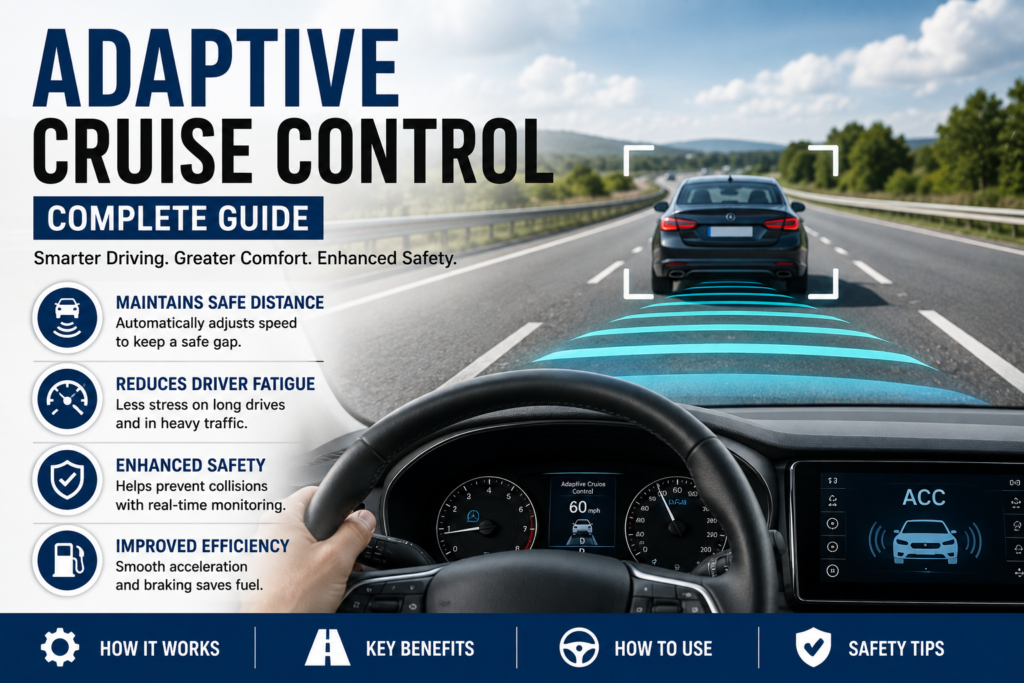
Adaptive Cruise Control, often called ACC, is an advanced driver assistance system that automatically maintains a selected speed while also monitoring the distance between your vehicle and the one ahead.
Unlike traditional cruise control, ACC does not simply keep the same speed at all times.
If another vehicle enters your lane and begins driving more slowly, the system automatically reduces your speed to maintain a safe following distance.
Once the road becomes clear again, the vehicle accelerates back to the speed you originally selected.
How Adaptive Cruise Control Works
Adaptive Cruise Control relies on several advanced technologies working together.
Most systems use:
Radar sensors
Forward facing cameras
Electronic control units
Brake control systems
Throttle control
These components constantly monitor the traffic ahead and adjust vehicle speed accordingly.
The entire process happens automatically within fractions of a second.
Radar Sensors
Radar sensors are usually mounted behind the front grille or bumper.
They continuously measure:
Distance to the vehicle ahead
Relative speed
Traffic movement
Lane position
Radar works reliably in many different weather conditions and plays a major role in Adaptive Cruise Control.
Forward Facing Cameras
Many vehicles also use cameras mounted near the windshield.
These cameras help identify:
Lane markings
Vehicles
Road signs
Pedestrians
Cyclists
Combining radar with camera information improves overall system accuracy.
Maintaining a Safe Following Distance
One of the features I appreciate most is the ability to choose the following distance.
Most systems offer several distance settings.
Drivers can select:
Short distance
Medium distance
Long distance
The vehicle then automatically maintains the chosen gap while driving.
This helps reduce driver workload during heavy traffic.
Automatic Speed Adjustment
If traffic begins slowing down, Adaptive Cruise Control gently reduces speed.
Depending on the vehicle, the system may:
Reduce engine power
Apply light braking
Completely stop the vehicle
Resume driving automatically when traffic moves again
These smooth adjustments make highway driving much more relaxing.
Difference Between Adaptive and Traditional Cruise Control
Traditional cruise control only maintains a constant speed.
If another vehicle slows down, the driver must brake manually.
Adaptive Cruise Control automatically responds to surrounding traffic.
This provides:
Greater convenience
Reduced driver fatigue
Improved safety
Better highway comfort
It represents a significant improvement over older cruise control systems.
Benefits of Adaptive Cruise Control
Adaptive Cruise Control offers many advantages.
Some of the most important include:
Reduced driver fatigue
Improved highway comfort
Automatic speed adjustment
Better following distance
Smoother driving
Improved fuel efficiency
Lower stress during traffic
Enhanced driving confidence
These benefits become especially noticeable during long road trips.
Can Adaptive Cruise Control Stop the Vehicle
Many modern systems include Stop and Go capability.
In slow moving traffic, the vehicle can:
Slow down automatically
Come to a complete stop
Resume driving once traffic begins moving again
This feature is particularly useful in congested city traffic.
Does Adaptive Cruise Control Improve Safety
ACC helps improve safety by maintaining consistent following distances.
However, it does not eliminate the need for driver attention.
The driver must always remain prepared to:
Brake manually
Steer around obstacles
Respond to emergencies
Take control whenever necessary
Adaptive Cruise Control is a driving assistance system, not a fully autonomous driving system.
Situations Where ACC Works Best
From my experience, Adaptive Cruise Control performs best in:
Highway driving
Long road trips
Moderate traffic
Open roads
Steady speed driving
These environments allow the system to operate smoothly and efficiently.
Situations Where ACC May Not Perform Well
There are conditions where drivers should be extra cautious.
These include:
Heavy rain
Dense fog
Snow
Sharp curves
Construction zones
Poor lane markings
Stationary obstacles
In these situations, manual driving is often the safer option.
How to Activate Adaptive Cruise Control
Although controls vary between manufacturers, the general process is simple.
Accelerate to your desired speed.
Press the cruise control button.
Activate Adaptive Cruise Control.
Choose your following distance.
Keep both hands on the steering wheel.
Monitor traffic continuously.
The system will begin managing speed automatically.
Choosing the Following Distance
Most vehicles allow drivers to select different spacing options.
A larger gap provides:
Greater safety
More reaction time
Smoother braking
Improved comfort
Although shorter distances may seem convenient, I generally prefer larger following gaps for additional safety.
Fuel Economy Benefits
Smooth acceleration and braking often improve fuel efficiency.
Because Adaptive Cruise Control avoids unnecessary speed changes, the engine operates more consistently.
While fuel savings vary, many drivers notice improved efficiency during highway travel.
Adaptive Cruise Control and Automatic Emergency Braking
Many vehicles combine ACC with Automatic Emergency Braking.
If the driver fails to react to a potential collision, the system may automatically apply stronger braking.
Although these systems work together, they serve different purposes.
ACC focuses on maintaining speed and distance.
Automatic Emergency Braking focuses on collision prevention.
Common Misunderstandings
Some drivers mistakenly believe Adaptive Cruise Control allows them to stop paying attention.
This is incorrect.
The driver remains fully responsible for controlling the vehicle.
Hands should remain on the steering wheel.
Eyes should remain focused on the road.
Traffic conditions can change unexpectedly.
Maintenance Requirements
Adaptive Cruise Control depends on clean sensors and cameras.
I always recommend:
Keeping radar sensors clean.
Cleaning the windshield regularly.
Repairing damaged bumpers promptly.
Checking system warnings.
Following manufacturer maintenance recommendations.
Proper maintenance helps ensure accurate system performance.
Who Should Use Adaptive Cruise Control
This technology is especially useful for:
Daily commuters
Highway drivers
Frequent travelers
Families
Long distance drivers
Anyone looking for a more comfortable driving experience
Even beginners quickly become comfortable using the system after some practice.
Future of Adaptive Cruise Control
Vehicle technology continues improving every year.
Future Adaptive Cruise Control systems are expected to offer:
Better traffic prediction
Improved lane recognition
Smoother acceleration
Enhanced sensor accuracy
Greater integration with autonomous driving features
These developments will likely make future driving even safer and more convenient.
Final Thoughts
Adaptive Cruise Control has transformed the way many people experience highway driving. By automatically maintaining speed and adjusting the distance from the vehicle ahead, it reduces driver fatigue, improves comfort, and helps create a smoother driving experience. While it cannot replace an attentive driver, it provides valuable assistance during long journeys and heavy traffic.
I believe Adaptive Cruise Control is one of the most useful driver assistance technologies available today. When used correctly, it helps make driving more relaxing without reducing the driver’s responsibility. Understanding how the system works, its benefits, and its limitations allows every driver to use it safely and confidently while enjoying a more comfortable journey.