
Related Articles


Cars have changed dramatically over the past decade. They are no longer just machines that take us from one place to another. Modern vehicles now include advanced technology that keeps us connected, entertained, and informed throughout every journey. One of the biggest improvements I have noticed in recent years is the development of car infotainment systems. What started as a simple radio has now evolved into a smart digital hub that controls navigation, music, phone calls, vehicle settings, and much more.
When I drive a vehicle equipped with a modern infotainment system, the experience feels much more enjoyable and convenient. Everything I need is available on one screen, making it easier to stay focused on the road while still enjoying useful features. In my opinion, understanding how infotainment systems work can help every driver choose the right vehicle or upgrade for their needs.
In this article, I will explain what car infotainment systems are, how they work, their main features, different types, and what you should consider before buying a vehicle with one.
What Is a Car Infotainment System?
A car infotainment system is the central multimedia and information unit installed inside a vehicle.
It combines entertainment, communication, navigation, and vehicle settings into one easy to use interface.
Most modern infotainment systems use a touchscreen display, although many also support steering wheel controls, physical buttons, rotary controllers, and voice commands.
Instead of using several separate devices, drivers can control many vehicle functions from a single screen.
Why Infotainment Systems Are Important
Modern drivers expect more than basic transportation.
They want easy access to navigation, hands free phone calls, music streaming, smartphone integration, and real time information.
An infotainment system brings all of these features together.
It also helps reduce distractions because many tasks can be completed using voice commands instead of handling a smartphone.
For me, this combination of convenience and safety is one of its biggest advantages.
Touchscreen Display
The touchscreen is usually the center of the infotainment system.
Most modern vehicles include displays ranging from seven to over fifteen inches.
Larger screens make maps easier to read and menus simpler to navigate.
High resolution displays also improve image quality, making the overall experience feel more premium.
Many systems now support smooth animations and quick response times.
Navigation System
Built in navigation remains one of the most useful infotainment features.
It provides turn by turn directions, estimated arrival times, traffic updates, and alternative routes.
Many newer systems also display nearby fuel stations, restaurants, parking areas, and charging stations for electric vehicles.
Having navigation built directly into the vehicle makes long trips much easier.
Smartphone Integration
One of my favorite features is smartphone connectivity.
Most modern infotainment systems support Android Auto and Apple CarPlay.
These systems allow drivers to access compatible smartphone apps directly from the vehicle’s display.
Navigation, music, messaging, podcasts, and phone calls become much easier to manage without touching the phone.
Wireless connectivity has made the experience even more convenient.
Bluetooth Connectivity
Bluetooth allows drivers to connect smartphones wirelessly.
Once paired, the system supports hands free phone calls and wireless music streaming.
Many vehicles automatically reconnect to previously paired devices every time the engine starts.
Bluetooth has become a standard feature in almost every modern infotainment system.
Voice Control
Voice control greatly improves driving safety.
Instead of searching through menus while driving, I can simply speak commands.
Voice assistants can start navigation, make phone calls, play music, adjust certain settings, and even answer general questions.
As voice recognition technology continues improving, these systems become even more useful.
Audio System Integration
An infotainment system controls much more than the radio.
It manages speakers, equalizer settings, balance, bass, treble, surround sound options, and audio sources.
Many premium vehicles include branded sound systems that provide excellent listening quality.
A well designed infotainment system allows drivers to customize the audio experience according to their personal preferences.
Music Streaming
Instead of relying only on FM radio, modern infotainment systems support music streaming services.
Drivers can enjoy millions of songs, podcasts, and audiobooks through compatible applications.
This makes every journey more enjoyable, especially during long road trips.
USB and Media Support
Most infotainment systems include USB ports for charging and media playback.
Drivers can connect flash drives containing music or videos where permitted.
Some systems also support memory cards and external storage devices.
These options provide flexibility for different media sources.
Wireless Charging
Many modern vehicles now include wireless charging pads near the infotainment system.
Simply placing a compatible smartphone on the charging pad keeps the battery charged without using cables.
Combined with wireless smartphone integration, this creates a very clean interior.
Rear View Camera Integration
Modern infotainment systems often display images from the reverse camera.
When reverse gear is selected, the display automatically switches to the camera view.
Many systems also include parking guidelines that help estimate distance while reversing.
This feature improves parking safety significantly.
Vehicle Information
Infotainment systems do more than entertainment.
Many display useful vehicle information.
Fuel economy.
Tire pressure.
Oil life.
Maintenance reminders.
Driving statistics.
Trip information.
Battery status on hybrid and electric vehicles.
Having this information easily available helps drivers maintain their vehicles properly.
Climate Control Integration
Some modern vehicles integrate climate controls directly into the infotainment system.
Drivers can adjust cabin temperature, fan speed, seat heating, seat ventilation, and other comfort settings from the touchscreen.
Although physical buttons remain popular for certain controls, touchscreen integration creates a cleaner dashboard design.
Internet Connectivity
Advanced infotainment systems now support internet connectivity.
This allows live traffic information, weather forecasts, software updates, online music streaming, and connected vehicle services.
Some manufacturers even provide WiFi hotspots for passengers.
Internet connectivity continues expanding every year.
Software Updates
Many manufacturers now deliver software updates over the air.
This allows new features, security improvements, and bug fixes without visiting a dealership.
Just like smartphones, infotainment systems continue improving even after purchasing the vehicle.
Types of Infotainment Systems
Factory installed systems are designed specifically for individual vehicle models.
They integrate perfectly with vehicle controls and safety features.
Aftermarket infotainment systems provide an excellent upgrade option for older vehicles.
Many aftermarket models include larger displays, wireless smartphone integration, and advanced multimedia features.
Choosing between factory and aftermarket systems depends on your vehicle and budget.
Choosing the Right Infotainment System
When selecting an infotainment system, consider screen size, display quality, ease of use, smartphone compatibility, navigation features, voice control, audio quality, software support, and overall reliability.
A fast and responsive system provides a much better user experience than one with slow menus or outdated software.
Reading reviews before purchasing is always a good idea.
Common Problems
Like any technology, infotainment systems can occasionally experience issues.
Slow performance.
Bluetooth connection failures.
Software glitches.
Frozen screens.
Navigation errors.
Touchscreen responsiveness problems.
Fortunately, software updates often resolve many of these issues.
Restarting the system may also solve temporary problems.
Future of Car Infotainment
Technology continues advancing rapidly.
Future infotainment systems will become even more intelligent.
Artificial intelligence will improve voice recognition.
Larger displays will provide better visibility.
Cloud connectivity will expand available services.
Augmented reality navigation may become more common.
Vehicle to vehicle communication could also integrate with future infotainment systems.
The driving experience will likely become even more connected and personalized.
Final Thoughts
In my opinion, car infotainment systems have become one of the most valuable features in modern vehicles. They combine navigation, entertainment, communication, and vehicle information into one convenient interface that improves both comfort and safety. Features such as smartphone integration, Bluetooth connectivity, voice control, reverse camera support, and real time navigation make everyday driving easier and more enjoyable.
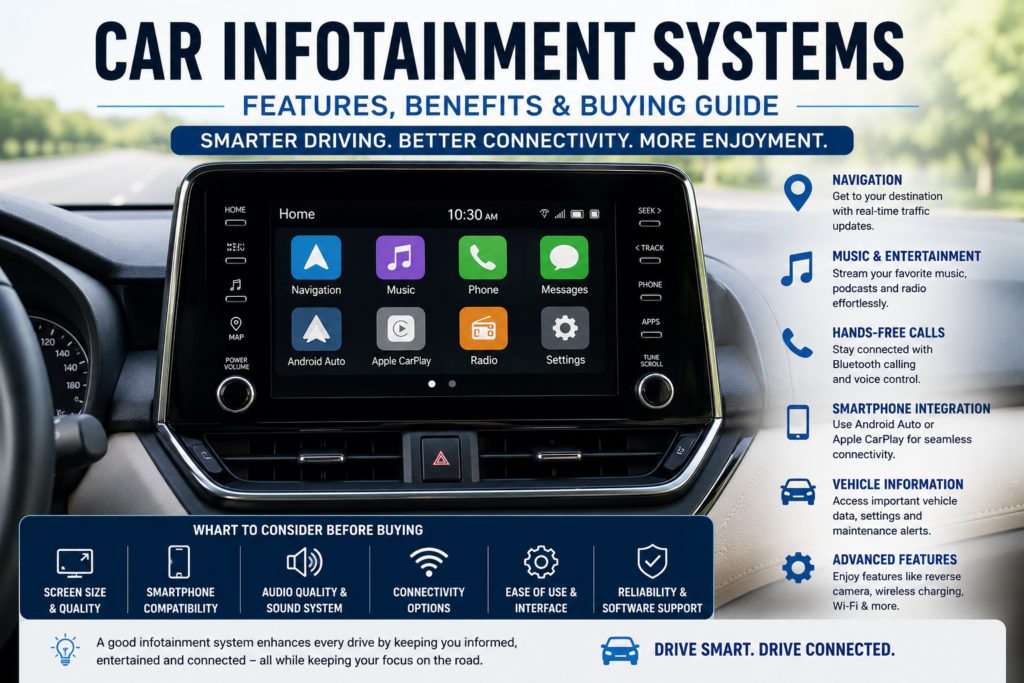
Whether you are purchasing a new vehicle or upgrading an older one, choosing the right infotainment system can significantly enhance your driving experience. By selecting a system with reliable software, responsive controls, useful features, and excellent smartphone compatibility, you can enjoy greater convenience every time you get behind the wheel. As automotive technology continues to evolve, infotainment systems will undoubtedly play an even bigger role in shaping the future of driving.