Related Articles

When I think about modern car technology, Adaptive Cruise Control is one of the features that can genuinely make driving more comfortable. It is not just another feature added to a car to make the dashboard look more advanced. When used correctly, Adaptive Cruise Control can reduce driver fatigue, make long journeys easier, and help maintain a safer following distance.
Many drivers already know about traditional cruise control, but Adaptive Cruise Control works in a different way. Instead of simply keeping the car at one fixed speed, it can adjust the vehicle speed according to the traffic ahead. This makes it especially useful on highways and busy roads where traffic speed changes frequently.
In this article, I will explain what Adaptive Cruise Control is, how it works, when you actually need it, and what you should know before depending on this technology.
What Is Adaptive Cruise Control?
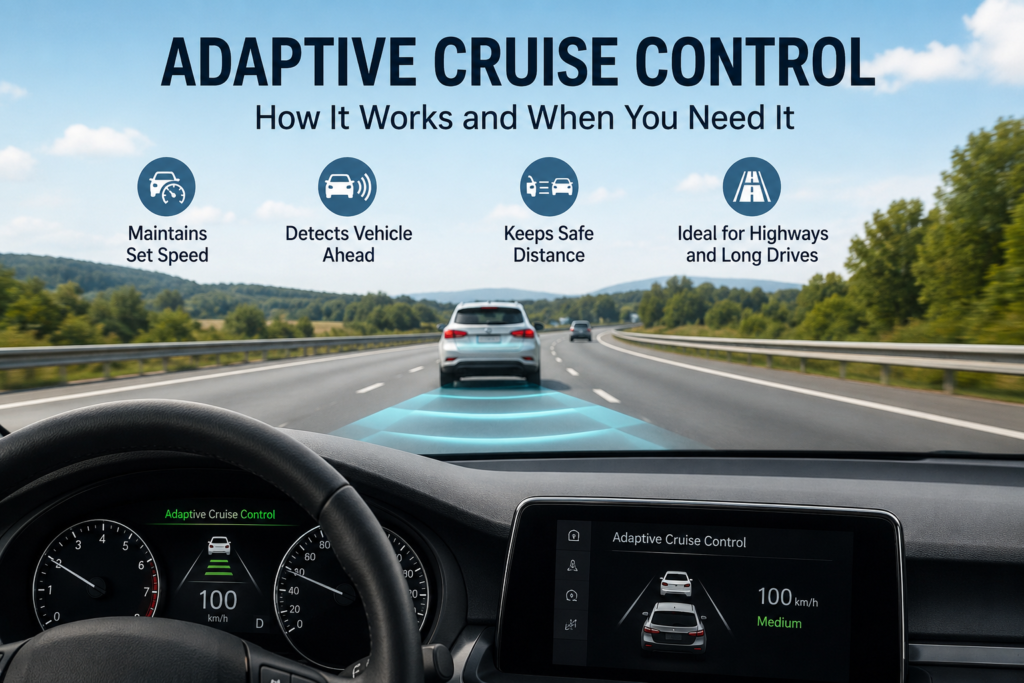
Adaptive Cruise Control, commonly called ACC, is a driver assistance system that automatically maintains a selected speed while also monitoring the vehicle in front.
With traditional cruise control, I can set my car to a particular speed, such as 100 km/h, and the vehicle will try to maintain that speed. If another vehicle enters my lane and is traveling slower, I have to manually reduce my speed.
Adaptive Cruise Control changes this process. If I set the system to 100 km/h and the car detects another vehicle traveling at 80 km/h ahead, the system can reduce my speed and maintain a safe distance. When the road becomes clear again, the system can gradually return to the selected speed.
This is why ACC is particularly useful for highway driving and long road trips.
How Does Adaptive Cruise Control Work?
The basic idea behind Adaptive Cruise Control is simple, but several technologies work together to make it possible.
Most ACC systems use radar sensors, cameras, or a combination of both. These sensors monitor the road ahead and identify vehicles traveling in the same direction.
When I activate Adaptive Cruise Control, I usually select two things. The first is my preferred cruising speed, and the second is the following distance.
For example, I might select 110 km/h as my maximum cruising speed and choose a medium following distance. If there is no slower vehicle ahead, the car can travel close to the selected speed. If traffic appears, the system detects the vehicle ahead and adjusts the speed.
The vehicle may use the braking system and engine power to control its speed. When traffic slows down, ACC can reduce the vehicle speed. When traffic starts moving faster, the system can accelerate again within its programmed limits.
Some advanced systems can also bring the car to a complete stop in slow traffic and resume driving when traffic moves again. However, the exact capabilities depend on the vehicle manufacturer and the specific ACC system.
The Difference Between Cruise Control and Adaptive Cruise Control
The difference between traditional cruise control and Adaptive Cruise Control is important.
Traditional cruise control is mainly designed to maintain a constant speed. Once I select a speed, the system tries to keep the car traveling at that speed until I cancel it or make a manual adjustment.
Adaptive Cruise Control is more flexible because it responds to traffic ahead. It can automatically slow down when necessary and accelerate when the road becomes clear.
For example, imagine driving on a highway at 100 km/h. With traditional cruise control, if the vehicle ahead is traveling at 80 km/h, I need to react myself. With ACC, the system can detect that vehicle and reduce my speed while maintaining the selected following distance.
For me, this is the biggest advantage of Adaptive Cruise Control. It reduces the amount of repetitive speed adjustment required during longer drives.
When Do You Actually Need Adaptive Cruise Control?
I would not say every driver needs Adaptive Cruise Control. It is a convenience and safety assistance feature, but its usefulness depends heavily on how and where you drive.
ACC is most useful during long highway journeys. When I spend several hours on a motorway, constantly adjusting the accelerator can become tiring. Adaptive Cruise Control can handle many of those small speed adjustments.
It can also be useful in moderate traffic where vehicles are moving at relatively consistent speeds. Instead of repeatedly accelerating and braking, the system can help maintain a more consistent gap.
Another situation where ACC can be helpful is during road trips. If I am driving hundreds of kilometers, reducing unnecessary accelerator and brake inputs can make the journey feel less tiring.
However, I would not depend on ACC as a replacement for attentive driving. It is a driver assistance system, not an autonomous driving system.
Adaptive Cruise Control in Heavy Traffic
One of the most interesting uses of modern ACC is stop and go traffic.
Some vehicles with advanced ACC systems can slow down as traffic slows and may even bring the vehicle to a complete stop. If traffic starts moving again within the system’s operating conditions, the vehicle may resume automatically.
This can make slow traffic much less tiring.
Still, I believe drivers should be especially careful in heavy traffic. Motorcycles, pedestrians, vehicles changing lanes suddenly, and unexpected obstacles can create situations where the system may not respond exactly as a human driver would.
The driver must remain responsible for what happens around the vehicle.
Is Adaptive Cruise Control Safe?
Adaptive Cruise Control can be a useful safety technology when used properly. One of its major benefits is that it can help maintain a consistent following distance from the vehicle ahead.
Human drivers sometimes become distracted or misjudge distances, especially during long journeys. ACC can continuously monitor the vehicle ahead and make speed adjustments based on the system’s sensor information.
However, this does not mean ACC makes a car completely safe.
Weather, road conditions, sensor limitations, unusual traffic situations, and poor visibility can affect how the system operates. For this reason, I always consider ACC an extra layer of assistance rather than something that allows me to stop paying attention.
The driver still needs to watch the road, understand the traffic situation, and be ready to brake or steer whenever necessary.
Situations Where You Should Not Depend on ACC
Adaptive Cruise Control works best under suitable driving conditions. There are situations where I would prefer to control the vehicle manually.
Heavy rain, fog, snow, poor visibility, damaged roads, sharp curves, and complicated city traffic can make driver assistance systems less predictable.
I would also be cautious when driving through areas with frequent pedestrians, motorcycles, bicycles, construction zones, or vehicles entering the road unexpectedly.
Another important point is that different ACC systems have different capabilities. One vehicle might provide advanced stop and go assistance, while another may only adjust speed at higher speeds.
Before using the system regularly, I recommend reading the owner’s manual and understanding exactly what the ACC in your car can and cannot do.
Benefits of Adaptive Cruise Control
There are several reasons why Adaptive Cruise Control has become popular in modern vehicles.
The first major benefit is comfort. Long highway drives can be physically and mentally tiring, and ACC can reduce some repetitive driving tasks.
The second benefit is smoother driving. When the system works correctly, it can make speed changes more gradual than constant manual acceleration and braking.
Another advantage is maintaining a following distance. Instead of constantly estimating the distance to the vehicle ahead, the system can monitor it using its sensors.
ACC can also make road trips more relaxing. I personally see this as one of its strongest advantages because the technology is most useful when driving for extended periods.
Does Adaptive Cruise Control Save Fuel?
Adaptive Cruise Control may help improve fuel efficiency in some driving situations, but I would not consider fuel saving its primary purpose.
Smooth acceleration and braking can sometimes reduce unnecessary fuel consumption. However, fuel economy depends on many factors, including driving speed, traffic, road conditions, vehicle weight, engine type, tire pressure, and driving style.
If ACC allows a vehicle to maintain a smoother speed on a highway, it may contribute to more efficient driving. But there is no guarantee that using ACC will always reduce fuel consumption.
What Should You Look For When Buying a Car With ACC?
If Adaptive Cruise Control is important to you, I recommend looking beyond the simple presence of an ACC label.
First, check the operating speed range. Some systems work mainly at highway speeds, while others can operate in slower traffic.
Second, check whether the system includes stop and go functionality.
Third, look at the available following distance settings. Having multiple distance options can make the system more practical in different traffic conditions.
It is also worth checking whether ACC works together with other driver assistance features, such as lane keeping assistance or forward collision warning.
Most importantly, I would read the manufacturer’s documentation instead of assuming that every Adaptive Cruise Control system works the same way.
Final Thoughts
Adaptive Cruise Control is one of those car technologies that can make a real difference when used in the right situation. It can maintain a selected speed, monitor traffic ahead, adjust vehicle speed, and help maintain a more consistent following distance.
For me, its biggest value is on highways and long journeys. It can reduce driving fatigue and make changing traffic speeds easier to manage.
At the same time, I would never treat Adaptive Cruise Control as a replacement for the driver. The system has limitations, and road conditions can change faster than technology can respond.
If you frequently drive on highways or take long road trips, Adaptive Cruise Control is a feature I would seriously consider when buying a modern car. It may not be something you need every day, but when the right situation comes along, it can make driving considerably easier and more comfortable.