Related Articles
When choosing new tires, most drivers focus on size, price, tread life, and brand. However, one important decision that often gets overlooked is whether to choose run flat tires or regular tires. Both types are designed to keep your vehicle safely connected to the road, but they work very differently when something goes wrong.
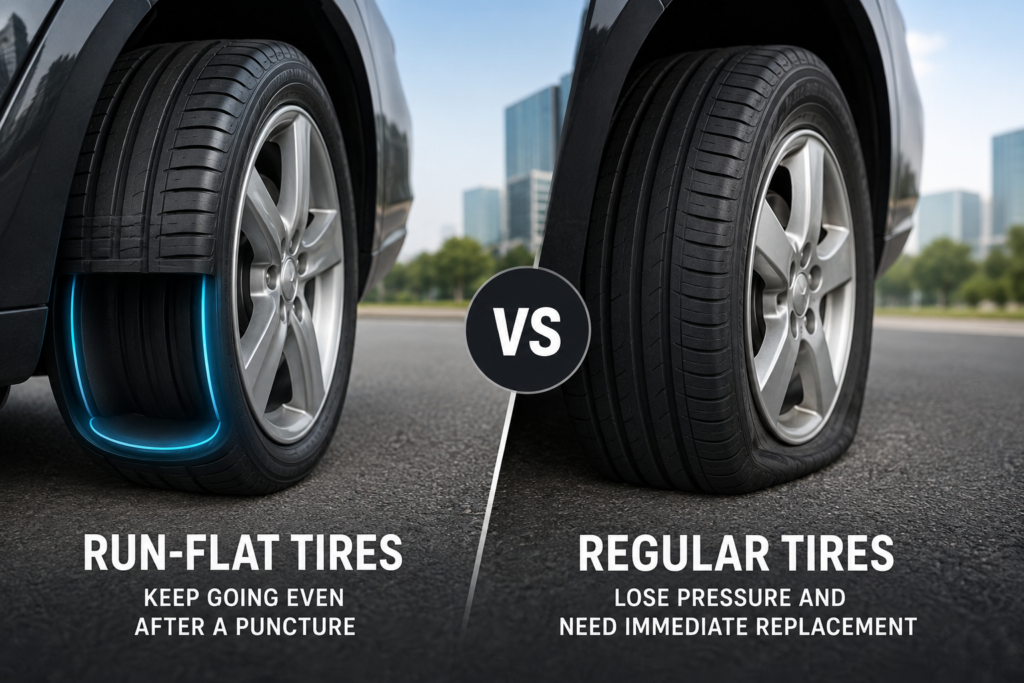
In my view, the biggest difference between run flat tires and regular tires becomes clear when you experience a puncture. A regular tire usually loses air pressure and may require an immediate tire change or repair. A run flat tire is designed to support the weight of the vehicle for a limited distance even after losing most of its air pressure.
That sounds like an obvious advantage for run flat tires, but there is more to the story. They can cost more, may provide a firmer ride, and are not always the best choice for every driver. In this guide, I will explain the main differences between run flat vs regular tires and help you understand which option may suit your driving needs.
What Are Run Flat Tires?
Run flat tires are specially designed tires that can continue supporting a vehicle after a significant loss of air pressure. Their sidewalls are reinforced so they can carry the weight of the vehicle even when the tire is no longer properly inflated.
The main purpose of run flat technology is convenience and safety. If you get a puncture while driving, you may be able to continue driving for a limited distance at a reduced speed instead of stopping immediately to install a spare tire.
Most run flat tires are designed for limited emergency driving. The exact distance and speed depend on the tire manufacturer and the specific model. Drivers should always check the information supplied with their tires.
One thing I think is important is that run flat tires should not be treated as tires that never need attention. They still require proper inflation, regular inspections, and replacement when damaged.
What Are Regular Tires?
Regular tires are the traditional tires used on most cars. They depend on air pressure to maintain their shape, support the vehicle, and provide the correct contact with the road.
If a regular tire suffers a serious puncture and loses its air pressure, continuing to drive on it can damage the tire and wheel. In many situations, you will need to repair the tire, replace it, or install a spare tire.
Regular tires have been around for a long time and are available in a huge range of sizes, designs, and price levels. They are also usually easier to find and replace.
For many drivers, regular tires remain a practical and affordable choice.
Run Flat vs Regular Tires: The Main Difference
The most important difference between run flat tires and regular tires is what happens after a loss of air pressure.
A regular tire generally needs air pressure to maintain its structure. Once the pressure drops significantly, the tire can become unsafe to drive on.
A run flat tire has reinforced construction that allows it to support the vehicle temporarily after losing pressure.
This can make a major difference if you experience a puncture on a busy highway, at night, during bad weather, or in an unfamiliar area.
However, run flat technology does not mean you can drive normally after a puncture. You still need to reduce speed and find a safe location where the tire can be inspected or replaced.
Safety After a Puncture
Safety is one of the biggest reasons people consider run flat tires.
Imagine driving on a highway and suddenly seeing a tire pressure warning. With regular tires, you may need to pull over and deal with the problem immediately. If you are carrying a spare tire, you may have to stop and change it yourself.
That can be uncomfortable and potentially dangerous, especially on a busy road.
With run flat tires, the reinforced sidewalls may allow you to continue to a safer location. This can reduce the need to stop beside a busy highway.
In my opinion, this is the strongest advantage of run flat tires. The technology is not mainly about better everyday driving. It is about giving you more control when something unexpected happens.
Ride Comfort
When comparing run flat vs regular tires, ride comfort is another important factor.
Run flat tires often have stronger sidewalls. This construction is necessary to help the tire support the vehicle after pressure loss, but it can also make the tire feel firmer.
Some drivers like the more controlled feeling. Others may notice that bumps and rough road surfaces feel more noticeable.
Regular tires usually provide a softer and more comfortable ride when properly inflated. This can be especially noticeable on roads with potholes, broken surfaces, or uneven pavement.
Modern run flat tires have improved considerably, so the difference is not always dramatic. Still, if comfort is your highest priority, regular tires may have an advantage depending on the vehicle and tire model.
Handling and Driving Feel
Tire construction has a major effect on how a car feels on the road.
Run flat tires can provide a firm and responsive feel because of their reinforced sidewalls. This can make the steering feel more controlled, particularly during cornering.
Regular tires can also provide excellent handling, especially when you choose a high quality tire designed for your vehicle.
I would not say that every run flat tire handles better than every regular tire. Tire quality, tread design, vehicle suspension, tire size, road conditions, and inflation pressure all affect handling.
The best tire is the one that matches the vehicle and the type of driving you actually do.
Cost of Run Flat Tires
Price is another major factor in the run flat vs regular tires comparison.
Run flat tires are often more expensive than comparable regular tires because of their specialized construction and reinforced sidewalls.
The initial purchase price may therefore be higher.
Regular tires generally provide more choices at different price levels. If you are trying to keep your tire replacement costs low, regular tires can be attractive.
However, there is another factor to consider. Some vehicles equipped with run flat tires do not include a traditional spare tire. That can save space and reduce vehicle weight.
So the overall value depends on your vehicle and your priorities.
Tire Replacement and Repair
Repairability is another area where drivers should pay attention.
A regular tire with a small puncture in a repairable area may sometimes be repaired according to accepted tire industry guidelines. The tire must first be inspected to determine whether repair is safe.
Run flat tires require additional consideration after being driven with low or zero air pressure. Even if the tire looks acceptable from the outside, internal damage may have occurred.
This is why I would always have a run flat tire inspected by a qualified tire professional after a pressure loss.
Do not assume that a run flat tire is safe simply because it allowed you to reach a tire shop.
Do Run Flat Tires Need a Spare Tire?
One advantage of run flat tires is that they can reduce the need for a spare tire.
Many vehicles equipped with run flat technology are designed without a traditional spare. This can create additional storage space in the vehicle.
For drivers who frequently travel with luggage or use their trunk for equipment, that extra space can be useful.
Regular tire users may have a spare tire, temporary spare, or tire repair kit depending on the vehicle.
If your vehicle does not have a spare tire, carrying a suitable emergency repair solution may still be worth considering.
Tire Pressure Monitoring Is Important
A tire pressure monitoring system is especially important when using run flat tires.
The reinforced sidewalls can make it difficult to notice a pressure loss through the normal appearance or feel of the vehicle.
You may not immediately realize that a run flat tire has lost pressure.
The tire pressure monitoring system can alert you when pressure drops. When that warning appears, you should take it seriously.
Even with run flat technology, maintaining the correct tire pressure is essential for safety, handling, fuel efficiency, and tire life.
Fuel Economy Considerations
Tire weight and rolling resistance can affect fuel economy.
Some run flat tires are heavier than comparable regular tires because of their reinforced construction. The additional weight can have an effect on efficiency, although the actual difference depends on the specific tire and vehicle.
Modern tire technology has improved, and manufacturers continue to develop run flat tires with better efficiency and comfort.
Still, if fuel economy is one of your main priorities, compare the specifications of individual tire models rather than assuming that all run flat tires or all regular tires will perform the same.
Which Tires Last Longer?
There is no simple answer to whether run flat tires or regular tires last longer.
Tire life depends on tread compound, driving habits, alignment, inflation pressure, road conditions, climate, vehicle weight, and maintenance.
Some run flat tires can offer good tread life, while others may wear faster depending on their design.
Regular tires can also last for many years when properly maintained.
Instead of choosing a tire only because it promises a certain mileage figure, I recommend checking the tire manufacturer’s specifications and maintaining the tires correctly.
Run Flat Tires Are Great for Some Drivers
In my opinion, run flat tires make the most sense for drivers who value convenience and added mobility after a puncture.
They can be especially useful for people who regularly drive on highways, travel long distances, or do not want to stop beside the road to change a tire.
They can also be attractive for drivers whose vehicles were originally designed around run flat technology.
If your car manufacturer specifically recommends run flat tires, I would take that recommendation seriously because the suspension and vehicle systems may have been developed with a particular tire setup in mind.
Regular Tires Are Still an Excellent Choice
Regular tires are not outdated simply because run flat technology exists.
For many drivers, regular tires offer a very good combination of comfort, availability, price, and performance.
They are usually easier to find at tire shops, and there are countless options for different driving conditions.
If you have a spare tire and are comfortable dealing with a puncture, the extra emergency capability of run flat tires may not be worth the additional cost.
For everyday city driving, a good quality regular tire can be an excellent choice.
Run Flat vs Regular Tires: Pros and Cons
Run Flat Tire Advantages
Run flat tires can allow limited driving after a puncture.
They can reduce the need to change a tire beside the road.
They can provide additional convenience during emergencies.
They may allow vehicles to be designed without a traditional spare tire.
Their reinforced construction can provide a firm steering response.
Run Flat Tire Disadvantages
They can cost more than regular tires.
Some models may provide a firmer ride.
Replacement options can be more limited in some areas.
A damaged run flat tire may not always be repairable.
Drivers still need to inspect the tire after a pressure loss.
Regular Tire Advantages
Regular tires are generally less expensive.
They offer a huge variety of choices.
They can provide excellent ride comfort.
They are widely available.
Many punctures can be repaired when the tire is suitable for repair.
Regular Tire Disadvantages
A serious puncture can leave you stranded.
Changing a spare tire beside the road can be inconvenient.
Vehicles without run flat technology may require a spare tire or emergency repair kit.
Driving on a flat regular tire can cause serious tire and wheel damage.
Which Is Better, Run Flat or Regular Tires?
There is no single answer that works for every driver.
If your main priority is emergency convenience and the ability to continue driving after a puncture, run flat tires can be a smart choice.
If your priorities are lower cost, comfortable ride quality, easy availability, and a wider selection of tires, regular tires may be better.
I personally think the best decision starts with the vehicle manufacturer’s recommendation. After that, consider your driving habits, road conditions, budget, and how comfortable you are dealing with a flat tire.
A driver who spends hours on highways may appreciate run flat technology much more than someone who mostly drives short distances around town.
Final Thoughts
The choice between run flat vs regular tires is ultimately about what you value most.
Run flat tires provide a useful advantage when a tire loses pressure because their reinforced construction can help you continue driving for a limited distance at a reduced speed. That added mobility can make a stressful situation much easier to handle.
Regular tires, however, remain a practical option for millions of drivers. They are generally affordable, comfortable, widely available, and available in an enormous variety of designs.
Neither option is automatically better for everyone.
Before buying tires, check your vehicle’s recommended tire size and specifications. Think about your normal driving conditions, your budget, comfort preferences, and how important emergency mobility is to you.
A good tire is not simply the most expensive tire or the newest technology. It is the tire that matches your vehicle, your roads, and the way you drive.